
Divorcing a Narcissist & Getting Child Custody
Narcissists see divorce as a threat to their control, causing them to lash out at and manipulate their soon-to-be-ex-spouse, even if they initiated the split. This typically leads to a high-conflict, lengthy divorce and child custody process.
You might discover that divorcing a narcissist is even harder than being married to a narcissist. However, equipped with the right mindset, strategies and tools, you can successfully navigate your divorce while protecting yourself and your child. After you divorce, learn how to co-parent with a narcissist.
Understanding narcissism
Your narcissist spouse probably has some (or even all) of these hallmark traits:
- Inflated sense of self-importance and entitlement
- Unreasonable expectations of preferable treatment
- Belief that they're better than everyone and should only associate with high-status people and institutions
- Need for constant attention, validation and admiration
- Preoccupation with fantasies of success and power
- Extreme jealousy or a belief that everyone is jealous of them
- Lack of empathy
- Tendency to manipulate others through lying, gas lighting and emotional abuse
- Volatility and rage
If you're dealing with a covert narcissist, they have these same traits but hide them behind a quiet or humble facade. These narcissists can be even more crazy-making because other people may not recognize their danger.
Unfortunately, you can expect these traits to only get worse during your divorce.
Note that there's a difference between Narcissistic Personality Disorder (NPD) and someone who simply has a narcissistic personality. NPD is a mental illness diagnosed by a psychologist or psychiatrist. An individual may have traits associated with NPD but not meet the diagnostic criteria or be officially diagnosed. This distinction is particularly important in child custody disputes.
Narcissism is a spectrum; at one end is someone with a few narcissistic traits, and at the other is Narcissistic Personality Disorder. Where your ex is on that spectrum, their specific behaviors and the nature of your relationship all factor into the strategies you need to get the best outcome for you and your child.
Divorcing a narcissist
It's impossible to have a "normal" divorce with a narcissist. Expect your ex to take advantage of any chance to make your life harder, from lying to the judge to using your child as a pawn.
To start preparing for your divorce from a narcissist, you need hire to an experienced lawyer, set firm communication boundaries with your ex, and document all of your interactions with them.
Hire an experienced lawyer
If possible, hire a lawyer experienced in high-conflict divorce cases. As an expert in your state's custody laws and your local family court, a good family lawyer can make all the difference.
In addition to completing paperwork and representing you in court, your lawyer will develop a legal strategy to get the divorce outcome you want and the custody arrangement that's best for your child. They'll also advise you on the evidence you need and how to protect yourself financially.
When consulting with lawyers, ask about their experience litigating divorce and custody against a narcissist.
If you can't afford a lawyer, look into legal aid, modest means legal programs, and law clinics in your area.
Set firm communication boundaries
Establishing and sticking to firm boundaries can protect you from unwanted and unhealthy communication from your narcissist ex. Lay out — in writing — how you will communicate with them and what topics you're willing to discuss. For example, set rules that phone calls must be scheduled in advance and that you'll only discuss co-parenting or logistical issues related to your case.
When communicating with your narcissist ex, take care to react strategically rather than emotionally. Remember that they may document anything you say. Plan out what you'll say before responding to voicemails, emails and texts. Don't engage in arguments, and don't take the bait when they try to antagonize you.
Document all interactions with your ex
Narcissists are notorious liars, and because they often feel they're above the law, they have no problem lying to the court. They may lie about something you said, deny that a conversation took place, or use other dirty tricks to try to win the judge's favor.
Try to communicate with your ex via text or email only, so you have a word-for-word record of every conversation. Consider using a messaging tool designed for high-conflict cases. With Custody X Change messaging, you can print or export messages on a certain topic for the court — with hostile language flagged.
 Try this with Custody X Change.
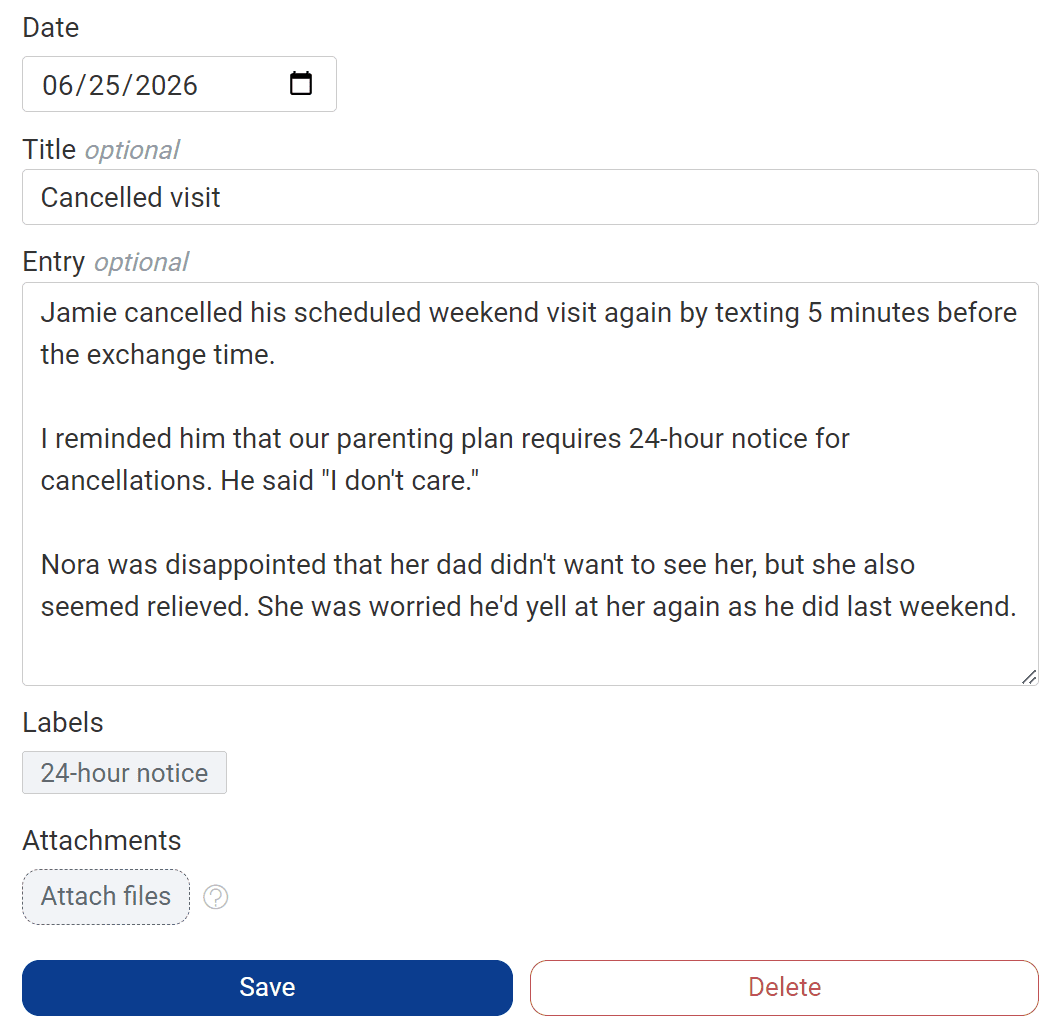
When you can't avoid in-person or phone conversations, note the details in a parenting journal. To give your journal credibility, use it often and include plenty of detail.
How to win a custody battle against a narcissist
A narcissist will probably refuse to compromise on your child's custody because they don't want you to "win," so you may not be able to settle your case out of court. If this proves true, expect a high-conflict case that will last a year or more.
To win your custody battle with a narcissist, start by preparing lots of strong evidence. You should also request a custody evaluation and a guardian ad litem. Lastly, you might consider getting your child involved.
Prepare evidence
To be successful in a child custody dispute, you need to prove that you're better than the other parent at supporting your child's needs and interests. You need evidence showing how you care for your child, along with evidence showing how your ex doesn't.
Family courts don't simply take what parents say at face-value — they require proof (evidence) of every claim made in court paperwork and proceedings. Remember that you not only have to prove the claims you make but also need to disprove claims made by your ex.
Common custody evidence includes photos, emails, text messages, social media posts, family calendars and official records (medical, school, criminal, etc.). You can upload these to your journal as attachments. You can also use the journal to document the other parent's behavior (and your own) to share with your lawyer and the court.
Witness testimony is also common evidence in a custody trial. Lay witnesses are people who know the family and testify to what they have personally observed. Parents also generally give their own testimony as witnesses. Carefully consider who you want to testify on your behalf and if you want to testify yourself, keeping in mind that the other parent (or their lawyer) can question you and your witnesses.
Don't bother trying to convince the judge that your ex is a narcissist. Unless your ex has been diagnosed with Narcissistic Personality Disorder, the judge won't give much weight to the vague term narcissist. Instead, document specific behaviors or incidents that make your ex an unfit parent.
Request a custody evaluation
In a child custody evaluation, a court-appointed custody expert interviews the parents and child individually. To get a bigger picture of the situation, they also review the family's personal records and often interview people who know the family (relatives, child care providers, etc.). They may also conduct scheduled or surprise home visits.
If mental health issues are a concern — including Narcissistic Personality Disorder — the court may order a psychological evaluation, in which a psychologist interviews the parents and child to assess their mental health. Sometimes a psychological evaluation is part of a custody evaluation.
In both types of evaluations, the evaluator writes a report for the judge that summarizes what they've learned about the family and recommends custody arrangements. Judges don't always order what the evaluator recommends, but they give the reports great weight.
Either parent can request an evaluation, or the judge might order one of their own accord (common in high-conflict cases). Additionally, either parent can hire a private custody evaluator to testify as an expert witness. If you're confident a neutral expert would recommend custody go to you, a custody evaluation is a good idea (but check with a lawyer first).
Keep in mind that these psychological evaluations only provide insights — they don't result in diagnoses. While the evaluator may note how your ex's narcissism prevents healthy parenting, you should also provide the court with proof of a diagnosis if you claim that your ex has NPD.
Request a guardian ad litem
A guardian ad litem (GAL) is a court-appointed custody expert who looks out for the interests of the child in custody cases. A trained child advocate (often a lawyer), a GAL conducts a custody investigation and makes recommendations to the judge. They also participate in court proceedings on behalf of the child's best interests — independent of what the parents want.
Either parent can ask the court to appoint a guardian ad litem. In high-conflict cases, judges often appoint them of their own accord when it seems like parents are losing sight of the child's interests. In some family courts, a GAL is automatically appointed when child abuse is alleged or suspected.
If the other parent's narcissism affects your child, a GAL can be important to make sure the child's needs don't get overlooked.
Consider your child's involvement in the case
If you want your child's opinion heard, let the judge know. It might encourage them if they were on the fence about speaking with your child.
However, your child won't get to choose who they live with (unless your case is in Georgia and your child is at least 14). While most states allow children to share their preference with the court, their preference is just one of many factors judges can consider. The older a child is, the more weight a judge gives their preference. Judges also evaluate whether the child has been unduly influenced (e.g., bribed with a gift) or simply prefers the more lenient parent.
Children rarely testify to their custody preference in open court in front of their parents. Instead, the judge interviews the child privately with a court reporter present. Depending on the court's rules, parents' lawyers might observe or ask questions.
Alternatively, if your child is interviewed by a custody evaluator or guardian ad litem, their preference (if they share one) is included in the report for the judge.
Keep in mind that judges and family courts vary in how they view a child's preference in custody disputes. Some believe it's important that children have a say, while others think it's best to avoid putting children in a position where they have to "choose" between parents. Consider your court's views on this and what's best for your child.
Preparing for divorce or custody mediation with a narcissist
Experts advise against negotiating with a narcissist on your own, so mediation is generally the best place to present proposals to your ex. At the beginning, the mediator will assess whether mediation is right for you. Be honest about any fears you have about your ex, as this could lead the mediator to suggest the court exempt you from the mediation requirement.
To prepare for mediation with a narcissist, consult with a lawyer, draft a parenting plan and consider agreeing to joint custody.
Prepare with a lawyer (and maybe bring them)
Since a narcissist may use mediation to further manipulate you, prepare with your lawyer (or if you can't afford one, with a friend). If your mediator allows it, bring your lawyer to mediation as well.
Practice calmly laying out your ideas. You can role-play, with the other person criticizing your proposals so you learn to respond without getting emotional.
Get a clear idea of where you're willing to compromise, but plan to start by asking for more. Your lawyer can tell you what requests are reasonable and help you understand the potential risks of not settling.
Lastly, prepare notes with any important points you want to make or issues you want to remind yourself not to bend on.
Create a detailed parenting plan and schedule
A parenting plan explains how you'll share parenting responsibilities. Yours should include rules that make co-parenting with a narcissist manageable. If you can't cooperate at all, include rules for parallel parenting instead.
Try this with Custody X Change.
A parenting time schedule details when the child will live and spend time with each parent. It should address holidays, school breaks and vacations.

Have drafts of both ready when you go to mediation. Ideally, come with several proposals since a narcissist is likely to attack your ideas.
If you can agree on a plan and schedule, you and your ex will submit them to the court for approval. But since an agreement with a narcissist is unlikely, you'll probably need to submit your own drafts to show the court which custody arrangements you want.
The more specific and organized your plan, the better chance your proposals have of being accepted. Your plan should be tailored to your child's needs, with customized provisions for all aspects of co-parenting. Your detailed parenting time schedule should have start and end times for each visit for years to come.
Your lawyer or mediator can create your plan and schedule, or you can make your own with Custody X Change. Even if a professional is making your final plan, it's a good idea to make your own preliminary version to show what you want.
Don't rule out joint custody
Going into mediation hoping for sole custody is likely to leave you disappointed. A narcissist is not going to agree to it because they would see it as defeat.
As long as it would be good for your child, consider agreeing to joint custody — but with provisions to protect you from your ex's destructive behaviors (e.g., a limit on how often they contact you).
If you end up in court, your judge is likely to award joint custody, so you can save time and money by agreeing to it now. In many places, the laws assert that it's in children's best interests for parents to share custody. (Exceptions include cases with domestic violence and child abuse.)
Other tips for mediation with a narcissist:
- Choose a mediator who specializes in high-conflict divorces.
- Request shuttle mediation (where you and your ex sit in separate rooms).
- If you can't bring a support person in the room, have one wait outside to give you confidence.
- Be mentally prepared for more than one session.
- Talk about your kids' and ex's interests, but don't mention your own.
- Insist on a detailed agreement. You don't want your ex taking advantage of ambiguities.
- Look over the agreement closely before you sign, ideally with a lawyer.
The tools you need when divorcing a narcissist
To successfully navigate your divorce from a narcissist, you need to create a comprehensive parenting plan and visitation schedule, set communication boundaries and document everything.
Fortunately, Custody X Change empowers you to do all of this and more.
The Custody X Change app walks you through each step of creating a detailed parenting plan. You can easily create a detailed parenting time schedule from commonly-used templates or from scratch.
The many co-parenting features — the messaging center, expense tracker, parenting journal and parenting time tracker — equip you to effectively go to court against and eventually co-parent with a narcissist.
Use technology to take the guesswork out of the equation and protect your child's future.