
Vermont Parenting Plan & Custody Agreement Guidelines
In any case involving parental rights and responsibilities, you should write a parenting plan. It's generally required, and it's an opportunity to create customized provisions specific to your child's needs. If you're divorcing, separating, or breaking up with your partner, write a solid proposal to benefit your child.
When to write a parenting plan
Start drafting a parenting plan as soon as it becomes clear you'll be parenting apart. Once you open your court case, pay attention to deadlines so you'll know when to submit the plan.
Try this with Custody X Change.
Do we have to agree on a parenting plan?
No, but you should try to. Agreeing speeds up your case and saves legal fees. Plus, parents who settle report that their kids adjust better to divorce. Parents who don't settle are twice as likely to say their kids adjust poorly or only slightly well.
Possible pathways:
- If parents submit a proposal together, the court is likely to approve it. (An agreement is called a stipulation.)
- If only one parent submits a proposal, the court is likely to approve it since the other parent hasn't offered an alternative.
- If neither parent submits a proposal or if each parent submits a different proposal, the court can order its own version.
Tips for writing a parenting plan
Whether you're writing your proposal alone or together, your parenting plan should:
- Inform the court of the outcome you want
- Keep your child's well-being at the center
- Limit the focus to how you behave as parents, not what you expect your child or anyone else to do
- Avoid financial matters (including child support), as they'll be handled separately
Choosing a template
You may use the sample parenting plan that the state provides. It's designed to collect the minimum information:

Many parents use the Custody X Change parenting plan template, which guides you through over 140 provisions so you're confident you're being thorough.
 Try this with Custody X Change.
If you wish, you can use both by starting with Vermont's template and attaching extra pages you create with Custody X Change.

Although a lawyer or mediator can create a parenting plan for you, providing them with a draft will help you communicate what you believe is important. It will save them time and likely save you money.
What to cover: Parenting rules
First, say which parent will have legal responsibility for major decisions about your child. Day-to-day decisions fall to whichever parent has the child at that time (unless you specify otherwise).
Then, say who will have physical responsibility, i.e., with whom the child will live.
Both types of responsibility, legal and physical, can be shared.
Parents commonly add provisions about these topics:
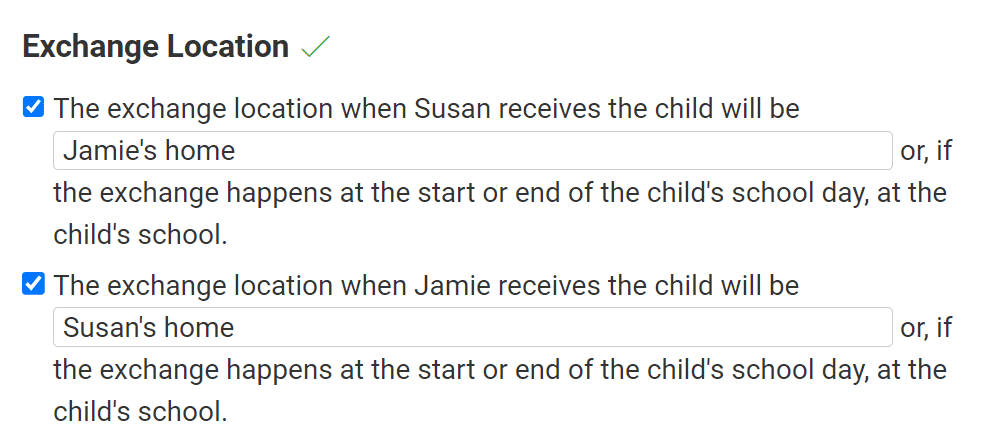
- Transporting and exchanging the child
- Contacting the child
- Accessing school and medical records
- Planning for the possibility that one parent may move away
- Meeting periodically to update the parenting plan
- Promising to try mediation (in the event of a dispute) before returning to court
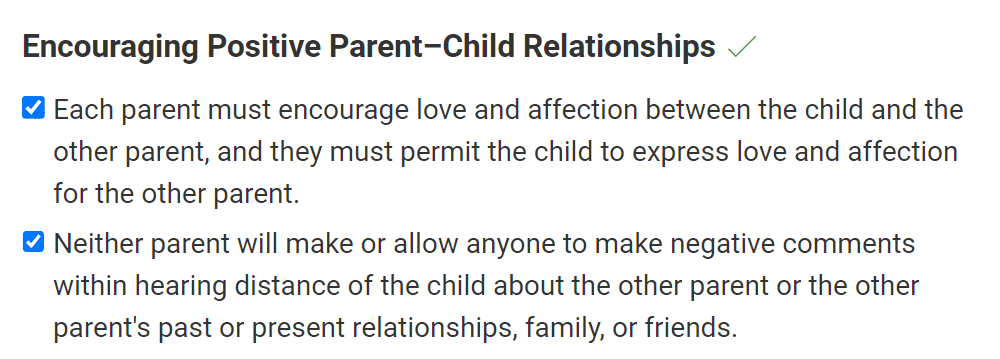
- Not criticizing the other parent in front of the child
All of these provisions are in the Custody X Change template. Just click the statements you want in your parenting plan, and customize them as you like.
What to cover: Parenting schedule
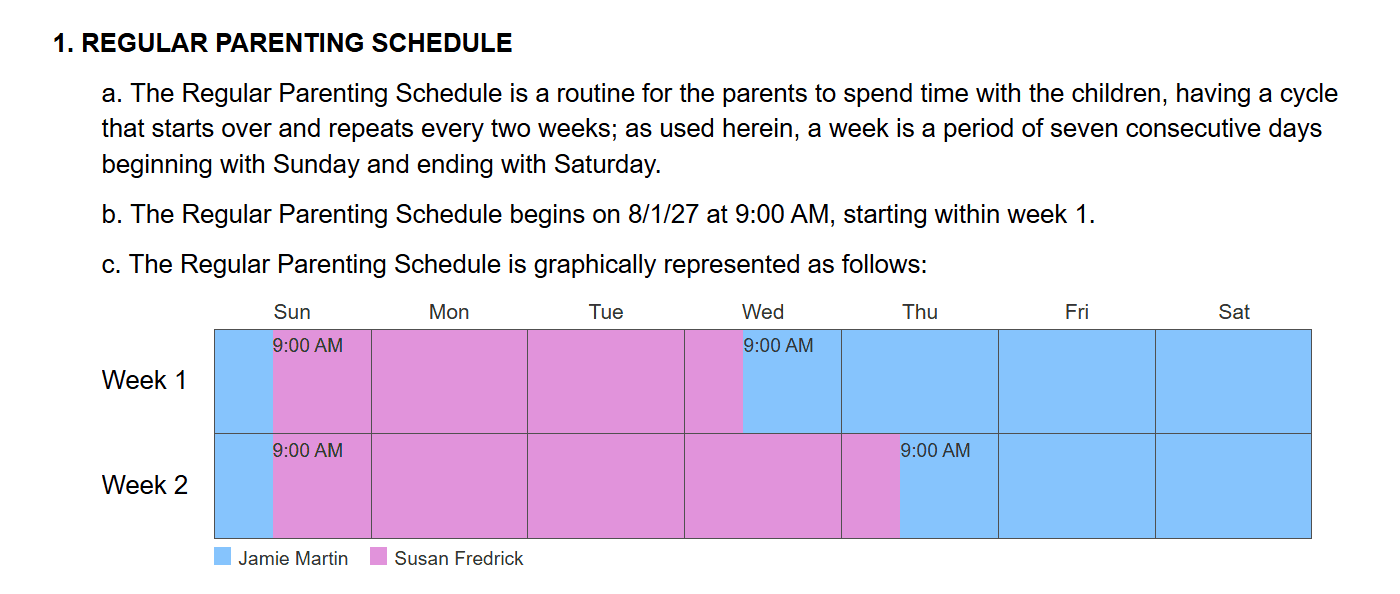
When you propose your parenting schedule, remember to plan for:
- School breaks (Thanksgiving, Winter, February and April)
- Summer vacation
- Holidays
- Your child's birthday
The Custody X Change app lets you create a visual calendar and automatically describes it in words, pulling it into your parenting plan.
The easiest way to make a parenting plan
When you create a parenting plan, it's critical you address all of your children's needs and use airtight language that leaves no room for interpretation.
If you're writing your own plan, use technology to take the guesswork out of the equation. The Custody X Change app will walk you through each step of creating a comprehensive parenting plan.
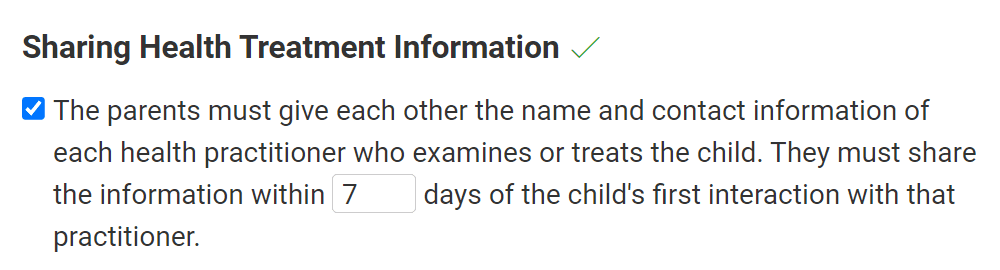
Choose from over 140 common provisions in more than 25 categories. Just select the items you want to include in your plan and fill in the blanks. You can also create custom provisions to meet your family's unique needs.
The result will be a professional document that demonstrates your competence as a parent from the first glance.
The easiest and most reliable way to make a parenting plan is with Custody X Change.
Frequently asked questions
If I have an amicable relationship with the other parent, do I need a parenting plan?
Yes. The court still needs to know how you'll raise your child and what you each agreed to do. However, if you expect to split amicably and not to fight over parenting, you may be able to keep your plan simple.
What if we have different parenting styles?
You can include provisions in your plan that blend your styles while leaving room for flexibility. You can also negotiate co-parenting boundaries, perhaps with the help of a mediator. When parents set their own rules in their own homes and minimize interaction, it's called parallel parenting.
What if my parenting plan isn't working out?
You can ask a Vermont court to modify your parenting plan if you have a good reason. It helps if parents agree on the proposed changes. In the meantime, you both have to follow your court order.