
Vermont Parent–Child Contact Schedules (Physical Custody)
A parent–child contact schedule helps you and the other parent create consistency for your child. You should detail when your child will spend time with each parent so you can avoid conflict. You have to stick to what the Vermont family court orders, except for minor changes.
How you get a parent–child contact schedule
Many parents write a schedule together and file a family case to have the court approve it.
Parents who disagree can try mediation. If they really can't reach a compromise, they can each present their ideas to the court and go to trial.
Either way, the judge orders a parenting plan that includes a schedule (unless a parent won't have regular involvement). The court's decision about which schedule is most beneficial and practical depends on the information you supply.
Writing your schedule for court
Vermont's sample parenting plan asks you to write your initials and the time of your exchanges. The form can get crowded, so it's meant for the simplest schedules. You don't have to use it; you can attach your own schedule or use a different parenting plan template if you prefer.
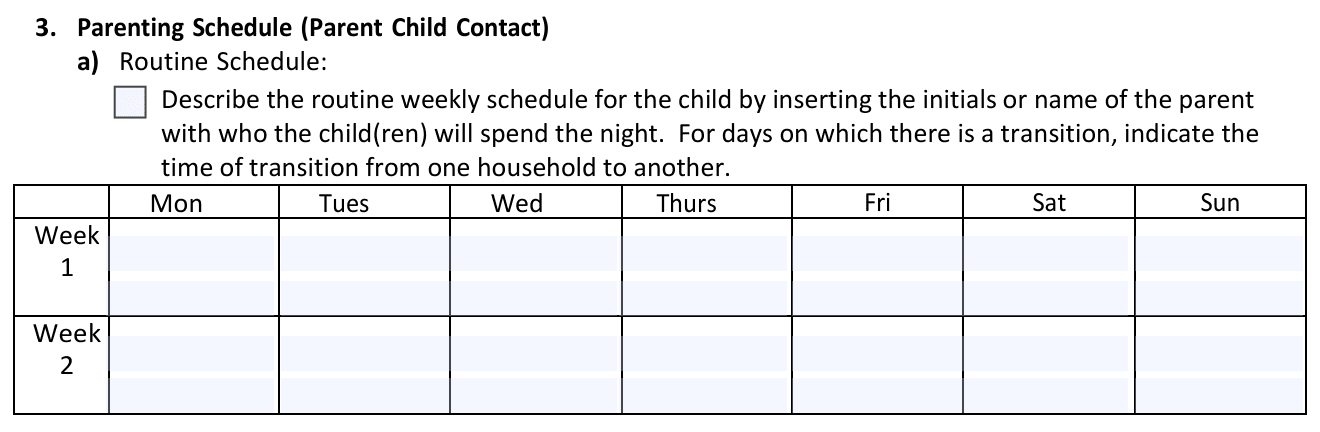
You can instead use Custody X Change to create a visual schedule as well as a parenting plan. The app automatically generates a written description of the schedule. It can also calculate your overnight parenting time (important for child support) and notify you of upcoming exchanges.
Schedule options
Vermont courts don't officially have preferred parenting schedules. The court will choose a schedule that's appropriate for your child. Ideally, both parents propose at least one schedule.
Joint physical custody
For a young child, the court might order a 2-2-3 schedule.
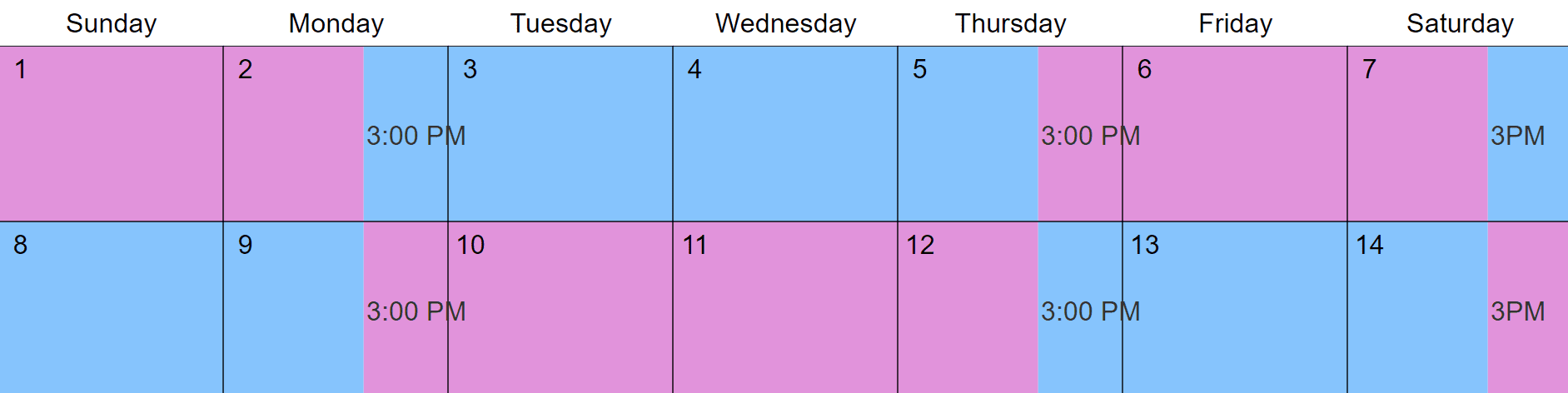 Try this with Custody X Change.
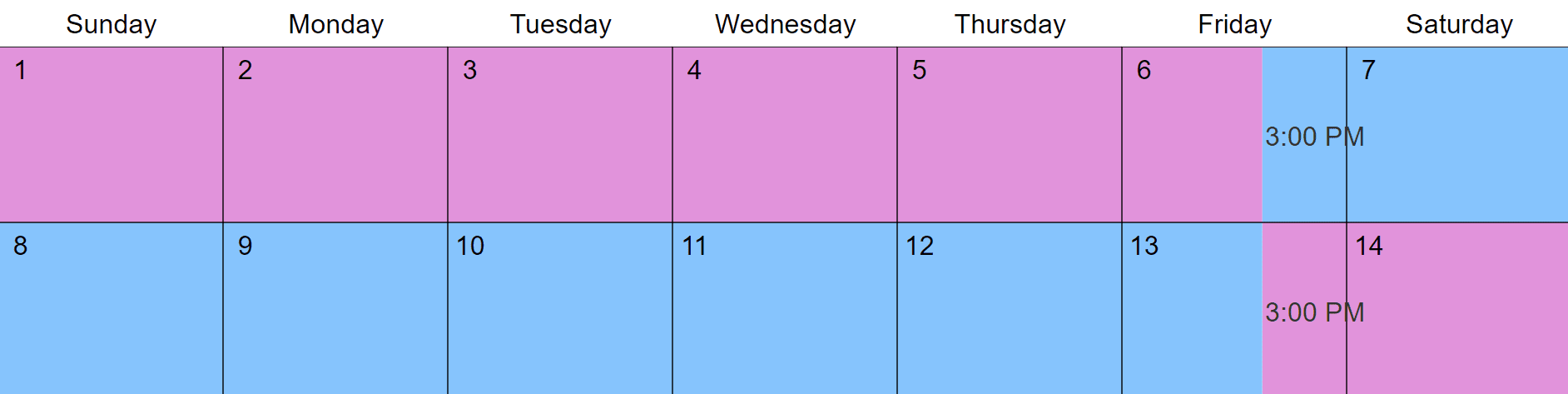
For an older child, the court might order alternating weeks.
Primary physical custody
The court may give one parent primary custody if there's a strong argument for it. The other parent (except in rare cases) will still have the right to visit their child. If the child hasn't yet spent much time with the other parent or there's a concern about abuse, the court may order supervised visitation or a step-up plan.
A baby might live with one parent while the other parent stops by every weekday for a brief daytime visit.

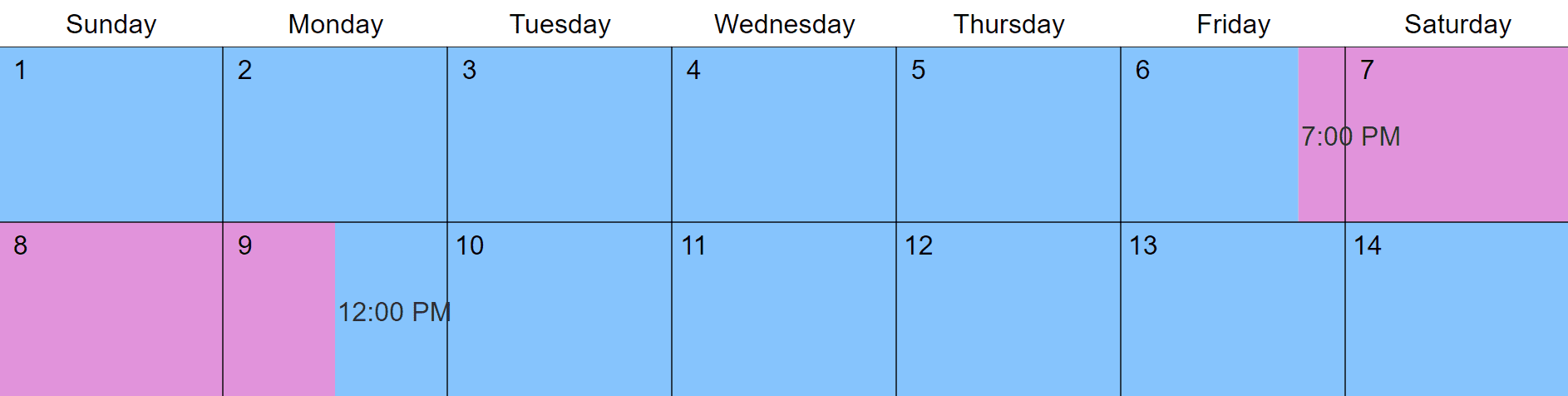
For a school-age child, the parents might receive an alternating-weekends schedule.
Holidays and vacations
Remember to consider weeklong school breaks: Thanksgiving, Winter, February and April. Define when you consider the break to begin and end. If your child will spend the entire week with one parent, it might be convenient to start the visit when school lets out and end it when school begins again.
Acknowledge all school holidays as well as any holidays that are important to you. Many parents split Christmas — one may get Christmas Eve, and the other Christmas Day.
If you need to modify your schedule
You can make minor adjustments as you go. That's up to you and your co-parent. Try to communicate respectfully.
Sometimes parents need to make big changes to their schedule because one of them has moved or had a job change. If you're in a situation like this, tell the court. That way, it can hold you both accountable to the new schedule and won't accuse you of not following the old one. You may qualify for a revision of child support based on your parenting time.
Ideally, you'll reach a full agreement with the other parent, and you'll submit it for a judge to approve.
The easiest way to make a schedule
If you're like most parents, creating a custody and visitation schedule will feel daunting. How do you write something that meets legal requirements and doesn't leave any loose ends?
The Custody X Change app makes it easy. Either customize a schedule template, or click and drag in your custody calendar to make a schedule from scratch.
Try this with Custody X Change.
Then watch a full description appear in your custom parenting plan.
Try this with Custody X Change.
The combination of a visual and written schedule means your family will have no problem knowing who has the child when. Take advantage of Custody X Change to make your schedule as clear and thorough as can be.
Frequently asked questions
What if our parent–child contact schedule isn't working?
You can ask the court to enforce or change your schedule. You should continue to follow your court order, except when you agree on minor scheduling changes.
What if one of us moves far away?
If you expect a long-distance move, you can ask the court to approve a schedule for now and another for after the move. For an unexpected move, try to agree on a new schedule, then have the court approve it. If you can't agree, you'll need to have the court decide what to do.
How many overnights do I need for "shared custody" in the child support calculation?
Each parent must have the child for at least 25% of the annual overnights to use the shared-custody child support worksheet. Schedules with 50/50, 60/40, or 70/30 time splits would likely qualify. The parent paying child support will get a credit for their time.
If the other parent misses scheduled visits, what can I do?
If it's an ongoing issue, keep a record of the parenting time you actually get and discuss it with the other parent. This is often best done in writing. You can log your actual time in the Custody X Change app. If you have to go to court, bring this evidence.