
Can My Work Schedule Affect Custody? Shift Workers, Etc.
A parent generally won't lose custody because of their work schedule, but it can impact how much parenting time they get. There are ways to lessen your work schedule's impact.
Nontraditional work schedules and custody
Work schedules usually aren't evidence that can be used against you in a custody battle — at least not successfully.
However, if work makes you miss school drop-off and pickup, bedtime and other crucial care moments, the judge might give you less parenting time than your co-parent, according to Kristen A. Stanton, an Ohio family lawyer.
Bottom line: As long as you're available substantially and consistently, you have as good of a chance at custody as a parent with a more traditional schedule.
Nontraditional fields that might affect custody schedules
A nontraditional work schedule is one that veers significantly from the typical 8 a.m. to 5 p.m. Monday through Friday.
Career fields that have nontraditional work schedules include:
- Healthcare
- Emergency response
- Law enforcement
- Hospitality
Parents in the military may have to think about deployment or travel, even if they have traditional work schedules when they're home. These parents should create a military visitation schedule.
If you have an unusual work schedule in any field, you may want to hire a lawyer to show the judge that you still a stable, capable parent.
Ways to limit your work schedule's effects on custody
Reach an agreement with the other parent
Negotiating an agreement one-on-one or through mediation gives you more control over the amount of parenting time you receive.
Collaborate with the other parent to make a schedule that's feasible and fair. You could also put terms in your parenting plan that allow flexibility if your schedule changes.
Propose a custody schedule on your own
When negotiating an agreement isn't working, suggest a schedule to the court on your own. Explain why this is the best arrangement for your child. You know how your schedule fluctuates, so you have the best sense of when you're available.
Show you have a consistent work schedule
Proving you have a consistent schedule could help your case.
A study by the American Public Human Services Association looked at how nontraditional work schedules impact children. It found that stability of the schedule matters more than the schedule itself.
Judges want to ensure consistency for the child. Show how you can provide consistency even if your work schedule is not typical.
Change your work schedule
If your employer allows it, you could adjust your work hours to better suit your child, or maybe even work remotely at times.
Prove you have other caregivers
The judge will want to know the child is supervised during your parenting time. Leaving a young child home alone is considered neglect in many places.
Show the court that you have relatives, friends or paid caregivers who will step in. Try to keep the child's caregivers the same; frequent changes can cause instability for the child.
Best custody schedule for shift workers
In a Reddit post, parents shared the schedules they followed when co-parenting with someone who has a nontraditional schedule.
It's possible to have a 50/50 custody schedule even when one has a nontraditional work schedule.
One parent had success following the 2-2-5-5 schedule.
 Try this with Custody X Change.
The 2-2-3 schedule is a similar schedule for parents with fewer consecutive days off.

Some nontraditional work schedules make equal timeshare unfeasible.
A mom in the same thread worked 9 a.m. to 5 p.m. while their co-parent worked the night shift. The kids spent Friday to Monday with Mom, and went with Dad on Wednesday and Thursday, his days off. They alternated Tuesdays. Mom has about 60% of parenting time and Dad 40%.

On Dad's Tuesday, the kids stayed home alone at night. If you have young children, you'll need a reliable caregiver.
Weekend schedules are another option. Weekend visits can start and end on any day you agree on.
Some parents have success with the alternating-weekends schedule.

The weekend parent could have a weekday visit if they have the time off.

Firefighters often like the every-third-day custody schedule because it works well with the 24/48 work schedule.

Nurses tend to use the 4-3 custody schedule since many work three or four long days in a row.

Third-party time
Adding third-party time to your schedule gives you a more accurate look of exactly how much time your child spends with you. Add the time your child spends with a caregiver while you're at work, the child's school schedule and more.

Can I lose custody if I work night shifts?
No, you won't lose custody just because you work night shifts. If you work night shifts and you've shown you're unfit to parent in other ways, then you could lose custody.
The parenting responsibilities you're given by the court will match up with your availability. For example, the court is unlikely to task you with dropping your child off at school in the morning.
Do I have to give my ex my work schedule?
Parents should know one another's work schedules so they can accommodate their child's needs.
During a custody case, it's common for parents to request work schedules during discovery. You could face sanctions for not providing your schedule, such as fines. Plus, it makes you look uncooperative in the eyes of the court.
Even after you have set a custody schedule, your court order might require you to share your work schedule if you ask to change a visit because of work.
Custody arrangements when one parent travels for work
Traveling frequently for work could make it difficult for your child to see you.
Here's what you can do:
- Give notice as soon as you learn of your work trip so you and your co-parent can adjust accordingly.
- Have virtual visits with your child.
- Ask permission to delegate visitation to your spouse, the child's grandparents or a paid caregiver while you're away.
- Use holidays and school breaks to make up time you miss.
- If you're able to come home during long trips, create two schedules — one for when you're away on work and one for when you're not.
When choosing a schedule, consider what you can carry out consistently.
An alternating-weeks schedule has one weekly exchange. The child won't expect to see you as often, which might make it easier for them to adjust when you have to miss a visit.

Young children need to see their parents regularly. In that case, you could go with something with regular exchanges. The 4-3 schedule is good for this.

If work travel severely limits your parenting time, the child could stay with you on extended school breaks.

Using technology to manage custody with a nontraditional work schedule
Nontraditional work schedules require co-parents to have a clear schedule, a plan for unexpected changes, and strong communication.
Custody X Change has the tools you need to manage it all:
Create a schedule from scratch, or choose from preloaded templates.
Create a parenting plan with provisions specifying how you'll adjust your custody schedule when work interferes.
Message the other parent about requests for makeup time and more.
Try this with Custody X Change.
Try this with Custody X Change.
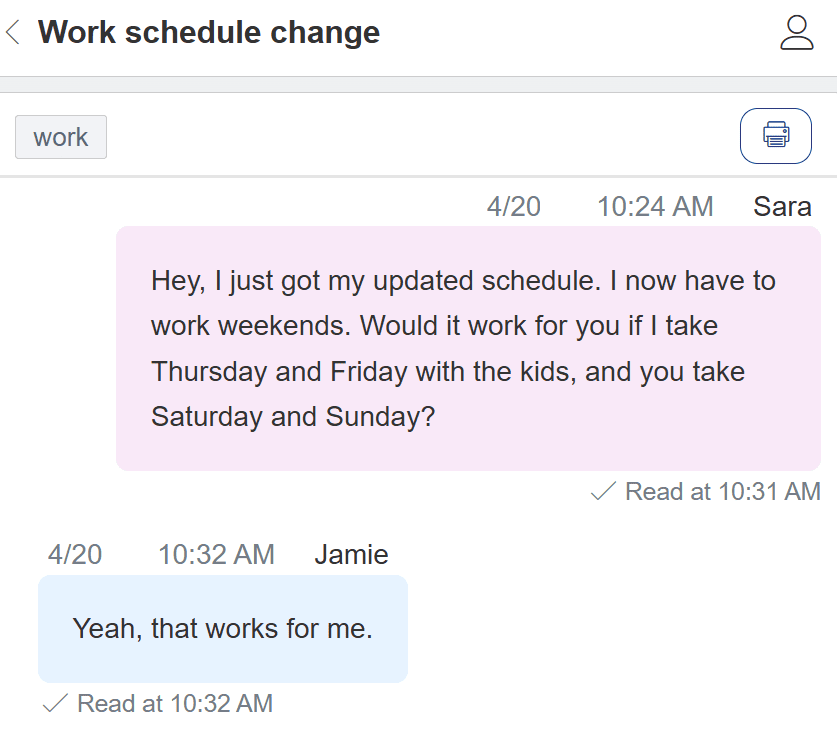
Custody X Change helps you balance your work and child custody schedules.