
South Dakota Parenting Plans (Custody Agreements)
Parenting plans set how parents must collaborate in caring for their children.
South Dakota has parenting guidelines that automatically become your parenting plan once you start a custody case. Parents can instead create a parenting plan together if they reach an agreement. Or a parent can create a plan on their own to propose an alternate arrangement to the court.
About the parenting guidelines
South Dakota's Parenting Guidelines explain what the court will order in a case where parents can't agree (unless one convinces the judge that something else would be better). They include age-based parenting schedules for primary custody, meaning one parent will get the majority of time with the child. They also include rules for communication, among other parenting duties.
Once a parent starts a custody case and notifies the other parent, the parenting guidelines become an enforceable court order. Violation can result in charges of contempt of court — although parents can agree to a different schedule.
At first, the guidelines are a temporary order parents must follow during the court process. The guidelines can become the final order if the terms suit the child's best interests.
Parents who agree to a different arrangement or want to propose one on their own should file an objection. To add detail, they can create a parenting plan for the court to consider.
Reasons to make a parenting plan
Many parents decide to create a plan because they want fairly equal parenting time. The schedules in the South Dakota guidelines give one parent less than 30% of time, with most of that falling on weekends.
Making a parenting plan also lets you choose co-parenting approaches that work for your family. For instance, you could explain the types of discipline that will be allowed and the religious practices your child will follow. Without a plan, you'll get a more generic court order.
Writing a plan is also recommended if you want to show the judge you've put thought into your child's future. This can help show your parental fitness.
Parenting plan templates
You may choose any format for your plan.
The Custody X Change parenting plan template offers over 100 parenting provisions and lets you create your own. It prints as a court-ready document.
Try this with Custody X Change.
Topics to include in your parenting plan
You don't have to cover all of the same bases as the parenting guidelines.
At a minimum, your parenting plan should cover physical and legal custody. Adding more topics will make co-parenting easier as you'll have a "handbook" to guide you.
Physical custody
Physical custody explains where the child lives.
With joint physical custody, the child lives with each parent for nearly equal time, or at least 180 overnights per year for child support purposes.
With primary physical custody, the child mostly lives with one parent, who is called the primary or residential parent. The nonprimary or nonresidential parent has visitation if it's safe for the child. They might have supervised visits if the child is not used to spending time with them or would not be safe alone with them.
A parenting schedule lays out when the child will be with each parent. Cover holidays, special occasions and school breaks to avoid headaches down the line.
Legal custody
Legal custody is the right to make major decisions for your child, like what school they go to, what religion they practice and what medical care they receive.
It's most common for parents to have joint legal custody, meaning they both have a say in these decisions.
In rare cases, one parent could have sole legal custody, giving them primary authority to make major decisions for the child.
In either case, parents can make day-to-day decisions for the child when the child is in their custody.
Information sharing
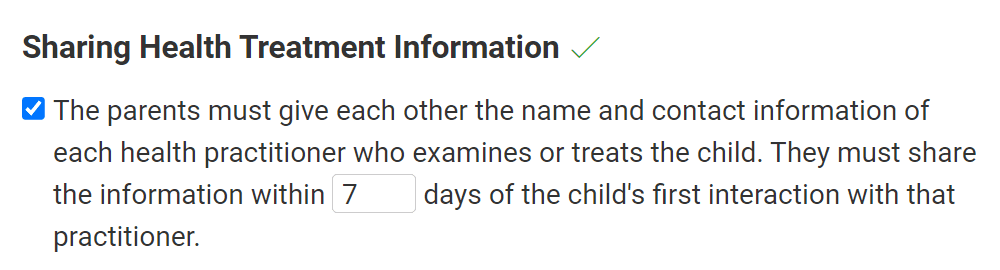
Both parents have a right to access the child's school, medical and other records. Include how you will share these records and the deadlines for sharing it.
Communication
State how you will discuss child-related issues. Specify whether you'll communicate in person or via phone, text, email or parenting communication app.
Also, consider how parents will stay in touch with the child during the other parent's time. In long-distance parenting situations, parents are encouraged to use phone calls and virtual visits when in-person visits aren't possible.
Exchanges
An exchange is when the child goes from one parent's care to the other's.
Explain who will be responsible for picking up and dropping off the child, and whether you will allow third parties like new partners to handle exchanges. You might also propose supervised exchanges if you're in a high-conflict co-parenting situation.
Transportation
Who can drive the child places?
Also, cover travel expenses if one parent lives far away. Parents who incur substantial travel expenses may qualify to pay a reduced child support amount.
Address what will happen when the child is mature enough to transport themself between households. Can they take the bus or ride their bike?
Relocation
Plan ahead for what will happen when a parent moves. Agreeing on this saves you the trouble of filing a notice of relocation and going to court later. Set rules for how much notice a parent must give and how you will adjust your current parenting schedule. For instance, you might say you'll agree on a schedule as similar as possible to the existing one.
Modifications
Your child's needs will change as they get older. Parents' work schedules might also change. Specify how you will adjust your parenting plan and schedule. Will you review it together annually? Will you meet with a mediator if you can't agree on changes?
Finances
Plan for your child's financial future. Detail whether you will start a college fund, savings account or something else for your child, and explain which parent will contribute what.
Child support
You can address child support in your parenting plan if you agree on the support amount.
Fill out a Child Support Obligation Worksheet — or, if you will each have more than 180 overnights a year, the Shared Parenting Child Support Obligation Worksheet. Attach it to your plan.
If the agreed amount differs from the amount calculated using the worksheet, you must explain why and how it's enough to meet your child's needs.
Finalizing your custody agreement
If you have an agreement, you'll attach your parenting plan to a stipulation for child custody or divorce. You can file this when you start a case or any time afterward (the sooner, the better).
If you're divorcing, you'll need the following divorce with children forms:
- Stipulation and Settlement Agreement for Divorce with Minor Children
- Affidavit as to Jurisdiction and Grounds for Divorce with Minor Children
If you're not divorcing, you'll need the following child custody forms:
- Stipulation, Custody, Parenting Time, and Support Agreement
- Order (Paternity Action)
- Notice of Entry of Order (Paternity Action)
The court may call you in for a hearing to go over the terms and confirm that you both agree. But most likely, the judge will review your forms on their own, then sign the order if they approve. You'll get a copy of the signed order in the mail.
The easiest way to make a parenting plan
When you're writing a parenting plan, it's critical you use airtight language that leaves no room for interpretation.
If you hire a lawyer, they'll write up the plan and ensure it meets the court's requirements.
If you write your own plan, use technology to take guesswork out of the equation. The parenting plan template in the Custody X Change online app walks you through each step.
 Try this with Custody X Change.
The result is a professional document that demonstrates your competence as a parent from the first glance.
The easiest and most reliable way to make a parenting plan is with Custody X Change.