
Yes, You Can Lose Custody for Not Co-Parenting. Here's How.
Courts often don't want to give joint custody to parents who seem unable to cooperate. If you're not actively co-parenting, you could lose custody. Start collaborating now to show the court you can do it.
How a parent could lose custody for not co-parenting
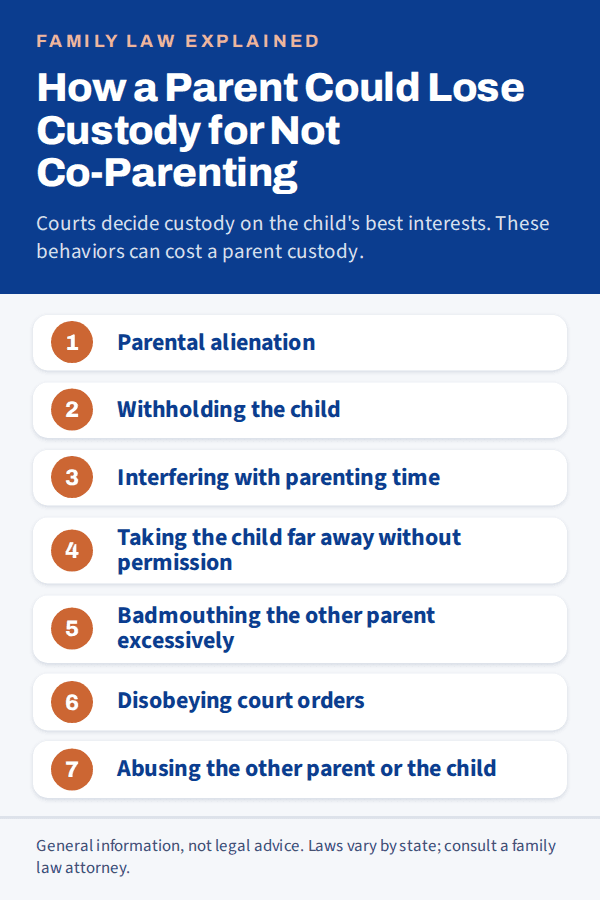
When two people fail to co-parent, a court might give sole custody to one of them. Reasons include:
- Turning the child against the other parent (parental alienation)
- Withholding the child from the other parent
- Interfering with parenting time — e.g., by planning inconvenient activities just to force the other parent to drive to them
- Taking the child far away without checking in — They could be charged with parental kidnapping.
- Badmouthing the other parent excessively
- Disobeying court orders to co-parent — e.g., an order to communicate through a co-parenting app
- Abusing the other parent or the child — Report abuse to police and the court. Family law takes domestic violence and emotional abuse seriously.
Doing one of these things once does not necessarily mean you will lose custody. However, if there are serious instances or a pattern, there's a good chance you could lose custody. Think about which behaviors might be used as evidence against you.
Not getting along with your co-parent will not cause you to lose custody. The court does not expect you to be friends with your ex. However, it does expect parents with joint custody to collaborate effectively, so follow your court order and try to stay courteous.
How a parent could lose parental rights for not co-parenting
In rare cases, a court may terminate your parental rights. While each location has its own laws, reasons include:
- Abusing the other parent or the child
- Being jailed for a felony
- Disappearing
- Voluntarily giving up parental rights so the other parent's spouse can adopt the child
Losing parental rights is more drastic than simply losing custody. It means the person is no longer legally considered a parent.
As a nonparent, they no longer have the right:
- To see or speak to the child (that would be up to the legal parent)
- To ask the court for a custody or child support arrangement
Nor will the nonparent have obligations:
- To care for the child
- To pay child support
What to do instead
Most parents should try to work together, even if they find each other difficult. Try to dial down conflict.
Remember that everything you're going through in a co-parenting dispute should ultimately be for your child's sake. Whether you and your co-parent were married for years or never were a couple at all, your role in each others' lives going forward will be as co-parents to the child you share.
Before your case
Start devoting time to your child immediately. Parenting now proves to the court that you can do it. It also demonstrates a strong bond with your child, which the court will try to preserve.
Encourage your child to have a healthy, loving relationship with their other parent.
During your case
Sometimes a judge gives you a temporary order for a few months until they can make a final ruling. Follow it. Disobeying it will count against you (unless you have a real reason and the judge is aware of it).
Prioritize your child's best interests. Focus on facts that are relevant to your child, not your opinions about your ex.
Try to resolve issues out of court. Co-parenting is easier when you can reach agreement rather than have an arrangement imposed by a judge. Mediation can help you negotiate.
After your case
Comply with the final court order. What the court believes co-parenting means for you should be spelled out somewhere (it may be called a parenting plan or custody agreement).
Collaborate with your co-parent on major decisions. Otherwise, the other parent could bring you back to court. For example, if you were told to consult the other parent about medical decisions, keep each other in the loop about doctor's appointments.
 Try this with Custody X Change.
At the scheduled exchange time, hand over the child as planned. If you're forgetful or you tend to be late, use an app like Custody X Change to notify you of upcoming exchange times.
Keep your phone calls within a reasonable limit.
If you must move out of state, give advance notice to the other parent or the court. You may need their permission. One parent will probably get sole custody.
As a last resort, one parent can ask the court to enforce the order. For example, in California, that could involve asking to hold the other parent in contempt of court, according to Cullen Family Law Group.
If your health is making it hard to co-parent
Your physical and mental health in itself isn't a reason for your child to be taken away, as that would be discriminatory. Parents can provide multiple kinds of support, children are resilient, and many factors go into a child's happiness and success.
However, problems that impact your parenting and put your child at risk may lead to a determination that you're an unfit parent.
Make healthy choices:
- If you have a physical disability, find the support services you need.
- If depression or anxiety interfere with your ability to parent, address it with a professional.
- If you have a drinking problem, commit to recovery. You may need to do sobriety testing.
Form a "solid support network," as Seattle Family Law Group recommends. Document your efforts to show the court you're serious. Reassure your co-parent and your child that you care.
If you lose custody for not co-parenting
If you lose custody and want to increase your parenting time, one good option is a step-up plan. It details a timeline and conditions by which one parent can increase their time.
For example, a step-up plan might say the noncustodial parent can have two weekly daytime visits now, then add an overnight visit once they begin co-parenting counseling.
When two co-parents propose a step-up plan, it shows the court exactly how you're moving toward shared parenting responsibilities. Courts tend to approve these proposals.
If your goal is to regain custody, talk to a lawyer as soon as possible. They can tell you how to start documenting the changes you're making to improve as a co-parent. One day you may have enough evidence to ask the court to change custody.
Using technology to co-parent well
Cooperating with your child's other parent can be challenging. You need ways to share information while reducing conflict. You also need to show the court you're trying your best.
The Custody X Change app has the tools, including:
A parenting journal where you can write about what happens and attach photos
Co-parent messaging so you can stay in touch and print out conversations
And more
Let Custody X Change help you. Don't risk losing custody for not co-parenting.
Frequently asked questions
What causes a mom or dad to lose custody?
A parent can lose custody if they can't take care of their child. Even when they're able to parent, if they can't cooperate with their co-parent, one parent may get sole custody. Gender is not a factor, though there may be patterns of bias against mothers or fathers in some courts.
Can you co-parent while married?
Yes, if you no longer consider yourself in a relationship. Co-parenting is for parents who aren't a couple. While you can work out a co-parenting arrangement with your spouse, generally such court orders are for parents who are divorcing or legally separating. But some places, like California, let married parents file for custody.
Can you co-parent after you remarry?
Yes, both of you remain your child's parents even if you remarry. Stepparents can help with your custody arrangement, but they themselves don't have custody (unless your court order says they do).