
Child Custody Rules
Every state has its own family code covering state child custody laws. In addition, there are rules of procedure that dictate the court process.
Some rules apply to custody no matter where you live. These should guide you as you figure out how to work with the other parent, create a parenting plan, get ready for court and more.
How can Custody X Change help me prepare for my custody case?
Custody X Change was designed to help you make your custody plan and visitation schedule. With Custody X Change, you can:
- Set up a custody and visitation schedule that includes a repeating cycle of custody, holidays, vacation time and special events
- View the custody schedule as a calendar and see as many years in advance as you want
- Use the time-share percentage report to see exactly how much time each parent has with the child
- Use the time-share percentage report to help you figure out child support payments
- Create a comprehensive parenting plan
- Select from a variety of parenting provisions to add to your parenting plan
- Keep a journal to keep track of what happens during parenting time
All of this prints out into professional documents that are easy to read and can provide the other parent, a mediator or a judge with a clear view of your proposals.
What types of custody are there?
Some states may call them different things, but as a general rule, there are two types of custody:
- Legal custody pertains to the authority a parent has over the child. This includes the power to make decisions regarding the child's education, medical care, religion, etc.
- Physical custody refers to the actual care and possession of the child.
There are also a few different kinds of legal and physical custody:
- Joint legal custody means that both parents can make major decisions about the child. This is the most common form of legal custody.
- Sole legal custody means that only one parent can make major decisions about the child.
- Joint physical custody means both parents have physical custody of the child for significant time. This does not necessarily mean they have to divide the child's time equally between them. Joint custody is becoming more common, and some states even prefer to award it.
- Sole physical custody means one parent provides the child's primary home. The other parent may get visitation rights.
- Split custody means that one parent has physical custody of one child and the other parent has physical custody of another child. This is not a very common kind of custody but it works for some families.
- Birdnesting is an option available in some states. Birdnesting means the children remain in one home and the parents take turns living there. It is not very common, but it does provide the children with a stable environment. This option is great for families that have a lot of children, since the parents will only be responsible for maintaining one large home for them instead of two.
Can I create my own parenting plan without the court's help?
Most courts prefer that parents work together to create their own parenting plans. The court will review their agreement to ensure it meets the needs and serves the best interests of the child.
You can use Custody X Change to help you reach an agreement with the other parent.
To start, create the parenting plan and visitation calendar you want. Then, print out a copy for the other parent to review and suggest changes.
After you review the suggestions of the other parent, you can easily make changes to your plan. Keep revising the plan until you are both in agreement or have agreed on all the things you were able to.
Using documents makes it easier to negotiate your parenting plan as your point of view is clearer when it is written down.
Once you have agreed on everything that you are going to agree on, you can then present a proposed parenting plan (highlighting the sections you were able to agree on) for the mediator or judge to consider.
What are the "best interests of the child"?
Another custody rule that is good to know is the best interests of the child standard. It is important to keep this in mind and create your parenting plan accordingly.
Some factors that courts consider when determining the child's "best interests" are:
- Parent-child relationships
- Which parent has acted as the child's primary caregiver
- Whether or not the child has any siblings and how to preserve interfamilial relationships
- The child's adjustment to his or her home, school and community
- How well the parents could execute the parenting plan
- Whether or not there is any history of domestic violence, child neglect, or any kind of abuse
- The ability and willingness of each parent to fulfill the child's physical needs
- The ability and willingness of each parent to meet the child's emotional needs
- The motives and sincerity of each parent seeking custody
Basically, anything that is relevant to the care and custody of the child will be considered. The judge will consider all of the important issues regarding the child and his or her future care.
What should I include in my custody agreement / parenting plan?
Your parenting plan (also called a custody agreement) is going to serve as the foundation for raising your child until they reach adulthood.
All good parenting plans should contain the following elements:
- A regular residential schedule that dictates when the child will be with each parent on a regular basis
- A holiday schedule that allows the child to spend equitable amounts of time with each parent
- A vacation schedule or provisions for vacation time so the child may spend extended time with each parent
- A statement that allocates decision-making authority (for important issues regarding the child's health, education, etc.) to each, either or both parents
- A method for modifying the agreement should the need arise in the future
- A method of dispute resolution should the parents fail to agree on something in the future
- Any stipulations or provisions that pertain to matters involving the child
Your parenting plan can be as detailed as you would like. In fact, the more details you include, the better your parenting plan will be.
Custody X Change offers a custody agreement template covering all the bases of child rearing so you're prepared every step of the way. Try it today and see how it can help you.
The easiest way to make a parenting plan
Creating a parenting plan on your own can feel overwhelming. You have to address all possible situations, while using airtight legal language.
Use technology to take the guesswork out of the equation. The Custody X Change app walks you through each step of creating a plan.
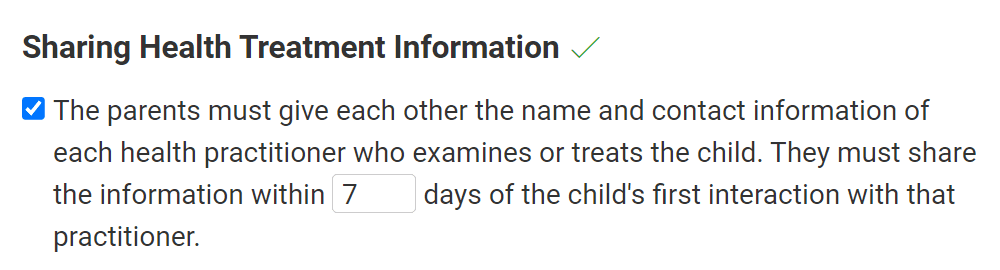 Try this with Custody X Change.
The result will be a professional document that demonstrates your competence as a parent and secures your child's future.
Try this with Custody X Change.
The easiest and most reliable way to make a parenting plan is with Custody X Change.