
Military Custody Schedule for Your Children
If you or your co-parent is in the military, you'll need a custody schedule that anticipates the unpredictable.
Though deployment, special assignments and travel can make visitation complicated, make sure to give your children quality time with both parents.
How to create a military custody schedule
You can create your own military custody schedule or hire a lawyer to create it. Since no schedule fits every military family, you need to create one for your unique circumstances.
Your court may offer a template you can fill out, or you can use a digital calendar like Custody X Change.
Try this with Custody X Change.
Family courts look for custody schedules that put the children's interests first. The judge will only approve your military custody schedule if they're sure it won't cause unnecessary stress to your children.
What to include in your military custody schedule
A military custody schedule should cover the topics a standard custody schedule does:
- School-year schedule: Where your child will be on typical days (If your child isn't in school, call this your regular schedule.)
- Holiday schedule: A division of holiday time between you and the other parent, including summer
- Vacation schedule: When each parent is allowed to vacation with the child
- Special events schedule: Changes to the schedule for things like a child's birthday
Then put details in your parenting plan about how military duty may affect the schedule.
How military custody schedules are unique
An active duty military parent faces several challenges to parental visitation:
- Temporary training at another location
- Temporary transfer to another location
- Mobilization
- Deployment
- Relocation
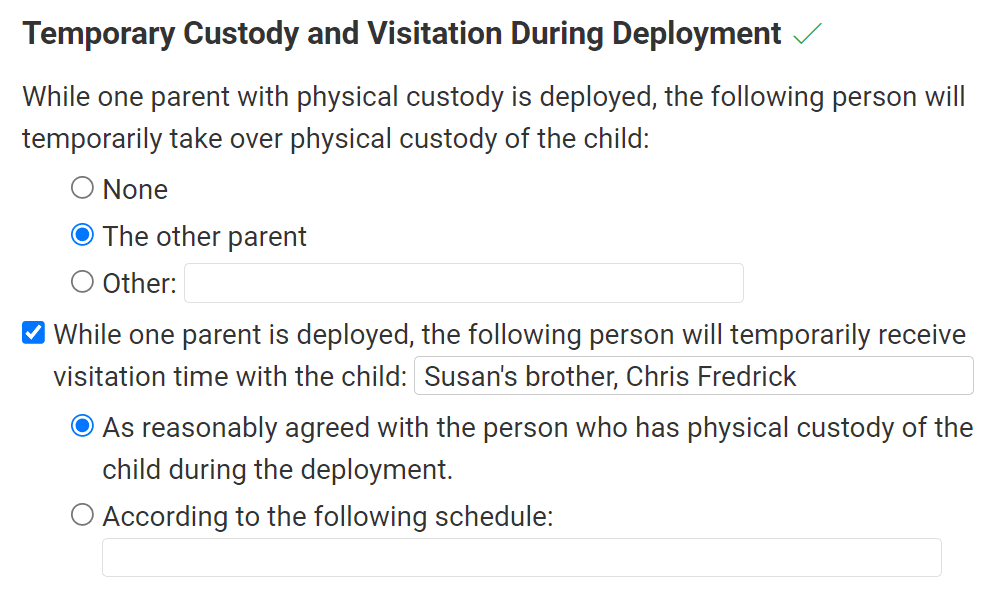
When you can't make visits with your children or have limited visits, the schedule should be adjusted. Your parenting plan could state that when the away parent does have time off, their time with the children will be prioritized. You could also have your parents or other relatives visit with your kids while you're away. This helps keep your children connected to your side of the family.
 Try this with Custody X Change.
Info to gather before you make a military custody schedule
You'll need to gather exact dates and times for at least the next year, like:
- Pickup and drop-off times for each child's school
- School calendar, including breaks and half days
- Work schedule for both parents
- Activities schedule for each child
- Holidays
- Special occasions, like birthdays or weddings
- Vacations
- Dates related to military service, like summer training
Military custody schedules for your child's age
Children go through stages as they grow. A judge is more likely to approve a schedule that satisfies age-appropriate developmental needs.
Here are some examples of age-appropriate visitation:
- Infants: Avoid taking the infant away from the primary caregiver for more than a few hours. Short, frequent visits are best.
- Toddlers: Because they lack an understanding of time, toddlers should also have short, frequent visits. Daytime visits in familiar surroundings are the least stressful.
- Preschoolers: Still no overnights unless the child is extremely comfortable. Counting days and hours to visits can help with transitions.
- School kids: Depending on the child's maturity, visits can last up to a few days. Routines are important, so make your schedule predictable.
- Teens: While teens can handle short or long visits, they're often busy. Take your teen's schedule into consideration, and focus on the quality of your parenting time, not the quantity.
Protections for parents in the military
The government wants to prevent military parents from losing custody due to serving their country. Several state and federal laws protect your parental rights as a service member, including the Servicemembers Civil Relief Act. These laws say that military absence is not sufficient reason for a permanent custody change and that you can delay a civil court action when necessary because of military service.
In addition, your military parenting plan should use clear language to protect the military parent's rights and the children's well-being.
Tracking how well your military custody schedule works
Keeping a parenting journal is the best way to track the effects of your custody schedule.
It can help you see trends in how your children behave before and after visits, how they're doing in school, how you and your co-parent collaborate, and more.
If you need to, you can ask the court for a schedule modification, and your journal can serve as evidence of why it's necessary.
The easiest way to make a military custody schedule
Creating a schedule on your own can feel overwhelming. You have to be sure to use airtight legal language and can't omit any required information.
The Custody X Change app takes the guesswork out of the equation by helping you build a schedule piece by piece.
Try this with Custody X Change.
As a result, you get a written schedule and a visual calendar. They meet your family's needs, as well as the court's standards.
For quick, reliable and affordable help making a custody schedule, turn to Custody X Change.