
How Divorce Changes a Man | How Men Cope With Divorce
Everyone has unique feelings and concerns when they divorce, but certain patterns may nonetheless characterize men. For example, men may suppress their sadness and start dating quickly. To cope, they may need to open up.
Ways divorce can be different for men
Although divorce is not the same for all men or all women, here are a few ways the two genders may experience it differently.
Men often suppress emotions
A study from Vanderbilt University found that men are less expressive, even though they feel emotions similar to women's. Many men compartmentalize their feelings or even entirely suppress them. This is likely due to society's expectation of men to put on a tough facade.
Following a divorce, a man may seem to be less affected than a woman. But that may not be what's really going on. If the man is suppressing his emotions, it could affect future relationships and have other negative effects.
Fortunately, emotion suppression can be unlearned through therapy, self-care and a willingness to notice what you're feeling.
Men often date sooner
A 2026 Custody X Change survey found a gender gap in when divorcees begin dating. 71% of the men said they had started dating, but only 62% of the women had done so.
One reason could be that women do more cooking, cleaning and caregiving in a relationship, on average. So men are often eager to find a new partner who will help with household work, whereas women are less excited to enter into another caregiving role.
Another reason could be that parenting responsibilities, which fall disproportionately on women, can reduce interest in new relationships, as sociologists at Utrecht University and the University of Queensland found. Another study found that mothers are much less likely to repartner than fathers. Mothers may be too busy to date, or they may worry about the impact of a new relationship on their child.
Men often take on additional parenting duties
During an opposite-sex marriage, the mother is often the more active parent. In a Pew Research study, only 1 out of 10 parents said the father did more with the kids.
After divorce, the parents' involvement often shifts. When a single parent is with their child, they may not have another adult in the house with whom to share the cooking, grooming, entertaining or disciplining. Dads may find they have to do a lot more of this than they used to, as many courts now award 50/50 custody by default.
This can be a big adjustment for a dad, in addition to adjusting to his change in relationship status.
How men can cope with divorce
Divorce is one of the most stressful life transitions. You tell hard truths and hear them told to you, you lose your identity as a husband, and you may have to move and recalculate finances. These tips may help you cope:
Be straightforward about your goals. Say what you need from your ex. Present it to the court if you have to, but try having conversations about it first.
Treat your ex fairly. There's no need to play dirty tricks to win in court. An amicable divorce helps both you and your ex cope.
Don't drag it out. Try to reach an agreement so the divorce can wrap up within a few months. Once you've said everything you have to say, move on to your next chapter. This is your new life.
Look toward the future, not the past. Some men are tempted to badmouth their ex. If you need to, vent to a friend or therapist. Mediation sessions and court hearings are not the place to complain about how you've been wronged or how your ex is toxic. Instead, focus on what's under your control now.
Go "no contact." Spouses who don't have children together often entirely walk away from their history together. After negotiating their divorce, they may just stop talking. If one of you wants this, the other should respect it.
Or stay on friendly terms. This might make sense if you expect to encounter each other socially or professionally. You can still set boundaries.
For fathers
Fathers who co-parent with their child's mother need to adjust to their new parenting situation. Some ways to smooth your path:
Be an attentive father, starting today. Bonding with your child will help ease the pain of family changes. Plus, it will help if you go to court for custody. Individual judges might be biased against fathers, but most respect involved parents.
Ask for space to parent your own way. Everyone has their own parenting style. For minor details, respect your ex's choices in her home, and ask her to respect your choices in yours. Set co-parenting boundaries.
Improve your communication. Communicating effectively with your ex makes post-divorce life easier. A messaging app like Custody X Change can be a big help. You can set specific expectations in your parenting plan.
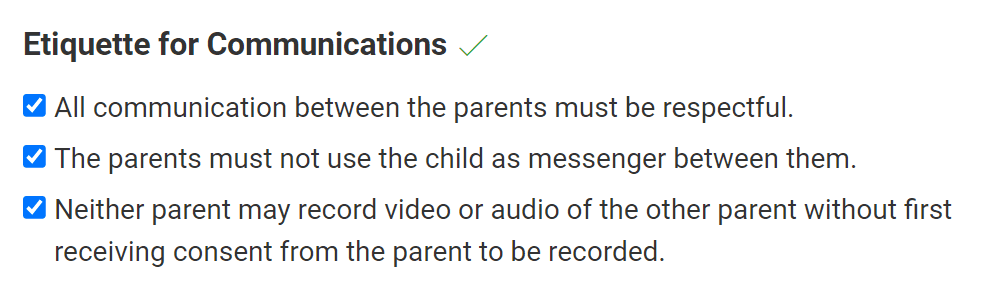 Try this with Custody X Change.
Try to work through disagreements. Communicate the facts as well as your feelings, and listen to your ex. Stay respectful for own sake and your child's sake.
Then, let disagreements go. Once you identify your different opinions, your best option may be to "agree to disagree." Maybe you'll begin to feel it's not such a big deal after all. You don't have to let it disrupt your co-parenting.
Emotions of a man going through divorce
When two people divorce, they'll feel differently simply because they're individuals. Their feelings aren't determined by their gender. Each person feels their own unique combinations of basic human emotions.
You may be reflecting on yourself as a man or on your role as a husband or breadwinner. Notice (or try to imagine) what your ex may feel too.
Love. After putting so much effort into building a home with someone, you may still have feelings for them. That's true even if you were the one who requested the divorce. You may feel ambivalent, meaning pulled in two directions. If you and your ex share a child, you have to learn how to co-parent with someone you still love, while accepting that the marriage is over.
Anger. You may resent your spouse for treating you unfairly, or you may just be angry that life didn't turn out the way you hoped. Consider what your anger is pointing toward. Once you acknowledge it, you can begin to work through it.
Grief. People usually grieve their marriage, even if only because they had high hopes when they entered it. Their grief can be multiplied if they spent many happy years together, if they feel their spouse betrayed them, if they were taught it's "wrong" to divorce, or if they don't know what they'll do next. If they're parents, they have to notice their child's grief, too, to help their child adjust.
Vulnerability. This means letting go of trying to control everything, living wholeheartedly, and letting others see you as you are. Brené Brown, a professor who studies courage and empathy, discusses vulnerability as an important part of emotional life.
Relief. Getting out of a marriage that isn't working is the start of a new chapter in your life. Separating and finalizing a divorce can be immensely relieving.
Men often believe they're supposed to be stoic, but it really helps to share your feelings with someone who gets it or who cares about you.
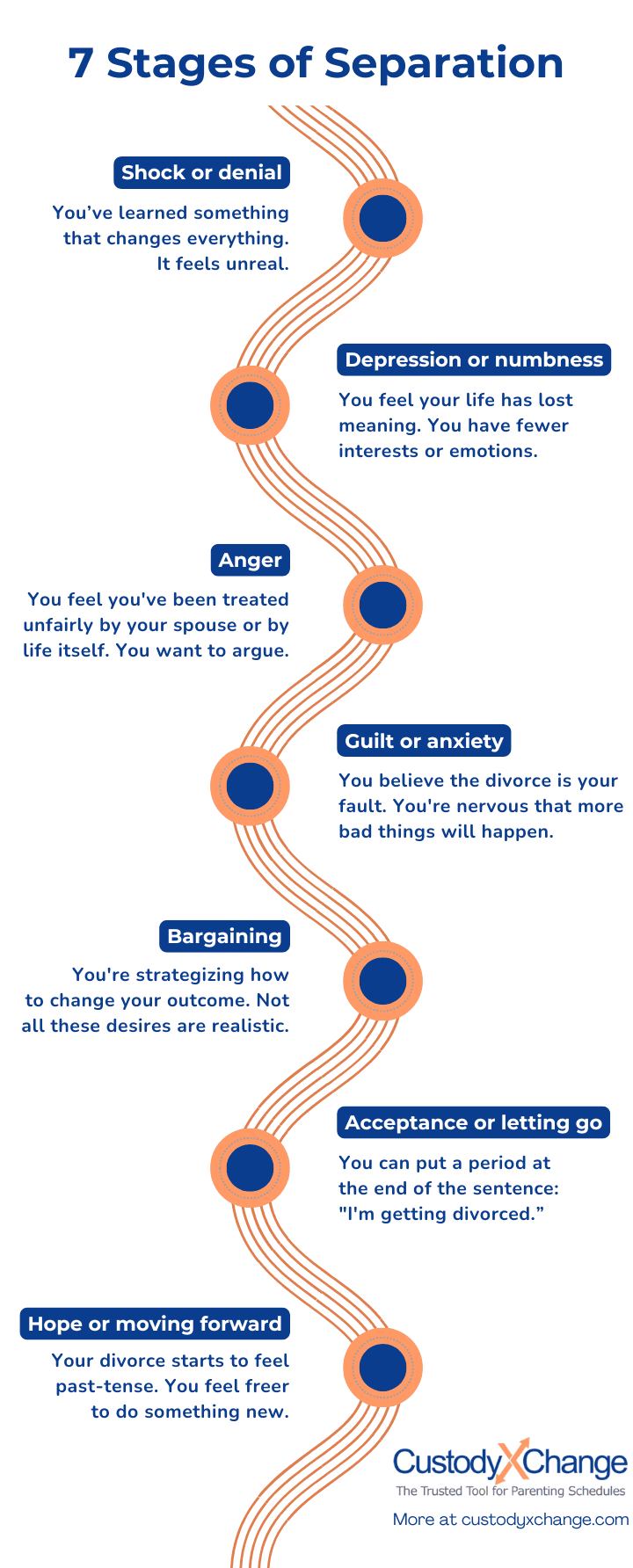
Emotional stages of divorce for a man
The emotional stages of divorce are generally considered the same for men and women.
People do not always move through these stages in this exact order. You may bounce between different emotions.
Practical stages of divorce for a man
While everyone's divorce is unique, there are some common steps in the process.
Stage 1: Processing the split
When it becomes clear that a divorce is imminent, men and women both go through a period of intense emotions. You may feel alone, but remember that divorce is common, as is emotional turbulence.
You may benefit from hiring a psychotherapist or divorce coach who specializes in issues like grief. This not nearly as common for men as it should be; generally, men are about half as likely as women to receive counseling or therapy. Prioritize your well-being, and remember that mental health and coaching professionals are trained to support you, not judge you.
Stage 2: Telling family and friends
At some point, people will find out that your marriage is on the rocks or that it has ended. Anticipate questions. Explain your situation with thoughtful, respectful language, like:
- "We explored our options."
- "We wanted what was best for our child."
- "We're still figuring out what's changing."
If you'd rather not share, you can say "We prefer to keep that private" or "That's my ex's story to tell."
Keep in mind that, in a contested court case, you may need to call upon your friends for a character reference, so their perceptions of you can affect your case.
Stage 3: Preparing for the divorce case
Consult a lawyer. You may decide you don't need one, but a short consultation can still be a huge help. If you can't afford a lawyer at standard rates, reach out to your local legal aid office.
Look into divorce and child custody processes in your area. Knowing what you're getting into helps things go smoothly.
Stage 4: Deciding custody and who gets what
Spouses who negotiate tend to have their divorce settlement agreement approved, as long as it seems reasonable to the judge.
When parents don't have an agreement, U.S. courts give one-third of parenting time to fathers on average. However, there are trends toward shared custody, and sometimes a father gets sole custody. To avoid uncertainty, compromise on a parenting schedule with your ex.
When you negotiate, don't assume you'll be the better negotiator. A study from the University of Pennsylvania found that women perform as well as men in negotiations, though stereotypes say otherwise. Head into mediation prepared so you get a fair settlement.
Stage 5: Co-parenting and paying child support
If you have a child together, this last stage of divorce can span decades. You will continue to parent your children together until they are well into adulthood, which can make this the most difficult stage.
Focus on your child's well-being and on de-escalating tension with your ex.
While child support calculations are gender-neutral, usually the father ends up paying. This is because men earn more than women on average, while mothers often have more parenting time.
If you're having trouble affording child support, let your caseworker know. They may be able to offer a payment plan.
The easiest way for fathers to start co-parenting
Divorce is a big change for both men and women. Parenting in the same house worked a certain way for you, and now you have to learn how to parent apart.
Use technology so it feels less overwhelming:
- Propose a parenting plan
- Receive notifications from your parenting schedule
- Share a calendar of your child's activities
- Message the other parent
- Track your child's expenses
- Keep a parenting journal
The Custody X Change online app lets you do all of this in one place, so you can show up as a great father and do what's best for your child.
Frequently asked questions
How long does it take to move on after divorce?
It will probably take a few years. By five years after divorce, almost 70% of people have seen someone else. The emotional healing also takes two to five years generally. But everyone has a unique timeline.
How do divorced dads stay connected with their kids?
If you're far away, consider moving closer. Stay on good terms with their mother. Plan virtual visitation. Ask them about their friends. Tell them you love them and are proud of them.
How do divorced fathers cope with not seeing their kids enough?
Plan for quality time when you do see them. That doesn't necessarily mean being a "Disneyland dad" who's all about fun and extravagance. It can mean helping them with homework, paying attention to their emotional life and enjoying meaningful conversations.