
Grieving Process for Divorce | 7 Stages of Separation
Grief is a response to a major loss. Most people who divorce feel deep, long-lasting sadness about it. Grief can affect your eating and sleeping, your attitude and your enjoyment in life.
Even if you never find "closure" in your divorce, you can move through these feelings. It's helpful to share your thoughts with close friends and family, and many people benefit from counseling.
Stages of coping with any change (grieving process)
You may have heard that denial, anger, bargaining, depression and acceptance are coping responses. This comes from the "five stages of grief" framework by psychologist Elisabeth Kübler-Ross. She introduced it in 1969 and continued to refine it for many years. These emotions are how people react to big news or trauma.
When you experience one of these powerful and long-lasting emotions, it may seem like more than a feeling. You may intuit that it represents a "stage" in your life.
Regardless of whether they're emotions or stages, they can appear in any order, as Kübler-Ross and other grief experts have explained. Other relevant emotions include shock, numbness, withdrawal, guilt, anxiety and hope.
7 stages of separation
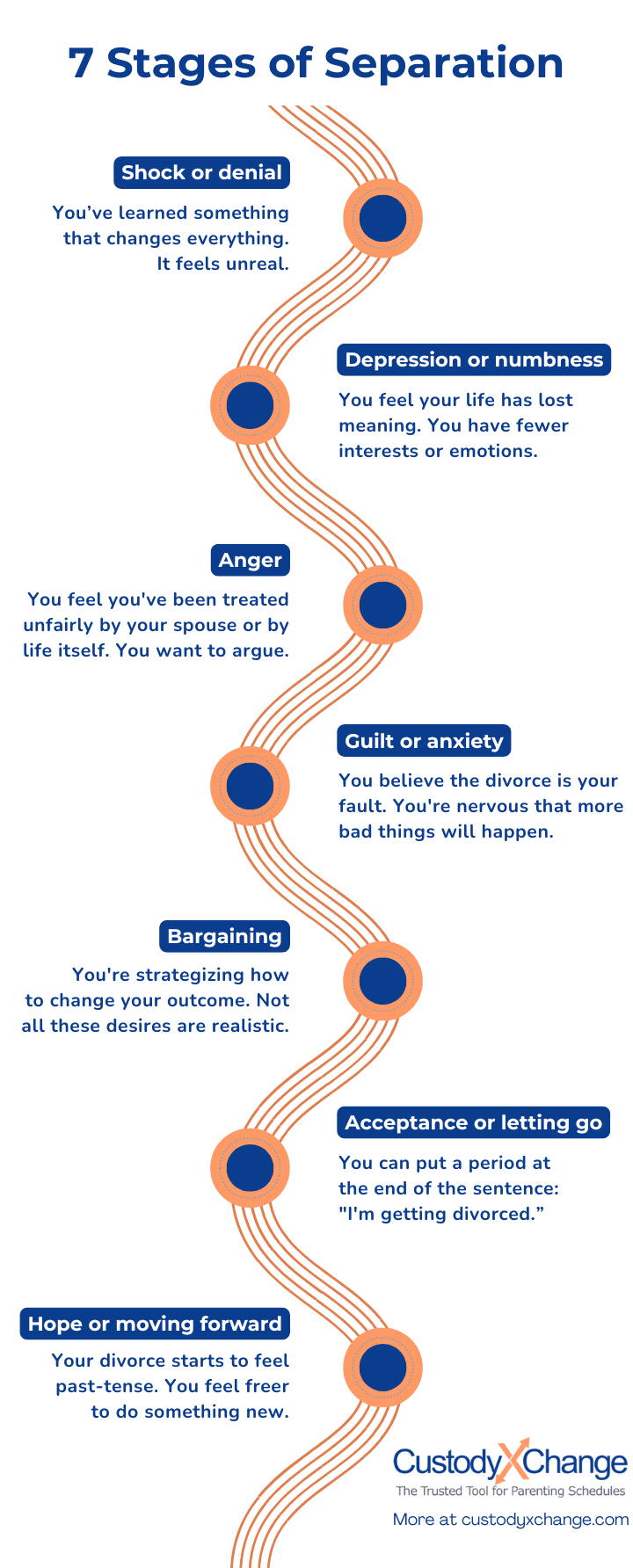
The way you grieve your divorce will be unique to you. Nonetheless, for some guidance, think about these "seven stages of separation." They aren't official categories, but they may help you make sense of your situation.
1. Shock or denial
You're in this stage if: You just learned something that changes everything, and you haven't begun to process it. It may be shock about the divorce itself or about something that makes you want a divorce. You're hurt or embarrassed, and you're trying to convince yourself it isn't real.
How to cope with this stage: Listen to feedback from trusted friends. They can give you a reality check. More, they may clearly see what's about to happen and where it will all end up.
2. Depression or numbness
You're in this stage if: You feel your life has lost meaning. Your body seems to be moving through glue. You want to stay inside or sleep a lot. You don't have as many interests or emotional reactions as you normally do.
How to cope with this stage: It's OK to spend time feeling deep sadness when you've had a major hurt. Many people listen to music or go outdoors to process their feelings. If it goes on too long, however, try spending time with friends or family who inspire you to shift your attention somewhere more positive.
3. Anger
You're in this stage if: You feel you've been treated unfairly, either by your spouse or by life itself. You can list some things someone shouldn't have done. This feels fresh and unresolved, and you want to argue about it.
How to cope with this stage: Some arguments can be constructive. Calling someone out on bad behavior can put a stop to it. However, if you're dwelling on something in the past that can't be fixed, it may be time to shift your focus. Pay attention to other people who are here right now and other activities that make you feel good.
4. Guilt or anxiety
You're in this stage if: You believe the whole divorce, or at least some day-to-day issues, are your fault. You're nervous that more bad things will happen.
How to cope with this stage: Give yourself some grace and forgiveness. Remember that everyone makes mistakes; address them and move on. Also, understand that sometimes a breakup is no one's fault. Believe that you have the strength to make it through.
5. Bargaining
You're in this stage if: You're planning how to get your spouse back, get custody of your kids, or get stuff you're owed. Maybe it's hard to co-parent because you're still in love with your spouse. You're thinking: "If I were a more attractive or successful person, I'd have a better life." This is a kind of wishful thinking.
How to cope with this stage: You might be able to share custody of your kids or win money in court. Those are realistic things to bargain for. For everything else, do a reality check.
6. Acceptance, withdrawal or letting go
You're in this stage if: You can put a period at the end of the sentence: "I'm getting divorced." You can say it without arguing "but…" or breaking down crying. It feels like a fact. You're not checking your phone every hour to see if your spouse has sent you a message.
How to cope with this stage: If you've developed an identity around grieving, you may wonder what to do now. Now that you're in less pain, it's a good time to engage in something that isn't active grieving.
7. Hope or moving forward
You're in this stage if: The sky seems brighter. The air feels lighter. Thinking about your ex or your breakup isn't taking up quite as much mental space. Divorce is starting to feel like it's in the past tense.
How to cope with this stage: Go ahead, believe in yourself and have a little fun. Change something about your daily routine. Chat with new people. Pursue those goals you've been putting off.
How divorce grief may feel in different situations
You won't necessarily recognize grief in your ex. Even if they speak harshly or are difficult to interact with, they may be grieving.
| What they may feel | |
|---|---|
| If they caused the rupture | Regret for what they did. Even if they don't feel regret, they can have tender and complex feelings. |
| If they're an abuse victim | Embarrassed. Victims of physical, emotional or financial abuse can still feel sad about divorce. |
| If they asked for a divorce | Guilt. But they may have a head start on the grieving process. |
| If they're moving on quickly | Eager to get past the pain. Some people prefer to rip off the band-aid. |
You may hear grieving a divorce compared to grieving the death of a loved one. While they have similarities, they are also very different. Because ex-spouses may hold out hope that the relationship may improve, divorce (unlike death) is an ambiguous loss, according to the work of Dr. Pauline Boss. While comparisons to grieving a death may be somewhat helpful, it's best to seek support resources that are specially designed for divorce grief.
Are the stages of divorce different for the initiator?
Not necessarily. The person who initiates divorce is sometimes assumed to "want" the divorce and therefore to feel less grief over the end of the marriage. However, this can be an unfair assumption.
When a marriage goes sour, the spouses may feel devastated. They both had originally intended to stay together happily, but circumstances have changed. They have many wounded feelings. They may conclude that their only real option is to consult a lawyer and file for divorce.
Maybe they find themselves in a high-conflict, toxic or abusive dynamic. Now they have to prioritize the safety and well-being of themselves and their child.
Or maybe they just aren't right for each other. They don't work well together. They wish their marriage could have love, trust, joy and mutual support, but they realize it can't. They aren't happy, and they can't fake it.
They don't exactly want the divorce. Divorce is just their best step forward, and they want what's on the other side of it.
Who initiated the steps toward divorce?
"Who started the divorce?" can be a simple procedural question. Usually, one spouse petitions the family court for a divorce, and the other responds. Some couples try a legal separation before they think about divorce. A lawyer might understand saying "I want a divorce" or moving out as formal steps toward divorce.
However, all of these events to you feel deeply personal. When people reflect on how their divorce started, often they're thinking about the emotions. They're thinking about why they fell out of love or couldn't get along anymore. Their relationship may have ended suddenly due to a major betrayal like an affair. It may have ended gradually because they became inattentive to each other and grew apart.
A divorce can play out in many ways. For example:
- One spouse takes all the steps toward divorce while the other passively waits to see what happens.
- One spouse makes demands, and the other actively resists.
- Each spouse takes turns making small steps toward divorce.
- The spouses keep changing their minds, taking a few steps forward, then a few steps back.
Each couple's divorce story of "who started it?" is a mix of how they each felt and how they treated each other.
How children grieve divorce and how to help them
It's common for a child to believe that the divorce is somehow their fault and to try to get their parents back together. Children going through a divorce can experience denial, anger, bargaining and depression, but they too can reach acceptance.
Several ways to help your child:
- Assure your child that the divorce isn't their fault and that you'll always love and support them.
- Allow them to express their feelings.
- Maintain parent–child relationships. Children benefit from ongoing contact with both parents.
- Tell the truth, but you don't have to tell it all. Give age-appropriate information.
- If you're in a new relationship, set boundaries to avoid upsetting or confusing your child.
- Minimize conflict with your ex, at least within earshot of your child. A 2024 Custody X Change survey found that parents who get along well after divorce are more likely to say their children adjust well.
- Don't put the child in the middle by asking them to pass messages between you and your ex. That's awkward and stressful for them.
- If your child is struggling, they may benefit from counseling.
How to get over divorce
How someone gets over divorce depends in part on their personality. They might prefer solitude or the companionship of friends. They might prefer to dwell on the hurt or try to keep their mind off it.
Every person is unique, and so is every relationship and breakup. When a person marries and divorces, they have a healing process. Should they marry and divorce again, their healing process could be entirely different.
Tips for getting over a divorce:
- Prioritize your safety. Find somewhere appropriate to live. Ask for the help you need.
- Honor your feelings. You're allowed to feel them, and you don't have to justify them to anyone.
- Make a list of the people in your support system and their contact info. This can be useful in an emergency or whenever you're feeling alone.
- Be aware of anyone you might be better off not talking to anymore, e.g., your ex's friends.
- Try taking up a new hobby that brings you joy.
- Plan for how you can become financially independent from your ex. (The two of you will still be responsible for child support.)
- Write down your personal commitments, e.g., self-care, boundaries and life goals. This can help you stick to your resolutions.
- Find a psychotherapist you trust and can relate to.
Getting over a divorce doesn't mean that you never think about it anymore or that you never feel sad. Your wedding anniversary, for example, may always feel awkward. Days like this "would have been milestones," as certified grief support specialist Rebecca Feinglos puts it. You have a former anniversary or a would-have-been anniversary. Recognizing this is a way of accepting your divorce. Feinglos says it's OK to observe the day by looking at old photos or reflecting on how you've changed.
Keep in mind that your child can't help you through this loss, and it's unfair to burden them with that request. Instead, try to help your child through the loss they're experiencing.
How long does it take to get over divorce?
It's normal for the process to take years, though some people feel better sooner than that.
"Getting over" a divorce tends to mean focusing less on the past and more on the future. It's a series of mental shifts. These shifts can happen at any time.
Grieving doesn't always coincide with the legal steps of divorce. By the time the court finalizes a divorce, one person may find they have no more tears to shed, while another is only beginning to grieve.
The length of your recovery depends in large part on:
- The length of your marriage
- Whether you felt betrayed or were fighting a lot
- Making enough money and finding a stable place to live
- Adjusting to new daily routines, including a co-parenting schedule
- Surrounding yourself with people who understand your situation and support your choices
- Taking time for self-care, relaxation and fun
- Forgiving yourself or your ex (if appropriate)
- Adapting to how you'll interact with your ex as your child's other parent
- Starting to date (if you want to), falling in love again (if it happens) or living with a new partner
You may have had a big network of friends and family while you were married, but when you split up, those people will likely feel the need to take sides. Typically, each spouse stays friends with the people they knew from before the marriage, but some old friends may switch sides. This can take a long time to play out, and it affects how long it takes you to get over divorce.
The tools you need to co-parent well
It takes a while to accept the end of your marriage. Meanwhile, use tools to bring clarity to your situation:
- Draft a parenting plan
- Draft parenting time schedules
- Keep a calendar of your child's activities
- Exchange messages with the other parent
- Log your parenting expenses
- Write in a parenting journal
The Custody X Change online app lets you do all this in one place. Addressing your co-parenting is a big part of moving forward.
Frequently asked questions
What is the short-term aftermath stage?
It's the stress a child experiences once the reality of their parents' separation has settled in for them but before they've fully adjusted to it. This stage usually lasts a few months but could be a couple years. The term appears in psychology professor Neil Kalter's 1990 book Growing Up with Divorce.
What is the hardest phase of divorce?
Continuing to live together in the same home after you've expressed a desire to move out can be awkward and tense. After separation, some parents find it's hard to reassure an anxious child or get used to transporting them between households. Lowering the temperature of arguments can help a lot.
Does the grieving process differ for men and women?
No, not necessarily. Grief is unique to each person and isn't determined by their gender. However, spouses who divorce cease to be and to have a husband or wife, and they may have thoughts about those gendered statuses. Gender can also factor into parenting roles and incomes, which can affect how people move on.