
Clean Break Orders: Advantages and Disadvantages
Divorcing spouses in the U.K. receive a financial order from the court. Some orders permanently dissolve all your financial ties, with the exception of child maintenance, giving you a "clean break". Others assign you ongoing financial responsibilities to each other or at least allow you to return to court in the future.
Clean break orders aren't right for everyone, so consider what the advantages and disadvantages might be for you.
What is a clean break order?
A clean break order in the U.K. says that the ex-spouses don't have any more financial obligations to each other, apart from parenting. A judge may order a clean break when neither spouse needs ongoing financial support from the other.
With a clean break order, you won't pay or receive spousal maintenance, and you'll disentangle from any family business you may have run together.
A clean break also specifies that ex-spouses can't come after each other for additional money in the future. For example, your ex won't be able to claim part of the earnings if you sell a property after the divorce. Because a clean break order limits your right to seek legal remedy, a judge might not order it unless you both consent to it.
Child maintenance will be addressed separately, likely by the Child Maintenance Service; just because your order says "clean break" doesn't mean you won't pay or receive child maintenance.
Once you receive a clean break order, it's difficult or impossible to change it. It's meant to be permanent.
Advantages and disadvantages of a clean break order
| Advantages | Disadvantages |
|---|---|
| It stops your ex from coming after your money later. | You won't be able to turn to your ex for money later. |
| It can help you both begin with a clean slate financially. | A solicitor may charge you a lot to discuss and draw up your document. |
| It can help you both move on psychologically. | |
| It's usually done by agreement, not litigation. |
A clean break order can give you peace of mind that the financial aspects of your divorce are truly over. This is especially important in the U.K, where there's no limit how long after divorce ex-spouses can file financial claims.
However, one disadvantage of a clean break order is that you won't be able to turn to your ex for money if your financial need increases someday. Additionally, preparing the agreement may be expensive. You'll probably have to hire a solicitor to do this (after all, the judge will review the document).
Who benefits and who loses out?
Generally, this arrangement benefits the wealthier spouse and disadvantages their ex who might wish to seek their money. That disadvantage is more profound if the ex needs the money (for example, due to illness or disability) or believes they're owed it (for example, because they shared a family business). In short, the spouse with more assets is usually the one who wants a clean break order.
How to get a clean break order
- Consider alternative dispute resolution methods, like mediation and arbitration, for guidance in negotiating.
- Write up your agreement for the court, or have your mediator or solicitor do so.
- The court will review your agreement to ensure it's fair and written in a way that the court can enforce.
- You'll receive an order if the court approves it. It's called a consent order because you both agreed to it.
Judges tend to like clean break orders because they prevent later drama. It's most likely you'll get a clean break order if your marriage was short or if you have no assets or property (like a pension or a house) to divide. Typically, if you're dividing assets as part of your divorce and you want to make it a clean break, the two of you will need to reach agreement about the clean break.
How to get a clean break order after divorce
People who are already divorced can return to court to ask for a clean break order. Send a financial order application to your local financial remedy court.
If the court previously ordered ongoing spousal maintenance payments, the ex-spouses may need to resolve this obligation through a lump sum payment.
If your ex won't sign a clean break order
If your ex is concerned that a clean break will short them, negotiating in mediation may help both of you feel more secure that you're getting a fair outcome.
If your ex still won't agree to a clean break order, you can ask the court for one without their agreement. Speak to a solicitor.
You can also find other healthy ways to communicate that the marriage is really over, like setting co-parenting boundaries.
Do I have to complete a D81 form?
Yes, you have to submit a D81 form for any consent order. It's called Statement of Information for a Consent Order. It summarises and discloses your financial circumstances. This is what you fill out when you've reached agreement with your ex.
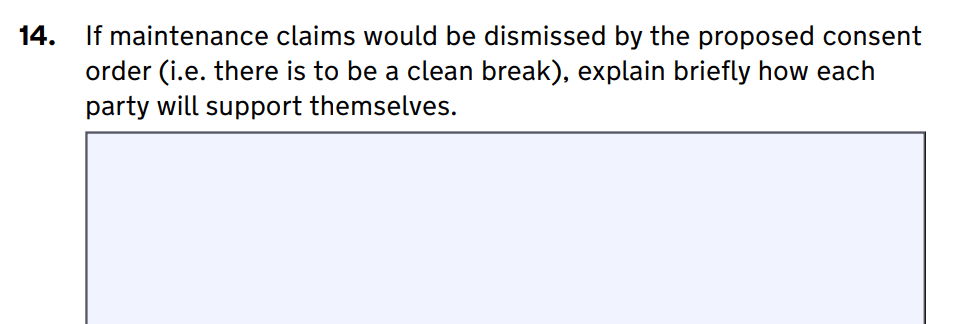
If you haven't yet reached agreement, you have to fill out a longer disclosure form, called Form E.
Clean break orders and child maintenance
Concerns about child maintenance must be addressed separately. Sometimes a court allows a parent to pay child maintenance as a lump sum payment instead of ongoing small payments. Psychologically, this may help the parents feel they've completely separated financially from each other. However, whenever child maintenance is concerned, it's not officially called a clean break and it's separate from what's in a clean break consent order.
Getting an accurate calculation of child maintenance
As a parent, even if you're cutting financial ties with your spouse, you may still have to pay child maintenance.
Estimating your parenting time can impact your child maintenance payment by thousands of pounds a year. The government's formulas allows a parent to cut their maintenance payment by more than half depending on how many nights per year they host their child.
The Custody X Change app lets you quickly calculate your exact number of overnights.
Try this with Custody X Change.
With Custody X Change, you can tweak your residence and contact schedule to see how even little changes affect your number of nights with the child. Plus, you can see how the number changes each year due to special occasion.
Whether you're paying or receiving child maintenance, make sure your parenting time calculation is exact. The number will affect you, your child and the other parent for years to come.
Frequently asked questions
When should I seek a financial order?
Most people apply for a financial order between the time they receive their conditional order (decree nisi) and their final order (decree absolute), as the U.K. government explains. The process may take several months.
Should I get a clean break before I remarry?
If you or your new partner are worried that your ex might seek money from you, then yes. You may want to consult a solicitor if you have specific financial concerns.
As a parent, can I seek a financial clean break from my child's other parent?
Yes, except that you can't avoid child maintenance, which the court will address. Think about how your child might be affected by any financial arrangement.
If I agree to make a lump sum payment, isn't that like "paying off" my ex-spouse or "buying them out"?
Yes, it could be viewed that way. Some people may find this upsetting, but if you consider that you're settling a lawsuit or preventing future lawsuits, such a "buyout" may be the most practical solution.