
Child Support in Puerto Rico
Child support evens out the financial responsibility parents have to their children. When a child mostly lives with one parent, the other parent pays child support. If parents share custody 50/50, the parent who would owe more child support pays.
The obligor (or alimentante) is the parent who pays support. The obligee (or alimentista) is the child for whom support is paid.
Child support guidelines
Puerto Rico's guidelines explain the details of calculating child support. You can get the child support guidelines in English and in Spanish.
Applying for child support
You can apply for support when you open a case for divorce or custody.
Or, if you apply for support on its own, you can do it anytime. You may go through court or the Administración para el Sustento de Menores (ASUME).
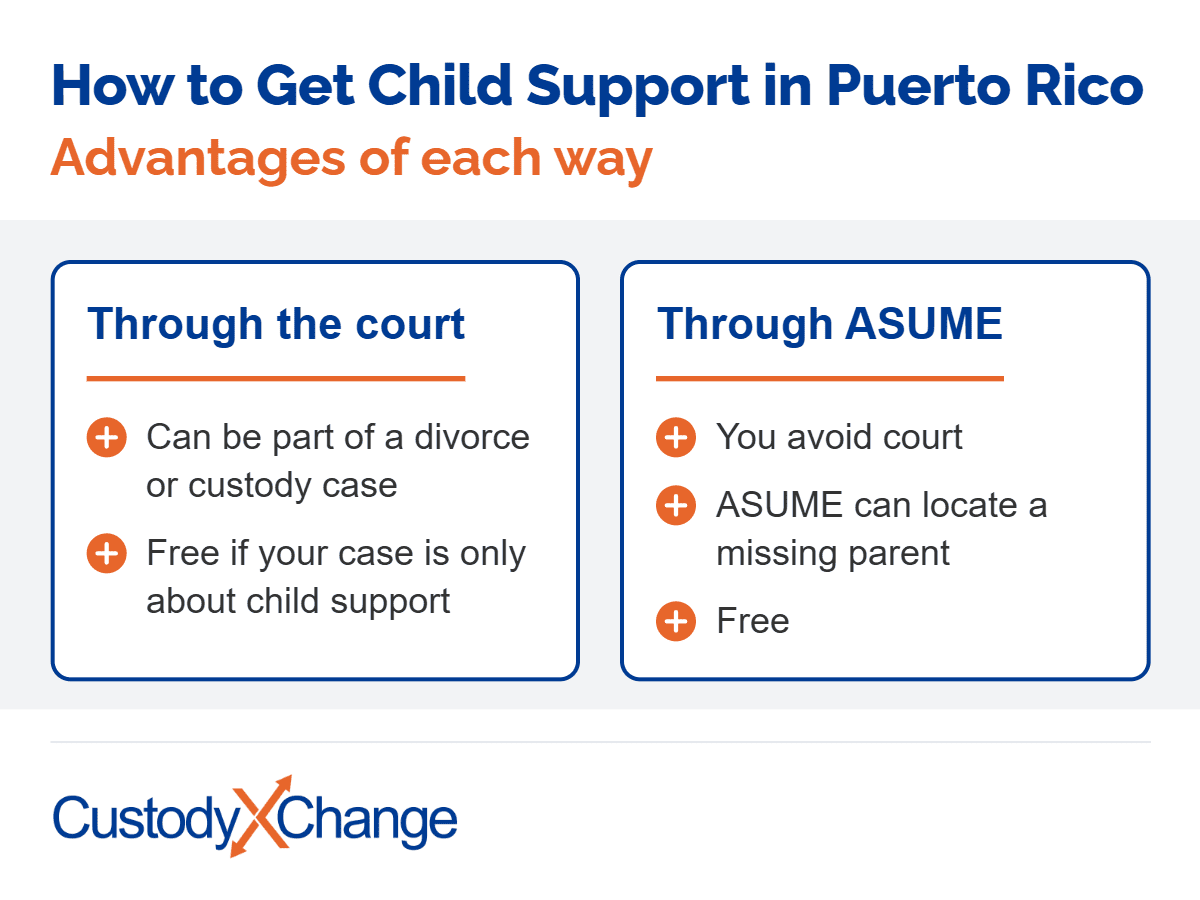
Filing through court
The court offers child support forms online.
- If you disagree on child support, fill out a support petition - OAT 1424 (Petición de Alimentos). When you file it, the clerk will give you a summons with the support hearing date. You must serve a copy of your petition and the summons to the other parent at least five days before the hearing.
- If you agree on child support, fill out a support petition by agreement - OAT 1428 (Petición de Alimentos por Estipulación).
If the amount you agree to differs from the amount calculated using the guidelines, it's up to a judge to decide whether to approve it.
You'll also need to provide:
- Personal and Financial Information Form - OAT 435 (Planilla de Información Personal y Económica)
- Copy of each child's birth certificate
- Obligor's address or information to help locate them
- Valid photo ID
When you file forms with the court, bring the original and two copies.
Filing through ASUME
Fill out a Request of Services for Child Support (Solicitud de Servicios 2025), available among ASUME's forms.
ASUME will need:
- Copies of the birth certificates of the custodial parent and each child
- Copies of the Social Security cards of the custodial parent and each child
- Marriage certificate (if you were married)
- Certified copies of any divorce or support judgments
- Proof of health insurance
- Photo of the person you're asking to pay support (if you don't know where they are)
The application allows you to request:
- A support order
- Paternity establishment
- Help locating a parent
- A modification of a current support order
- Child support enforcement
- A lawyer for your child
Even if you filed with the court, you can ask ASUME to enforce and collect support for you.
Filing as an adult child
If there isn't already a support order, an adult child who is at least 21 can apply for support. They must have enrolled in college or vocational school before that age and still be studying.
They'd fill out a Petition for Child Support by an Adult Child - OAT 1425 (Solicitud de Alimentos por Hijo(a) Mayor de Edad) and file it with the court. The court will consider their academic success and financial need, among other things.
If the court grants support, it continues until they turn 25 or earn their degree, whichever comes first.
Calculating child support
Support is based on:
- The obligor's number of dependents under 21, including ones they have with someone else
- The children's ages
- The obligor's net monthly income (gross income minus taxes and deductions)
- Their percentage of parenting time (Calculate yours with Custody X Change.)
Follow the steps below to calculate your guideline support amount.
Step 1: Calculate net reserve income
Multiply the obligor's net monthly income by the percentage in the table for their number of dependents. The result is their income reserve, which is set aside for the obligor’s own living expenses. (If the result is less than $615, the income reserve is $615.)
| Obligor's net income | 1 Dependent | 2 Dependents | 3+ Dependents |
|---|---|---|---|
| $0–$1,666 | 57.5% | 48.8% | 33.7% |
| $1,667–$3,333 | 55.5% | 48.6% | 39.1% |
| $3,334+ | 53.4% | 48.4% | 44.4% |
Deduct the income reserve from their net monthly income to get the net reserve income.
Step 2: Find the basic support obligation
Next, use the longer table of basic support amounts included in the guidelines.
At the top of the table, find the number of dependents. Below that cell, find the first child's age range. Follow that column down until it intersects with the row for the obligor's net monthly income (the amount before you took out the reserve).
Multiply the percentage you land on by the obligor's net reserve income (what you calculated in step 1). The product is the basic child support amount.
If you have more than one child, you'll need to do this for each of them, then add the results together.
| 1 Dependent | 2 Dependents | 3+ Dependents | |||||||
|---|---|---|---|---|---|---|---|---|---|
| Range of net income | 0-4 | 5-12 | 13+ | 0-4 | 5-12 | 13+ | 0-4 | 5-12 | 13+ |
| $0–$832 | 39.0% | 54.8% | 58.8% | 27.3% | 36.2% | 38.5% | 15.6% | 17.5% | 18.1% |
| $833–$1,666 | 37.0% | 51.9% | 55.6% | 26.0% | 34.3% | 36.5% | 15.0% | 16.7% | 17.3% |
| $1,667–$2,499 | 35.0% | 49.0% | 52.5% | 24.6% | 32.5% | 34.5% | 14.3% | 16.0% | 16.6% |
| $2,500–$3,332 | 33.0% | 46.1% | 49.3% | 23.3% | 30.7% | 32.6% | 13.7% | 15.3% | 15.8% |
Step 3: Figure out the parenting time adjustment
Obligors who have 20% to 49% of parenting time qualify for an adjustment. The court must have ordered the parenting time or approved an agreement for parenting time.
To find the obligor's percentage, add up all the hours they have in your visitation plan and divide it by 8,760 (the number of hours in a year).
Custody X Change has a quicker, easier way to calculate parenting time. Plug your visitation plan into the custody calendar, and let it do the math for you.
Subtract the parenting time percentage from 1. Multiply this number by the basic support amount to get the adjusted support amount.
Example: A parent with 20% of parenting time would pay 80% of their basic support amount (1–.20 = .80). If their basic support amount is $825, their adjusted support amount is $660 (825 X .80).
Step 4: Add supplementary costs
Supplementary child support covers child care, medical expenses, education and more.
Both parents are expected to contribute. Do the following to find out how much each parent should cover:
- Add parents' net incomes together to find the combined net income.
- Divide each parent's individual net income by the combined net income. The result is their percentage of the combined income.
- Add up all supplementary expenses.
- Multiply the sum by each parent's percentage of the combined income.
Add the obligor's share to their support amount. Keep track of your expenses to ensure everyone's paying what they owe.
Step 5: Calculate shared custody adjustment
If parents share custody 50/50 as ordered by a court, follow steps 1 and 2 for each of their net incomes. (Add supplementary costs later.)
If each parent would owe the same amount of support, neither pays basic support. They still share supplementary costs.
If one parent would owe more than the other, that parent pays support. Subtract the lower support amount from the higher, then divide that amount by two. This is their support payment.
Paying and receiving child support
Obligors can make support payments through wage withholding. This means their employer takes support out of their pay and sends it to ASUME. ASUME then passes it on to the other parent.
Parents who aren't on public assistance can agree to receive support directly from the obligor.
The parent receiving support can get the payments through direct deposit or a ÚNICA debit card.
Enforcing child support
When an obligor misses payments, it's time to ask for support enforcement.
If you have a case with ASUME, ask them to collect the debt.
If the court made your order, file a motion to enforce the support order.
Changing child support
Parents can ask for a child support review every three years.
For an earlier review, there has to be a substantial change in circumstances. Substantial changes include:
- The obligor involuntarily loses their job.
- The obligor's share of parenting time drops below 20%.
- The child requires more support for their care.
If you have a case with ASUME, request a child support review and modification using ASUME's forms.
If the court made your order, fill out and file a Motion for Child Support Review - OAT 1420 (Moción sobre Revisión de Alimentos) and Personal and Financial Information Form - OAT 435.
Getting an accurate child support order
In Puerto Rico, obligors who have at least 20% of parenting time pay a reduced child support amount.
Estimating your parenting time, rather than calculating it exactly, can impact your child support order by thousands of dollars a year.
The Custody X Change app lets you quickly calculate your time with your child.
Try this with Custody X Change.
Whether you're paying or receiving child support, use Custody X Change to make sure your calculation is exact. The number will affect you, your child and the other parent for years to come.
Frequently asked questions
Can I apply for child support in Puerto Rico if the noncustodial parent lives on the US mainland?
Yes. You'd fill out the same support forms. The court or ASUME will notify them of the date of the support hearing, where a judge or child support examiner will set the amount. They can attend virtually if they can't make it in person.
Can I just stop paying child support once my child turns 21?
No, you have to formally ask the court or ASUME to stop payment. If you missed payments, you have to pay them regardless of your child's age.
Will I have to pay support if I don't have income?
Most likely. The court or ASUME will estimate how much money you could make based on your education, job history and other factors. That estimated income goes into the support formula. If you can't pay the calculated amount, you may be allowed to pay a different amount. The judge or ASUME must find good cause to order an amount lower than minimum child support. (Article 20 of the child support guidelines lists the minimum amounts.)