
Starting a Case for Child Custody in North Dakota
Starting a case is the first step towards getting a court order for residential responsibility (custody) and parenting time (visitation). If you have an attorney, they will start your case for you.
Before you start: Make sure you qualify to file
The child must have lived in North Dakota for six months — or since birth if they're less than six months old. If you have recently moved to North Dakota, have an order from another state or need emergency custody, consult with an attorney before filing.
If you want a divorce, you or your spouse must live in North Dakota for at least six months before the judge signs the final judgment.
Step 1: Fill out your forms
There are family law forms available online. Though these are not official court forms, judges usually accept them from parents without attorneys.
If you prefer, you can have an attorney create your documents from scratch. If that's all you want them to do, find an attorney who offers limited legal services.
For any case, you will need a:
- Summons
- Complaint for your case type (more below)
- Confidential Information Form
If you agree on custody arrangements, create a parenting plan to file with your forms. If you don't agree, you'll each file a proposed parenting plan later in your case.
Make two copies of the summons and complaint. Keep one copy of each for yourself. You'll serve the other copies to the defendant.
Make one copy of the Confidential Information Form to keep for your records.
You'll file your original forms with the clerk of court later.
Divorce
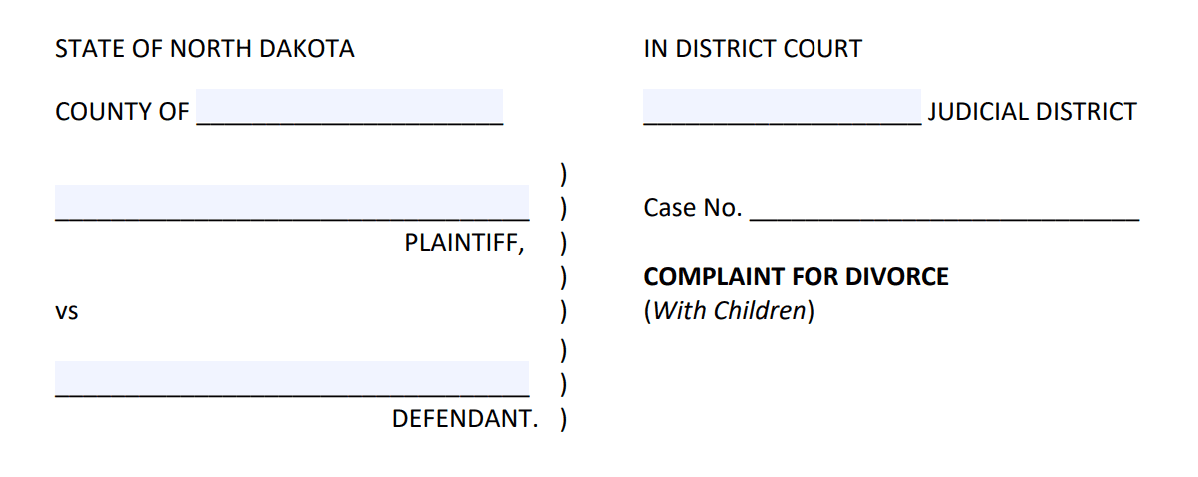
In addition to the forms for all case types, fill out a complaint for your situation:
- Starting a divorce on your own (if you haven't reached an agreement)
- Starting a divorce with your spouse (if you agree on all aspects)
Parenting responsibilities
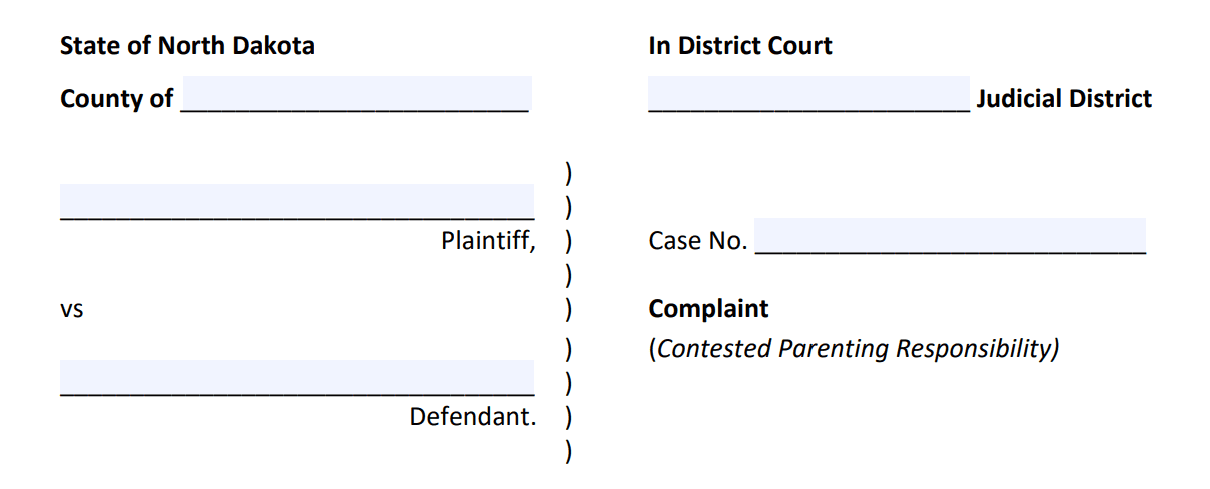
In addition to the forms for all case types, fill out a complaint for your situation:
- Starting a case for parenting responsibilities on your own (if you haven't reached an agreement)
- Starting a case for parenting responsibilities together (if you agree on custody)
Step 2: Serve the defendant
A defendant becomes aware of the case through service. Your case begins once the defendant is served.
You can find service forms and instructions online.
If you have not reached an agreement
Serve the defendant with:
- Summons
- Complaint
Do not give them a copy of the Confidential Information Form.
You'll need to provide proof of service to the court, along with the original summons and complaint.
The defendant has 21 days after receiving service to serve you with an Answer and Counterclaim. If they don't, you can motion for a default divorce judgment or motion for a default custody judgment.
Continue to Step 3.
If you have reached an agreement
The defendant needs to receive copies of the:
- Summons
- Complaint
- Settlement Agreement
- Confidential Property and Debt Listing (if this is a divorce)
- Parenting Plan
- Confidential Information Form
- Affidavit of Proof
- Proposed Findings
- Proposed Judgment
You do not need to follow formal service procedures; you can just give them the forms. Then they'll need to sign an Admission of Service. Skip to Step 4.
Step 3: Prepare informational statement
Skip this step if you have an agreement or the defendant doesn't respond within 21 days after service of the summons and complaint.
Within 30 days after service, parents should prepare and file a joint informational statement.
It details what you want the court to decide and how much time you think you'll need in court. If you can't agree on its contents, you should each prepare your own.
If you're unsure how to complete the informational statement, the court can hold a scheduling conference instead to iron out the same details.
Step 4: File your forms and proof of service with the court
File your forms in the district court in the county where the child lives. You'll need to pay filing fees unless you qualify for a fee waiver.
If you have not reached an agreement
Give these original forms to the court clerk:
- Summons
- Complaint
- Declaration of Service
- Motion for default judgment (if applicable)
- Informational statement
You can file the Confidential Information Statement at any point in your case.
If you have reached an agreement
Give these original forms to the court:
- Summons
- Complaint
- Confidential Property and Debt Listing (if applicable)
- Parenting Plan
- Confidential Information Form
- Admission of Service
- Affidavit of Proof
- Proposed Findings
- Proposed Judgment
If you filed an agreement, the judge will review your forms. You likely won't need to appear in court and will receive a copy of your final custody order or divorce judgment in the mail.
Step 5: Notify the defendant you've filed
Serve the defendant with a Notice of Filing. It informs the defendant of the case number and tells them the summons and complaint were filed.
After receiving the notice, the defendant must file their Answer and Counterclaim with the court.
Optional: Request temporary orders and custody experts
After filing, parents can make motions to request things, like:
Preparing for what's next
For many parents, the next step is mediation. You'll get six free hours of mediation.
Regardless of where your case takes you, custody software helps you prepare.
The Custody X Change online app offers a parenting plan template, custom custody calendars, parent-to-parent messaging, an expense tracker and more. You can use it to put together proposals for the other parent, prepare settlement paperwork or organize evidence.
Be prepared for your hearing and every step of your case with Custody X Change.
Resources
We'd like to thank Attorney Darcie Einarson, Attorney Kristin Binder and Attorney Misty Nehring for their help.
For more help, you can turn to:
- North Dakota Century Code Chapter 14-09 (Parent and Child)
- North Dakota Rules of Court (Chapter 8)
- North Dakota Rules of Civil Procedure
- North Dakota Rules of Evidence
- North Dakota Legal Self-Help Center
- Legal Services of North Dakota
Frequently asked questions
What happens if mediation is unsuccessful?
You'll have a scheduling conference within 30 days of filing. Here, the judge will determine the next steps for your case and set deadlines for discovery.
What's the most common mistake people make when filing?
Unrepresented parents often fail to completely fill out forms. The court can make them redo the forms. Another common mistake is not properly serving the defendant. Both will make the court process take longer — you might even have to start over.