
Harman Undertaking & Duty of Disclosure in Family Law
During your divorce or parenting case in Australia, your ex may formally disclose information to you. You must keep what you learn within the court process. It's for you, your lawyer and the judge to know, and no one else.
Your responsibility to share information with each other is the duty of disclosure, and your responsibility to properly handle the information you receive is the Harman undertaking.
List of disclosure documents in family law
Sharing documents enables you both to work off the same set of information.
Financial matters
For financial disclosure in family law, you'll need to provide wide-ranging information. It may include:
- Investment details (e.g., retirement account statements)
- Debt information (e.g., credit card statements)
- Information about your house and car
- The last three years of tax returns
- Payslips
- Bank statements
You're expected to make a "full and frank" disclosure, meaning you can't hold back details nor disguise their meaning. You must provide it "in a timely manner" for anything that's relevant, as stated in the Family Law Act. Legal practitioners are required to explain this to you.
Parenting matters
In parenting matters, you'll need to provide at least:
- Your child's school and medical records
- Any record of domestic abuse or criminal convictions
As parents gather information to support their case, many realize they prefer not to go through an adversarial court process. Instead, they write a parenting plan together.
Rule 6.06 in family law rules (financial disclosure)
Family court rules govern the disclosure process. They describe in detail the types of financial information you must disclose.
Most of Australia uses Rule 6.06 of the Federal Circuit and Family Court of Australia (Family Law) Rules 2021.
Western Australia has its own court system, and its disclosure rules are in Part 13 of the Family Court Rules 2021.
Failure to provide financial disclosure
If the court catches someone withholding information, it can penalise them. For example, it could restrict them from using certain evidence. Inform the court if you believe your ex isn't sharing everything required.
Even if the court issued a final order before becoming aware of a failure to disclose, the court can take action. It may decide to vary the order or even set it aside.
Understanding the Harman undertaking
The Harman undertaking is your implied promise not to use information from the case for unrelated purposes. It also prohibits you from sharing the information with people who don't need it for the case.
In other words, information either of you gets through discovery, subpoenas or personal affidavits is only for use in your court case.
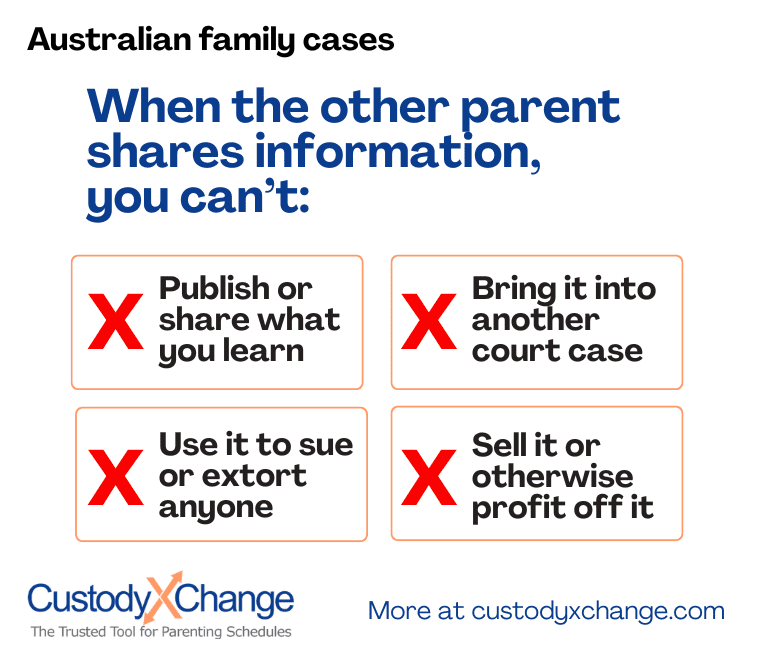
For example, if a neighbor writes a character reference letter for your ex and you get access to it through the disclosure process, you can't post it to social media. As another example, if you hear through the court process that your ex is in prison, you can't give that story to a journalist.
An exception is if the information is already public (e.g., it was read in open court). In that situation, you can't keep it secret anyway, so you don't have to.
The importance of the Harman undertaking
Complying with the Harman undertaking is essential because the court can hold you in contempt if you don't follow the rules.
Beyond this, the Harman undertaking is important for protecting confidentiality. Without confidentiality, people may not be forthcoming in their court cases.
Getting the court's permission to share information
Only with the court's permission can you use disclosed information elsewhere. To ask for permission, file a Harman application. Keep in mind:
- Informal agreements between you and the other parent don't substitute for the court's permission.
- Either of you may seek the court's permission alone, or you can submit a joint request.
- The permission must come from the court that originally required the disclosure.
Staying organised throughout court proceedings
Family court hearings require serious organisation.
You may want to present the judge with a parenting journal, messages exchanged with the other parent, a tally of parenting expenses, and more.
The Custody X Change app lets you create and manage all of this in one place. It helps you prepare for every step of your case.
Perhaps most importantly, Custody X Change helps you create parenting plans and parenting calendars. If you agree on these with your co-parent, you can forgo court entirely.
Take advantage of custody technology to get what's best for your child.
Frequently asked questions
What happens if one of us doesn't disclose information by the court's deadline?
The court may forbid you from using the document at trial. You could also be fined or held in contempt of court. The noncompliance may delay your case.
What do I do if my ex's lawyer demands that I disclose information?
If their lawyer makes a request that you disagree with or don't understand, you may want to hire your own lawyer. The request (or threat) may or may not be relevant or enforceable.
What if I suspect my ex has secret bank accounts?
You could hire a forensic accountant: someone who specialises in looking for fraud and hidden money. However, if you're trying to reduce conflict, try to talk it out with your ex. You may benefit from an alternative dispute resolution method.
If information was shared improperly, what should I do?
Consult a lawyer about how to report a violation or defend yourself against such an allegation. Improper sharing of information is called a breach of the Harman undertaking.