
Child Maintenance in Ireland (Child Support)
Parents must support their children financially. When they split up, this usually means one pays child maintenance to the other.
Paying maintenance does not automatically give you guardianship, custody or access to your child. Those issues can be decided separately or at the same time as maintenance.
Calculating child maintenance
Ireland introduced child maintenance guidelines and an official calculator in 2026. Both are voluntary, meant to guide courts and help parents agree on an amount.
Generally, the parent who has less parenting time is the payer. If parents spend equal time with the child and have equal incomes, maintenance may not be necessary.
The formula in the guidelines considers these factors.
Income
Each parent starts with their gross income from all sources, such as wages, bonuses, overtime, social welfare payments and rental income. Leave out only the One-Parent Family Payment and Supplementary Welfare Allowance.
Each parent then keeps a self-support amount of about €18,000 a year, based on the current at-risk-of-poverty threshold. What's left of each income is added together, and each parent's share of that total is their share of the children's costs.
If either parent has other dependent children living with them, the formula reduces that parent's income before working out the shares.
Number and ages of children
The "Cost of Children" table estimates what the children cost as a share of the parents' combined income. The share is higher for more children and for children 12 or older, and it also varies with how much the parents earn together. Families with more than three children are treated like families with three, based on the three oldest.
Parenting time
Parenting time is counted in overnights per year. If both parents agree overnight stays aren't possible, each day with more than eight hours of parenting time can count instead.
The formula assumes that a parent who has the kids for at least 14% of overnights covers part of their costs directly. That part grows as their time increases. (See the "care and cost" table in the guidelines.)
If the amount they should spend on the children is bigger than what they cover through parenting time, they pay the difference as maintenance. A parent with 60% or more of the parenting time doesn't pay child maintenance at all.
To calculate your overnights instantly, taking holidays and special events into account, use the Custody X Change parenting time calculator.
Minimum amounts
The parent with less parenting time usually pays at least a minimum amount, even if they earn less than the other parent. The minimums change periodically, so check the current guidelines. The minimum is higher when the parent has less than 14% of overnights (about a night a week), unless their income is very low. It also goes up with the number of children.
What the formula doesn't cover
Significant costs for disability, medical care, child care and education aren't included. Parents typically share these equally or agree on another split.
The guidelines say they may not be appropriate for families where one parent has significant assets, like property. And they don't apply when parents have an extremely high joint income — the cutoff changes periodically but is around €290,000 a year.
Setting up child maintenance
You can set up child maintenance in three ways.
By court order
You may go to court just for a maintenance order, or you may ask the court to decide maintenance as part of a case about custody or divorce.
You'll have to attend a hearing. Bring documents that prove the details of your financial situation.
By legal agreement
You might write up a legal agreement, such as a parenting plan, or have a mediator or solicitor write it for you. If you're struggling to agree, a mediator or solicitors can help you negotiate.
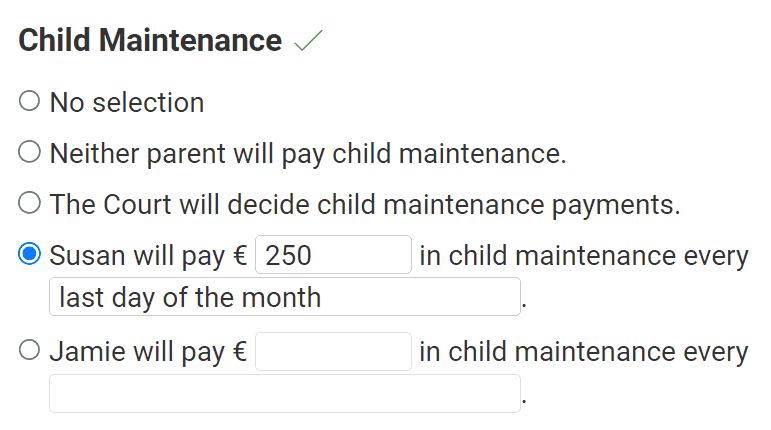
There aren't many rules for maintenance agreements. For instance, they can involve monthly or weekly payments, a lump sum payment and splitting of child-related costs. However, they cannot prohibit either parent from applying for a maintenance order in the future.
If you want your agreement to be enforceable like a court order, you can apply to make it a rule of court. You'll have to attend a hearing where a judge will decide if the agreement seems good for the child.
Applying for a rule of court follows the same process as applying for a maintenance order (explained below).
By informal agreement
This means you have an agreement but not a document with both parents' signatures. You might not even have your agreement in writing. This is the riskiest option as it gives you no proof of the agreement and no help enforcing it.
Applying for child maintenance
Whether you can't agree and need a maintenance order or do agree and need a rule of court, most applications are made to the District Court. It can award maintenance of up to €150 a week per child.
If you are asking for a higher payment, apply to the Circuit Court or, in exceptional circumstances, the High Court.
Apply to the court office in the area where you or your co-parent lives or works. Once you do, you'll serve case paperwork on the other parent and give the court proof that you've done so.
Paying and receiving child maintenance
Your order or agreement should specify how payments will be made and how often. Record each payment in your Custody X Change expense tracker or a spreadsheet in case there's an issue.
If the payer fails to pay and you have a maintenance order or a rule of court, you can turn to the court for enforcement. It might make an attachment of earnings order (which requires the payer's employer to deduct maintenance from their wages) or hold the payer in contempt of court.
Changing and ending child maintenance
Maintenance is generally paid until the child turns 18 years old, or until they turn 23 if they remain in full-time education. It might continue longer for a child with a mental or physical disability who cannot support themself.
If you do not have a maintenance order or rule of court, you can agree to change or end maintenance at any point. It's a good idea to put your new agreement in writing and both sign.
If you do have a maintenance order or rule of court, either parent may reapply to the original court to vary (change) or discharge (end) it.
The court might also vary the maintenance amount during an enforcement proceeding if it finds that the payer can't pay due to new financial circumstances.
Keeping track of payments and expenses
Whether you pay or receive maintenance, the Custody X Change online app can help you keep track of maintenance payments and child-related expenses.
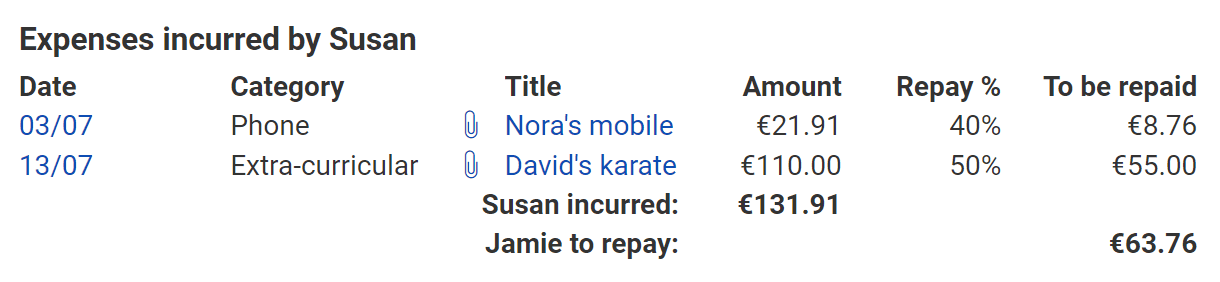 Try this with Custody X Change.
Log details of every payment or expense into your parenting expense tracker to ensure you're on time and have a record.
When you're owed money, share an expense report with the other parent — either digitally or on paper. This is just one way Custody X Change makes co-parenting simpler.