
Divorces Filed in Spring Take Months Longer
Study Also Shows January Most Common Time To Discuss Divorce, Consult Lawyer, Move Out
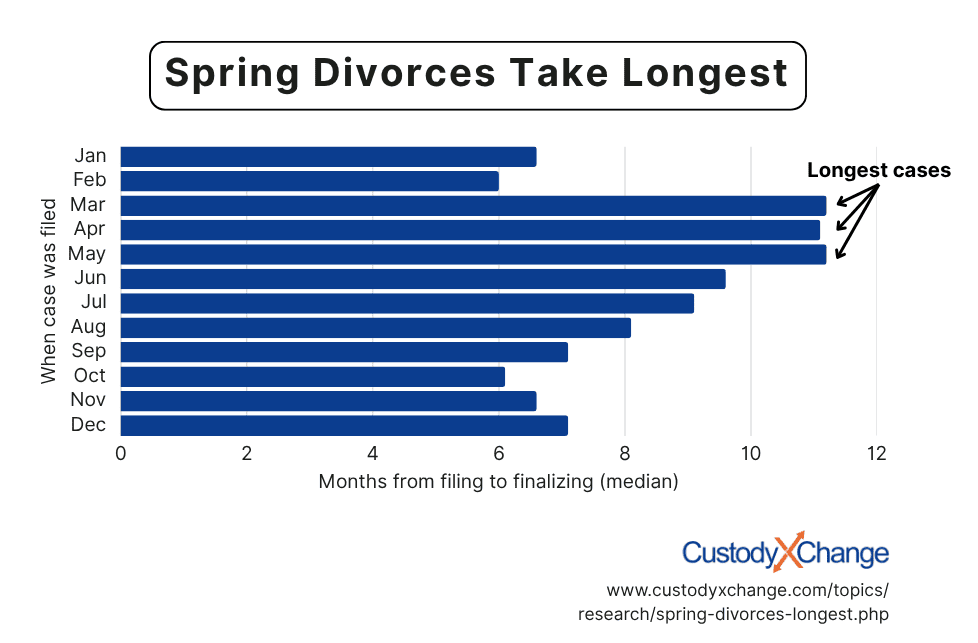
Research shows divorce cases filed in a spring month (March, April or May) take four to five months longer than cases filed in the fall or winter.
The median U.S. divorce filed in spring takes about 11 months to finalize. On the other hand, a case filed in February or October only takes about six months.
Use image with attribution
The data comes from a study by parenting app Custody X Change. The company surveyed 1,000 people in the U.S. (not customers) who divorced from 2021 to February 2026.
Two possible reasons for slow spring divorces
One possible reason for slow spring cases is the rush of filings in the first few months of the year.
The new study confirmed this rush of filings, and Attorney Whitney Antoniono said she sees it personally. Antoniono, who owns WLA Family Law, explained that it can create a logjam in the courts by spring.
She said a second reason for spring divorces slowing may be that they're ready for hearings right when lawyers and judges take summer vacations.
"I was in court a few days ago, and we were trying to find a date that works for everyone in June," said Antoniono. "We tried to find common dates in June, then July, then August and finally found a date that works in mid-September. That's three and a half months later than we could have probably found a date if we were looking for a fall date."
The study did not find anything unique about spring cases that would lead them to take months longer. They settle, involve minor children, and consult lawyers at roughly the same rates as cases filed in other months. This makes it likely that the timing of filing is itself the cause of the longer cases, though more research is needed.
"Now that we have this information, some couples may avoid filing for divorce in the spring," said Ben Coltrin, cofounder and president of Custody X Change. "It might spare them a few months of the limbo between starting a divorce and actually being divorced — which is a stressful time." Coltrin added that a lawyer can tell you the best time to file since it depends on many factors.
January most common month for a spouse to move out — but not to file for divorce
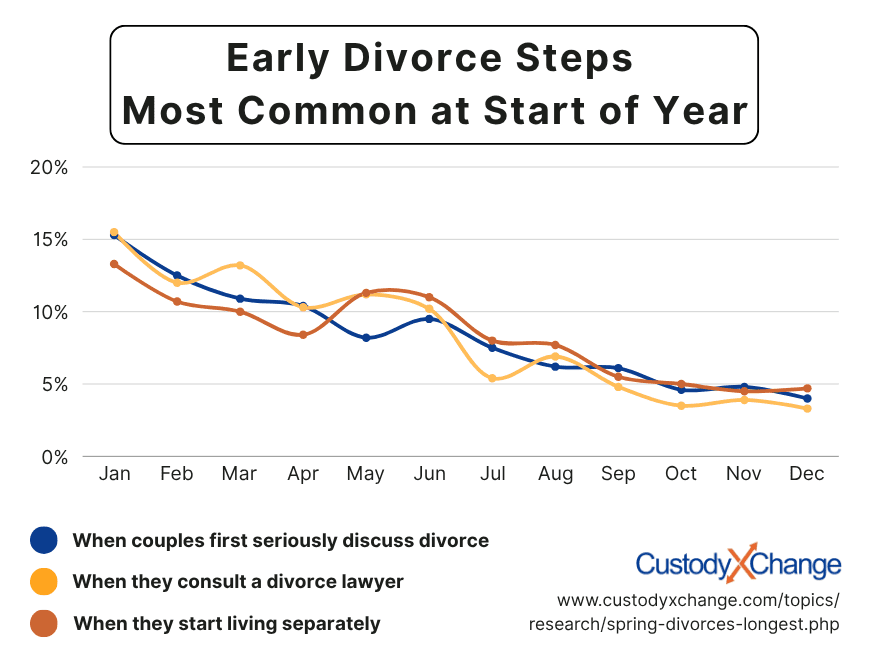
January has famously been called "divorce month," and many people believe it's the most popular time to file for divorce. The Custody X Change study found this belief only partially accurate — in fact, the first four months of the year are common for starting a divorce.
Several other divorce steps do peak in January:
- First discussing divorce with your spouse
- Consulting a divorce lawyer
- Starting to live separately
Use image with attribution
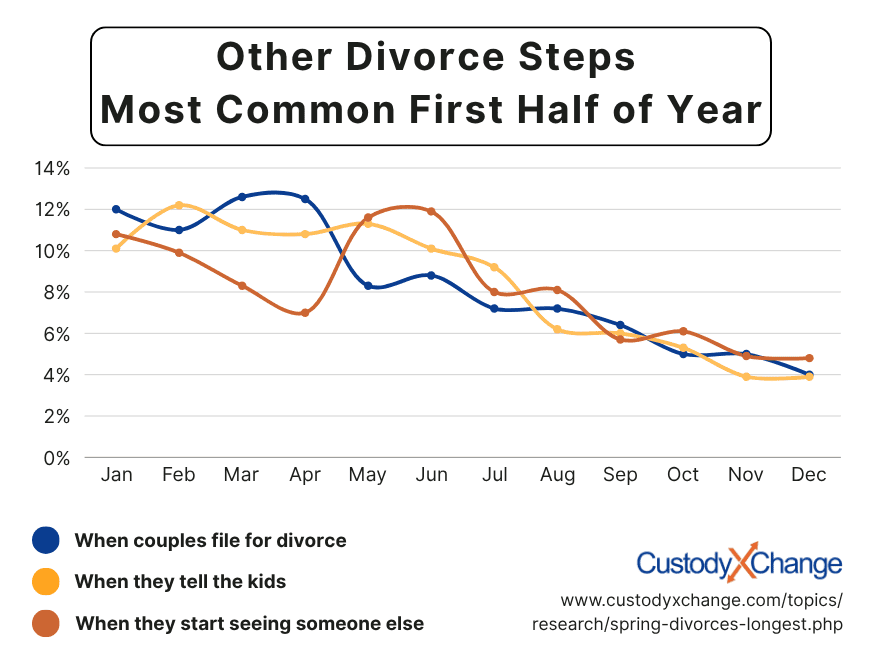
A few other divorce steps are most common in the first half of the year.
- Filing for divorce — most common January to April
- Telling your kids you're divorcing — most common January to June
- Starting to see someone else — most common in May and June (followed closely by January and February)
Use image with attribution
In short, it seems uncommon for much of anything related to divorce to happen in the last few months of the year.
Why the first half of the year sees a divorce rush
Attorney John Hoelle sees two possible reasons the first few months of the year are the busiest for new divorces at his Colorado firm, Conscious Family Law & Mediation.
"Either the holiday season has 'broken the camel's back' of the relationship, or … new resolutions mean separation and filing," he said.
He added that spouses seem to avoid starting a divorce before the winter holidays or summer vacations.
Attorney W. Scott Kimberly, who owns a law firm in Tennessee, confirmed that "divorce filings often pile up in the first quarter of each year." In addition to the end of the holidays, he credited tax returns, which start to arrive around this time and give some people extra cash for legal fees.
The Custody X Change findings contrast somewhat with a 2016 University of Washington study. Both found March to have the highest number of divorce filings. However, the UW study found an August surge in filings, whereas Custody X Change saw filings decrease gradually through the summer and fall.
The discrepancies might be explained by the different samples. The Custody X Change study looked at divorces that finalized from 2021 to early 2026 across the U.S. The University of Washington study focused on 2001–2015 divorces in Washington state.
April most common month to finalize divorce
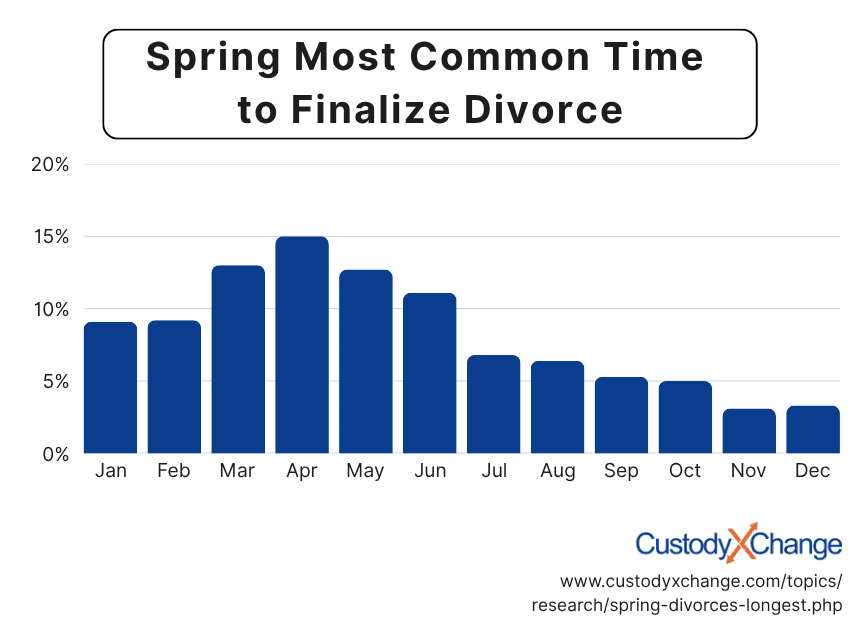
The study also found that the highest proportion of divorces finalize in April: 15%. That's about five times the cases that finalize in November, the least common month to finish a case.
Again, there's a clear annual cycle: The number of divorces finishing each month rises steadily until April, then decreases over the rest of the year.
Use image with attribution
This pattern is tied closely to the seasonality in divorce length. Since cases filed in the spring take almost a year, and ones filed later in the year move faster, a high number end in April.
More about the study
Custody X Change researchers conducted their survey in February 2026 via the Pollfish platform. Respondents reported the month and year of events related to their divorce. The study has a 3% margin of error at a 95% confidence level.
Download the spreadsheet of survey results.
Bottom line: What it means for spouses considering divorce
The Custody X Change study found that much of the divorce cycle is tied to the calendar year. In fact, many steps — like first discussing divorce and breaking the news to the kids — decrease in prevalence throughout the year.
Spouses thinking about divorce might consider that:
- Initial consultations with a divorce lawyer peak in January.
- Filing for divorce is most common January to April.
- Divorces filed in March, April and May take the longest.
"If you're ready to divorce in the last several months of the year, acting before the spring may get you the quickest case," said Coltrin of Custody X Change.
"Acting even sooner — before the new year — might have added benefits," he added. "If your lawyer and court have a lighter workload, it stands to reason that you might get more attention." But more research is needed in this area.
Many factors influence ideal divorce timelines: safety, child custody, finances, mandatory waiting periods, etc. This research provides new information for lawyers and their clients to take into consideration.