
Utah Parenting Plans (Custody Agreements)
As part of your Utah child custody or divorce case, you'll have a parenting plan. A parenting plan describes how you'll work together to raise your child.
If you expect to share legal custody (i.e., to make major parenting decisions jointly) or physical custody (defined as each of you having at least 30% of the year's overnights with your child), it's a good idea to write a detailed plan. You can write a plan together, or you can each propose your own.
Even if one of you will have sole custody, you're still required to submit a plan to the court. The information will likely be basic, but your child will benefit from as much information as you can provide. Writing down details will support your child in maintaining a relationship with both parents.
The court will review your proposals, and the final approved version will become part of your court order.
When and how to write a parenting plan
Submit your proposal as early in your case as possible. It's due along with your petition (if you're the one who's opening the case) or with your answer (if you're responding). If one of you delays, the judge could go ahead and approve the other's proposal.
Submitting a plan together speeds up your case, as the court is likely to approve your agreement.
A licensed paralegal practitioner can help you write a plan, but they can't represent you in court. If your case is complex or if you may need help in court, consult a family lawyer.
Keep in mind that you must also share financial responsibility for your child through a child support order, unless the court finds specific reasons for you not to do so. Child support will be decided separately from your parenting plan.
Choosing a template
You may write your plan yourself to save money. It's a good idea to hire someone at least to look over your proposal, but professional help isn't required.
Utah has a sample parenting plan (PDF) that you print out and write on with a pen. There's also an editable version (DOC download).
Many people prefer to use an app. The Custody X Change parenting plan template offers more than 140 standard provisions while letting you add as many custom provisions as you need. The app also lets you build a custody schedule by clicking and dragging in a calendar.
What to cover: Custody
Unless the court finds a reason not to, you'll be ordered to share responsibility for major decisions (like those about education, health care, and religious upbringing). This is called joint legal custody. If only one of you will make those decisions, that parent will have sole legal custody.
If the parents can't agree on a schedule or how many overnights they'll each have, the court will look at a variety of factors to make the decision. It could order sole physical custody (where one parent has less than 111 overnights per year) or joint physical custody (where both parents have at least 111 overnights per year). Joint physical custody can involve a 70/30, 60/40 or even 50/50 time split.
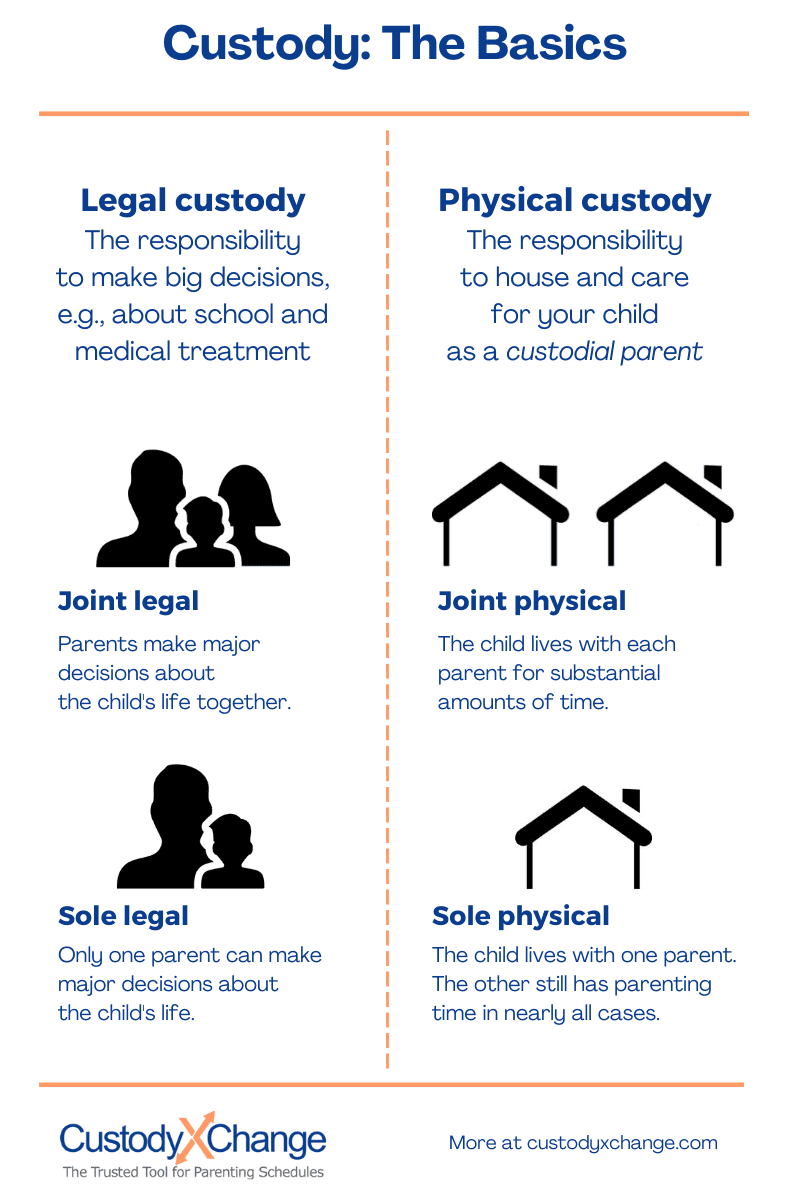 You can customize this to fit your situation with Custody X Change.
Your plan should give specifics about how you intend to co-parent, including which legal custody arrangement you believe will be best for your child and whose residence will be used for school enrollment.
What to cover: Custody schedule
If you'll have a parenting plan, you'll also need a parent-time schedule, including holidays. Sometimes the parent-time schedule is part of your parenting plan, and sometimes it's elsewhere in your decree or order.
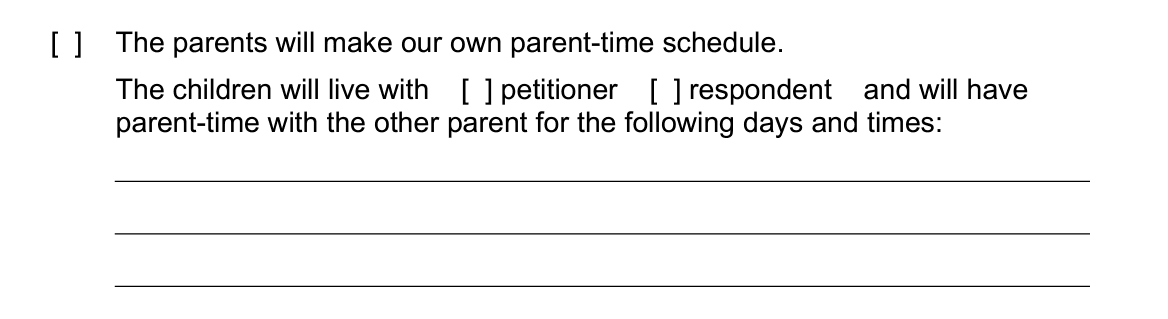
If you use Utah's parenting plan template, you write out your schedule.
If you use Custody X Change, you make a visual schedule that the app automatically describes in words. The app calculates your overnights too.
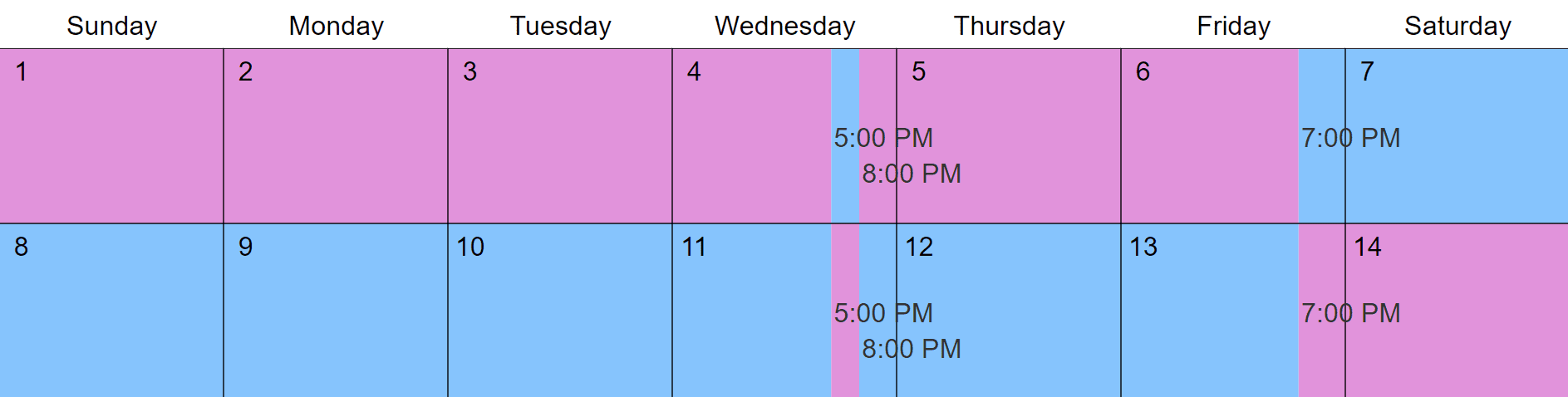 You can customize this to fit your situation with Custody X Change.
You can provide details about how you'll handle the transfers of your child.
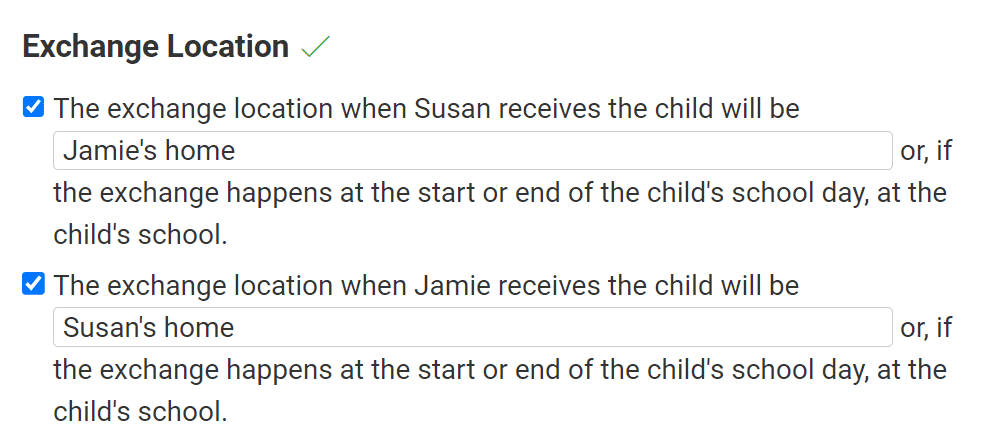 You can customize this to fit your situation with Custody X Change.
For example, to set boundaries with your co-parent, you might say you'll do curbside transfers. In Utah, that means the parents stay inside their car or house during the transfer. The child leaves the vehicle and walks up alone to the other parent's doorway or vehicle.
What to cover: Parenting rules
A Utah parenting plan should:
- Clarify your responsibilities as parents
- Describe how you'll protect your child's best interests, including their physical and emotional well-being
- Minimize your child's exposure to any conflict between you and your ex
- Encourage you and your co-parent to work together rather than battle in court
- Anticipate how your child's needs will change so the plan will continue to serve them as they grow
Say what will happen if one of you moves a long distance. Utah parents are generally expected to stay within 150 miles of each other. If you plan to move outside that range, you must give your co-parent 60 days' notice, and they may ask the court to revise the custody and parent-time order.
You might say in your parenting plan that you'll require agreements on any future moves.
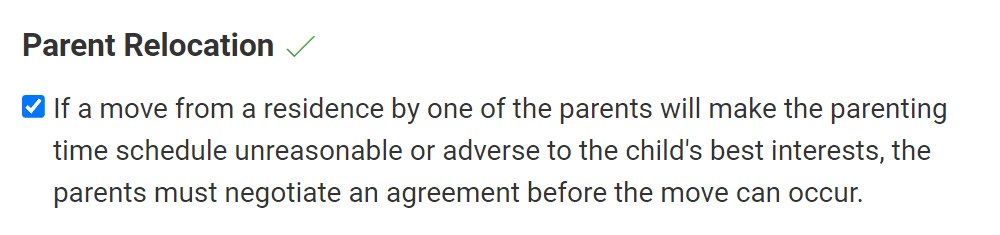 You can customize this to fit your situation with Custody X Change.
If one of you is in the military, you must specify who will care for your child if you deploy.
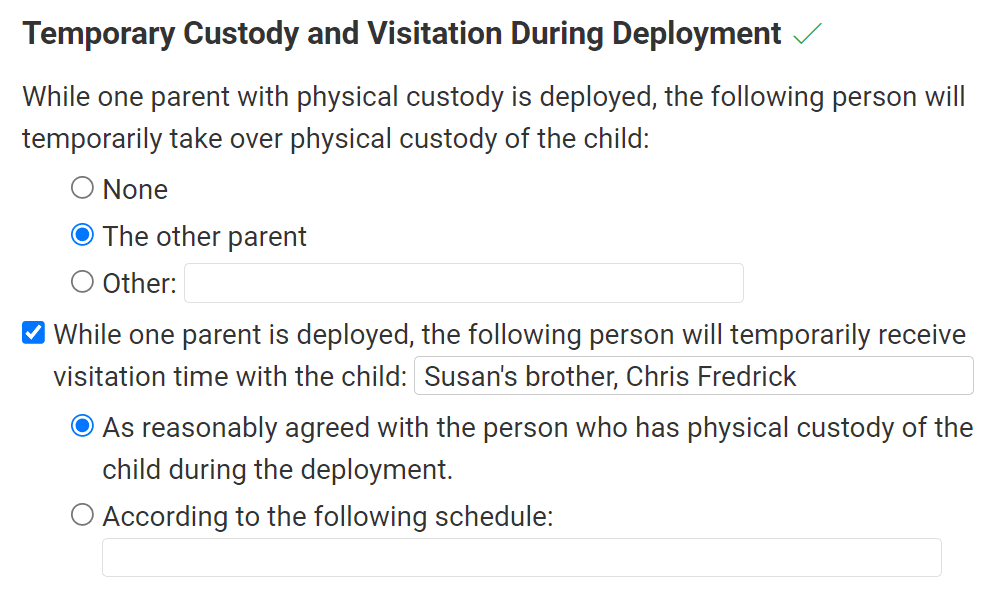 You can customize this to fit your situation with Custody X Change.
You might both promise that, in case of any future disagreement, you'll try mediation first. A mediator can often anticipate what a judge's solution would be. Their role is to guide you toward agreement. This helps you avoid court.
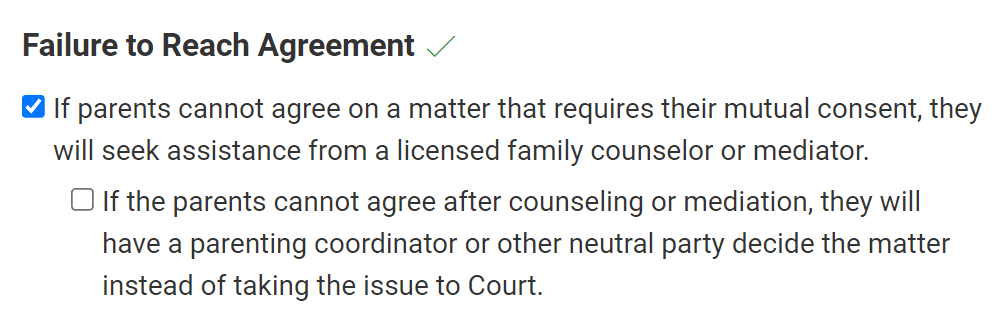 You can customize this to fit your situation with Custody X Change.
Read up on common provisions and add relevant ones to your plan. Phrase them to say what the parents will do (not what the child will do). You can put them in your own words to be sure they serve your child's unique needs.
If you need to change your parenting plan
File a request with the same district court that gave you your original order, and use the same case number. You'll pay a new filing fee for the modification (though it will be lower than the original filing fee), and you'll have to serve papers to the other parent.
Be aware that Utah's family law statutes have been renumbered. If your original parenting plan mentioned a law under Title 30, update it to the new number under Title 81. If you don't, the court may do this for you.
The easiest way to make a parenting plan
When you're writing a parenting plan, it's critical you use airtight language that leaves no room for interpretation. You must also be careful not to omit any information required by the court.
If you hire a lawyer, they'll write up the plan for you and ensure it meets the judge's expectations.
If you write your own plan, use technology to take guesswork out of the equation. The parenting plan template in the Custody X Change online app walks you through each step.
 You can customize this to fit your situation with Custody X Change.
The result is a professional document that demonstrates your competence as a parent from the first glance.
The easiest and most reliable way to make a parenting plan is with Custody X Change.