
Texas Child Possession and Access Schedules
A possession and access schedule lays out how a separated family will divide parenting time. It's one element in a parenting plan.
How the court decides on a schedule
Judges will approve any possession schedule parents agree on, as long as it's in the best interest of the child.
If parents can't agree, judges usually award the standard possession order, which gives the noncustodial parent the first, third of fifth weekend of a month, plus a weekly Thursday night visit. This changes slightly based on how far apart the parents live (details below).
If you don't like the standard possession order, try to agree on a different schedule with the other parent or demonstrate to the judge why an alternative would suit your child better.
Parents can decide together to stray from any court-ordered schedule. Otherwise, they must follow their court order.
Possession and access terminology
Texas uses the terms possession and access instead of physical custody and visitation, respectively.
A parent has possession of a child when the child is under their care. Access is a broader term that can refer to any communication a parent has with a child, as well as presence at the child's activities.
Typically, one parent (the custodial parent) has the majority of possession time, though it may be a only a slight majority. The custodial parent can be a joint or sole managing conservator.
The other parent is the noncustodial parent. They may be a joint managing conservator or a possessory conservator.
Very occasionally, parents split possession time evenly, making neither one custodial (details below under "50/50 possession").
Don't be confused by the language in the Texas standard possession order (SPO). It uses the term managing conservator to mean custodial conservator and possessory to mean noncustodial. Some judges prefer you use the SPO terminology when you write your own possession order.
Making your own possession and access schedule
You can make a customized possession and access schedule to propose to the other parent, to present to your judge, or to submit to the court when you settle.
Start by looking at common custody schedules for ideas.
One frequently-used option is the 4-3 schedule, where the child spends four days a week with one parent and three days with the other.
 Try this with Custody X Change.
The 2-2-5-5 schedule is also used by many families. The child spends two days with each parent, then five days with each parent. Then the cycle repeats.
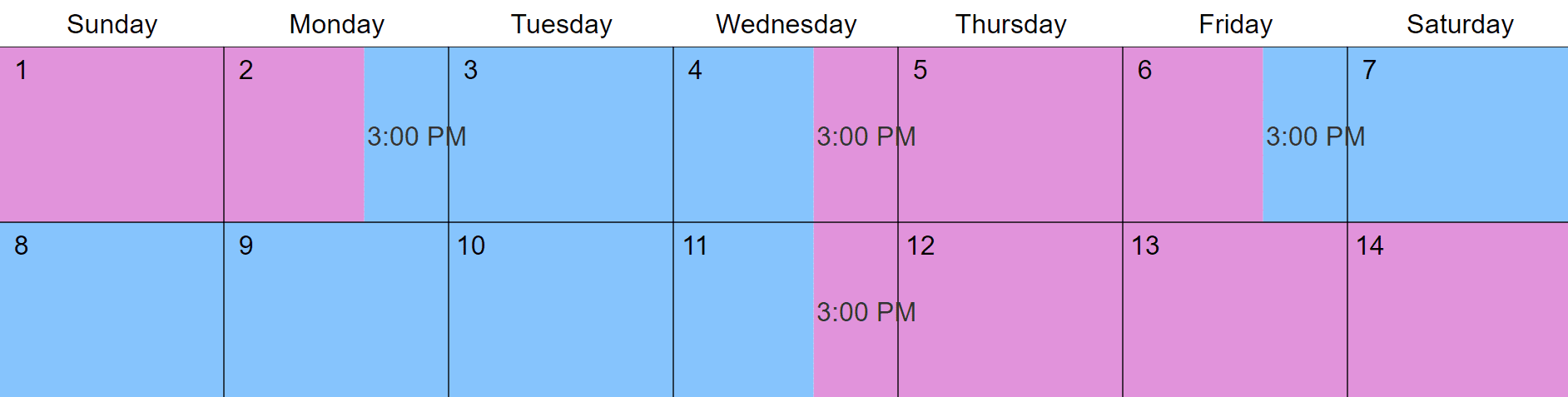
Keep in mind that you'll need provisions for times when the regular schedule doesn't make sense. You may need provisions for:
- Summer break
- Holidays (school holidays and any additional religious holidays)
- Special occasions (like the child's birthday)
- Different caretakers (i.e., 3rd party time)
You can use the Custody X Change online app to create a calendar that combines your plans for special situations like the ones above with your regular schedule so you can make sense of everything in a glance.
While judges will approve any possession schedule parents agree on that is in the best interest of the child, they may look more scrupulously at agreements reached without a neutral professionals (such as a mediator).
Consider these guidelines for the best chance of getting your schedule approved by a judge:
- Reflect on your child's unique needs before you select a schedule.
- Allow your child to have frequent contact with both parents (as long as that's in the child's best interest).
- Keep siblings together (if that's in their best interest).
- Think about both parents' work schedules, as well as the distance between their homes.
- Consider a schedule that changes as the child grows. A schedule that works for a 2 year old may not work for a school-age child.
- Write your schedule in language that is specific, yet applicable to any year.
When you're ready to put a schedule down on paper, the Custody X Change app can walk you through the process step-by-step. While you add days and times to a color-coded calendar, the software translates your selections into the legal language required by the court.
You can attach your color-coded calendar to help you and the court understand the schedule. But the written version will be what the court enforces if your proposal becomes a court order.
Standard possession and access orders
When parents can't agree on a schedule and their child is at least 3 years old, a judge will usually award the Texas standard possession order (SPO) or extended standard possession order — unless a parent convinces the judge this isn't in the child's best interest.
Parents can also opt to use the SPO or extended SPO in a settlement.
The standard orders give what the state considers a reasonable amount time to each parent.
The orders refer often to weekends. Note that Texas considers a weekend to begin on Friday. This means that — for example — Friday, October 31 to Monday, November 2 would count as the fifth weekend in October, not the first weekend in November.
Parents who live 50 miles apart or less (extended standard possession order)
This is technically the extended standard possession order. It's like the standard order farther below, except that:
- The midweek stay starts when the child gets out of school Thursday and ends when the child starts school Friday.
- The weekend stay starts when the child gets out of school Friday and ends when the child starts school Monday.
- Holiday possession starts when school lets out and ends when school begins.
In this sample calendar, pink represents the noncustodial parent:
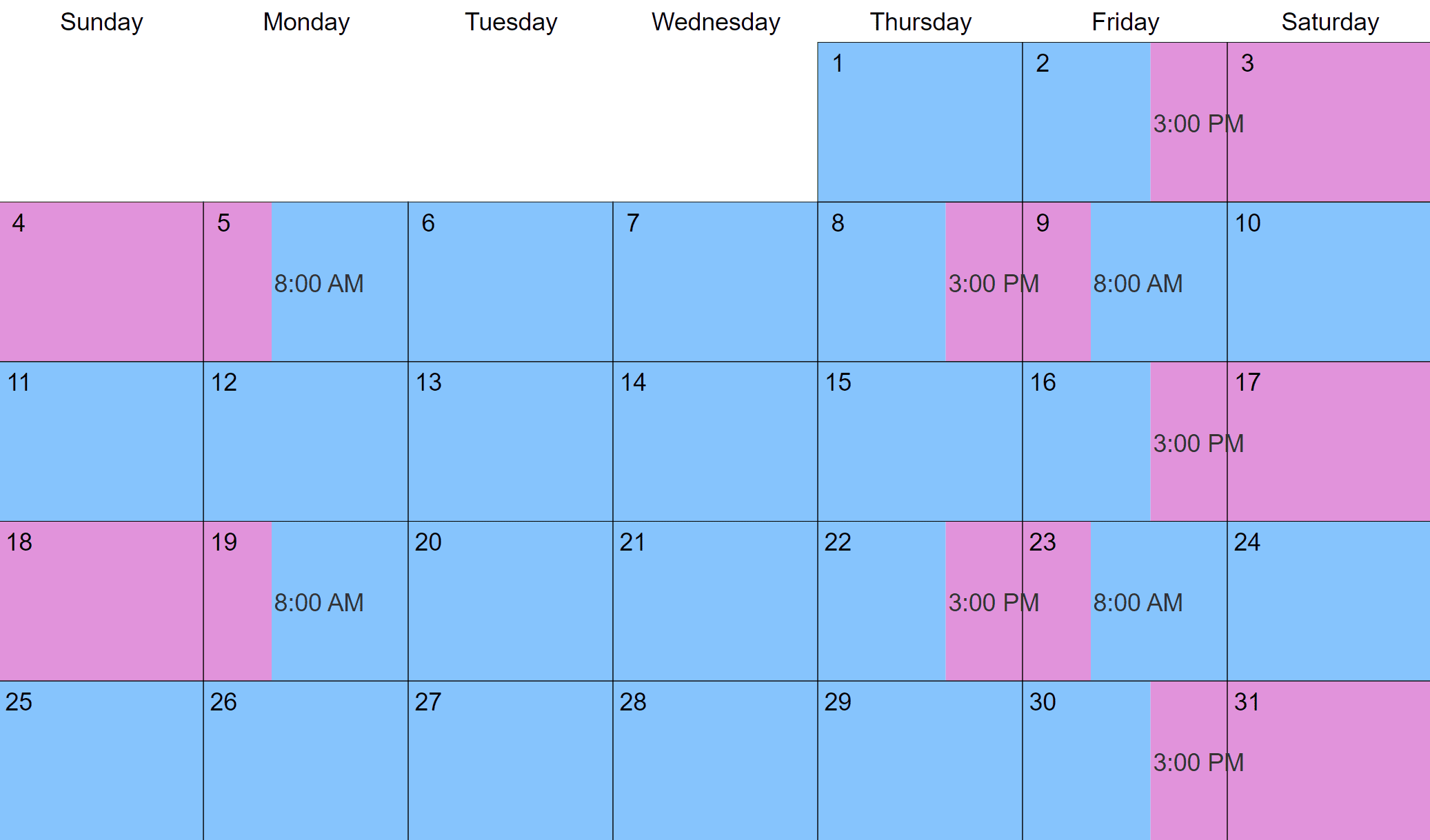
Together, these changes essentially give the noncustodial parent four days with the child during weekend visits rather than two days. In a year, the schedule gives the noncustodial parent about 40% of possession time.
The noncustodial parent can opt for the standard possession order instead.
Parents who live 51 to 100 miles apart (standard possession order)
When parents live more than 50 but not more than 100 miles apart, the standard possession order stipulates the following.
The noncustodial parent has possession of the child:
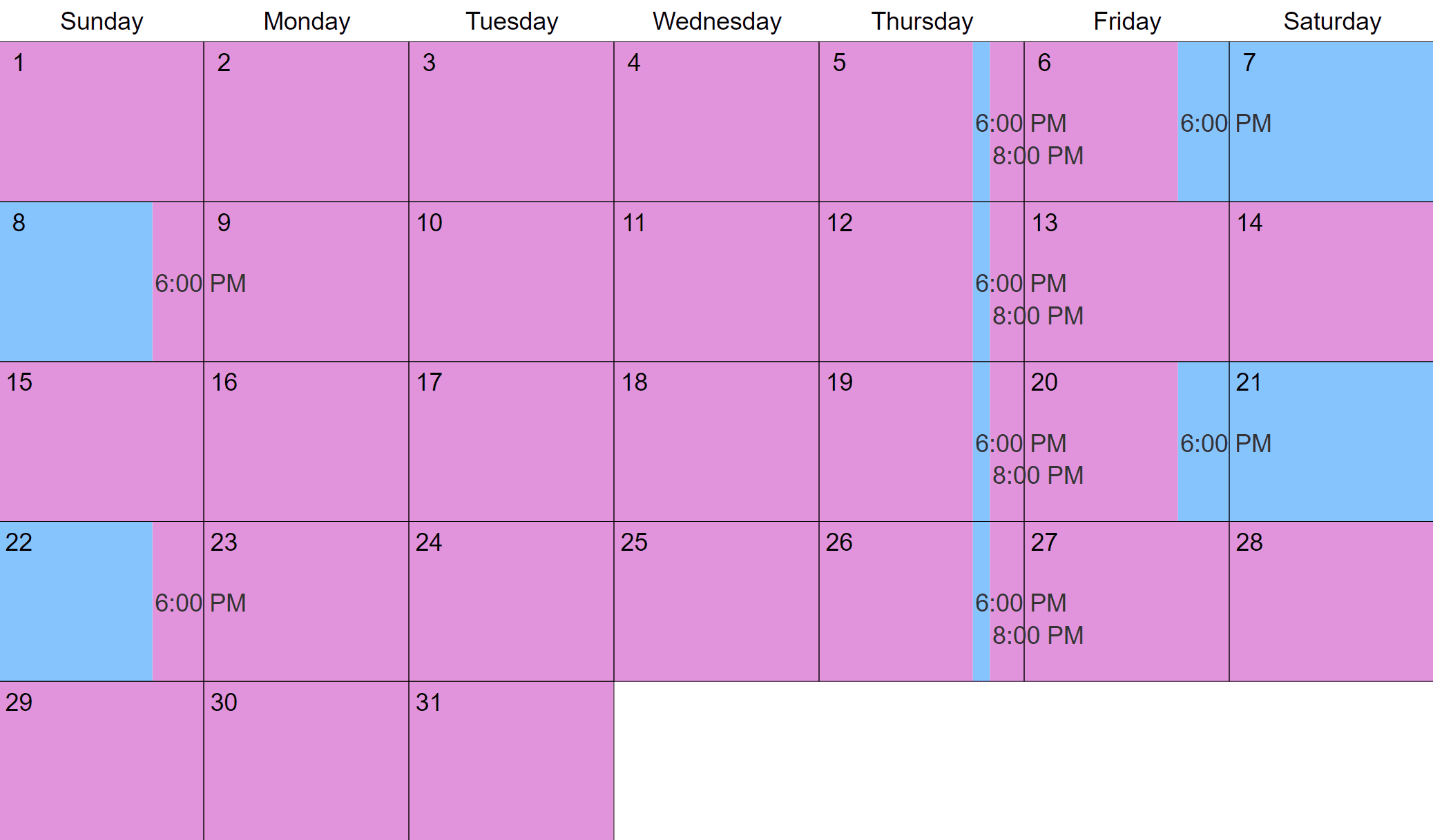
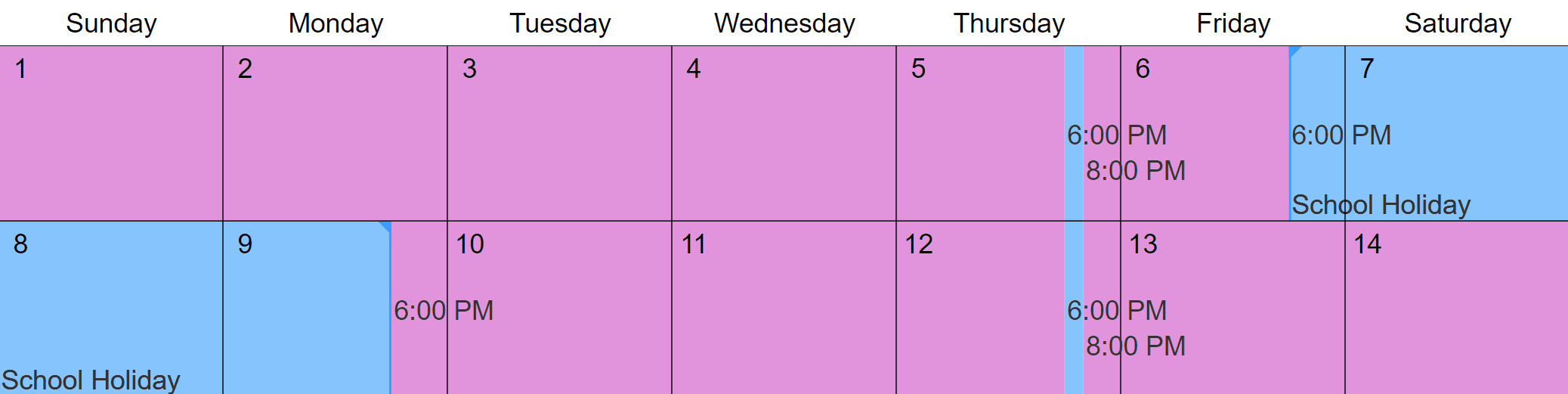
- Every first, third, and fifth weekend of a month from 6 p.m. Friday to 6 p.m. Sunday
- Every Thursday during the school year from 6 p.m. to 8 p.m.
In these examples, the parent in blue is noncustodial:
If the child has a school holiday the Friday before a weekend visit, the visit starts on Thursday at 6 p.m.
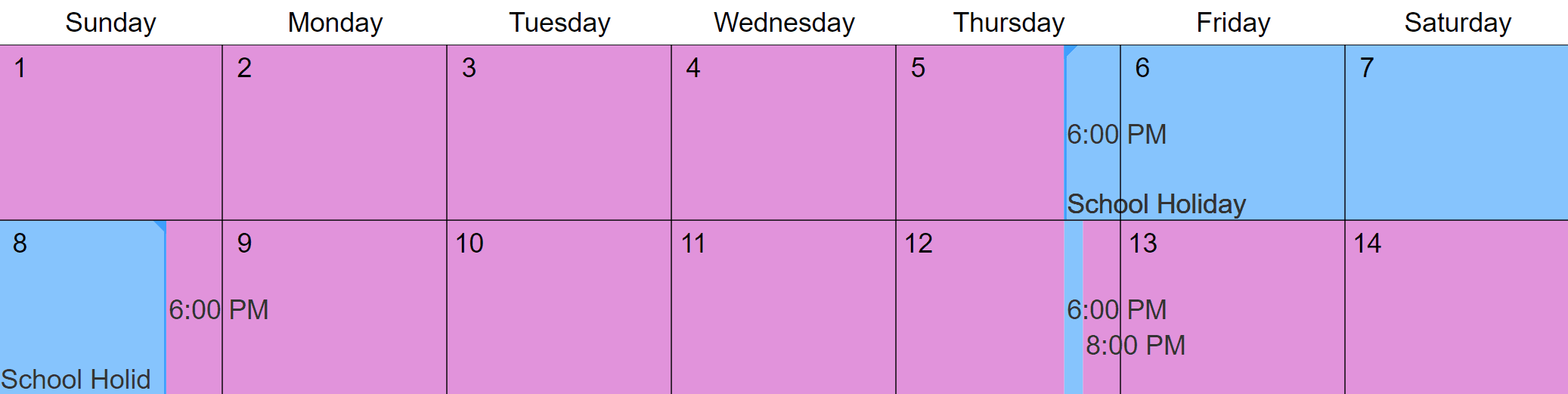
If the child has a school holiday the Monday after a weekend visit, the visit is extended until Monday at 6 p.m.
The standard possession order gives the noncustodial parent 30 days with the child during summer.
The summer stay goes from July 1 to 31, unless the noncustodial parent notifies the other parent prior to April 1 that they prefer different days.
The custodial parent gets one weekend with the child during this time.
Parents who live more than 100 miles apart
When parents live more than 100 miles apart, the standard possession order changes in the following ways:
- The noncustodial parent can choose to have one weekend of possession per month instead of visits on the 1st, 3rd, and 5th weekends (if notice is given at least 14 days in advance).
- The noncustodial parent has the child during spring break every year.
- The noncustodial parent has the child for 42 days of summer break (June 15 to July 27, unless different dates are scheduled by April 1).
Standard possession order for holidays
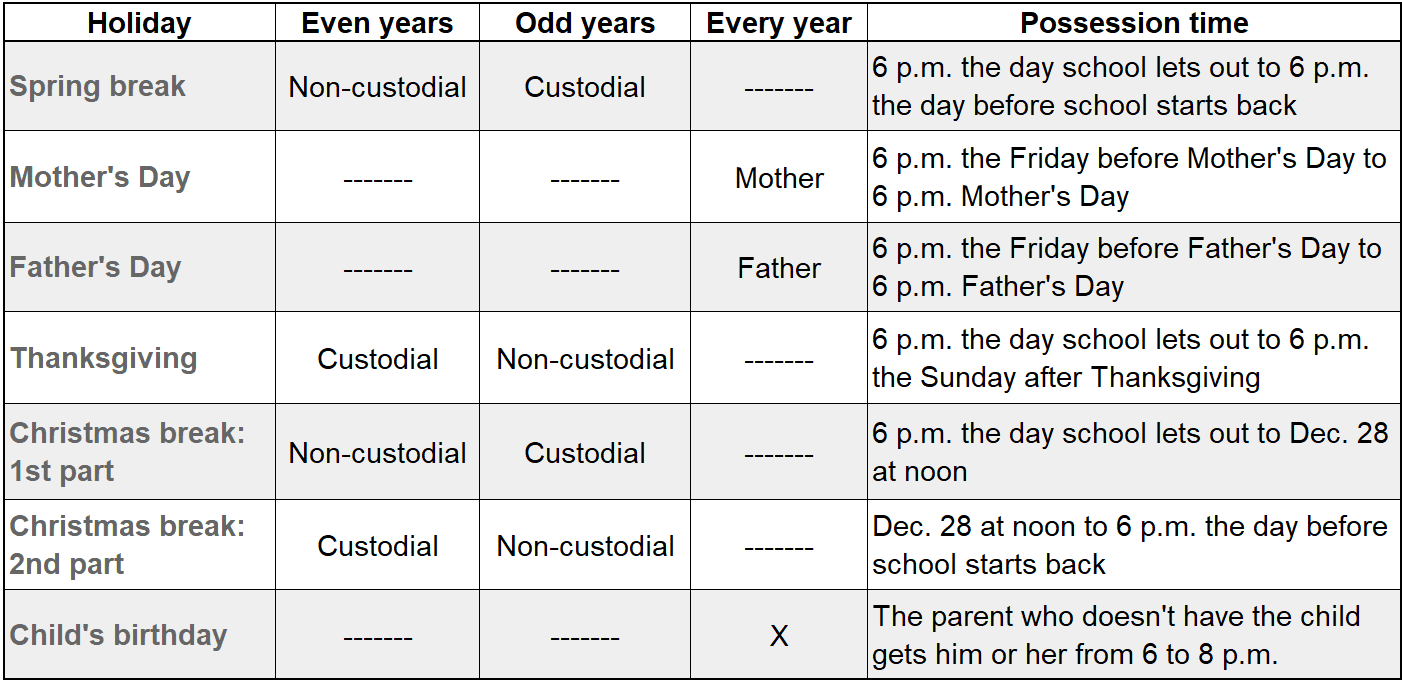
This chart shows which parent gets possession of the child on special occasions by default. The distance between parents doesn't affect whom the child spends the holidays with, but it does affect the time that the holidays visits start and end.
Other possession orders
While the standard possession order is designed to work for most cases, judges recognize that it doesn't fit every family perfectly. They have discretion to award a different possession order when necessary.
Below are a few ways a judge might depart from the standard possession order.
50/50 possession
Occasionally, a judge will rule that a child should spend roughly equal time with both parents rather than live primarily with a custodial conservator. In this case, the judge will require both parents to live within a smaller geographic area than usual, such as a school district.
Most often, parents agree to this arrangement, but judges are increasingly awarding equal possession time of their own volition (mostly when a family has already shown success splitting parenting time evenly).
Historically, Texas courts viewed 50/50 awards as more beneficial for parents than for children, who have to move back and forth in what can be an awkward schedule. Today, the likelihood of receiving 50/50 possession is still low but depends heavily on your court, judge and circumstances.
Children under 3
For kids under 3 years old, judges often award a possession and access schedule designed specifically for young children. These schedules may switch to the standard possession order when the child turns 3, or they can slowly morph as the child grows.
In deciding a schedule, the judge will consider the following:
- The parents' ability to share the responsibilities and rights of parenting
- Each parent's caretaking history
- Each parent's availability and willingness to care for the child
- Each parent's physical, medical, emotional, economic and social conditions
- The child's physical, medical, behavioral and developmental needs
- How the child handles separation from either parent
- The child's need to develop healthy attachments to both parents
- Other people who live with the parents
- The presence of siblings during periods of possession
- The child's need for routine
- The proximity of the parents' homes
No possession or access
While rare, a parent can be entirely denied possession and access if necessary for a child's physical or emotional health. This only occurs in extraordinary circumstances, such as when the parent has a history of abusing the child. In many cases, the orders are temporary and can change once the parent gets help for the problematic behavior.
More often, the judge will set rules to protect the child during time with the parent. For example, the judge may require that possession be supervised or take place during the day.
Electronic communication
A parent can request electronic communication with their child in addition to periods of possession. Electronic communication might be via email, voice calling, video calling, text messaging or instant messaging.
The court will consider whether electronic communication is in the best interest of the child and whether the necessary equipment is reasonably available to everyone involved.
The court may specify times (such as 6 to 8 p.m.) or frequencies (such as once a day) for electronic communication, or allow it at reasonable times for a reasonable duration. The other parent must give the child the same level of privacy during electronic communication as during other types of access.
Electronic communication is not a substitute for physical possession.
The easiest way to make a schedule
If you're like most parents, creating a possession and access schedule will feel daunting. How do you write something that meets legal requirements and doesn't leave any loose ends?
The Custody X Change app makes it easy. Either customize a schedule template, or click and drag in your custody calendar to make a schedule from scratch.
Try this with Custody X Change.
Then watch a full description appear in your parenting plan.
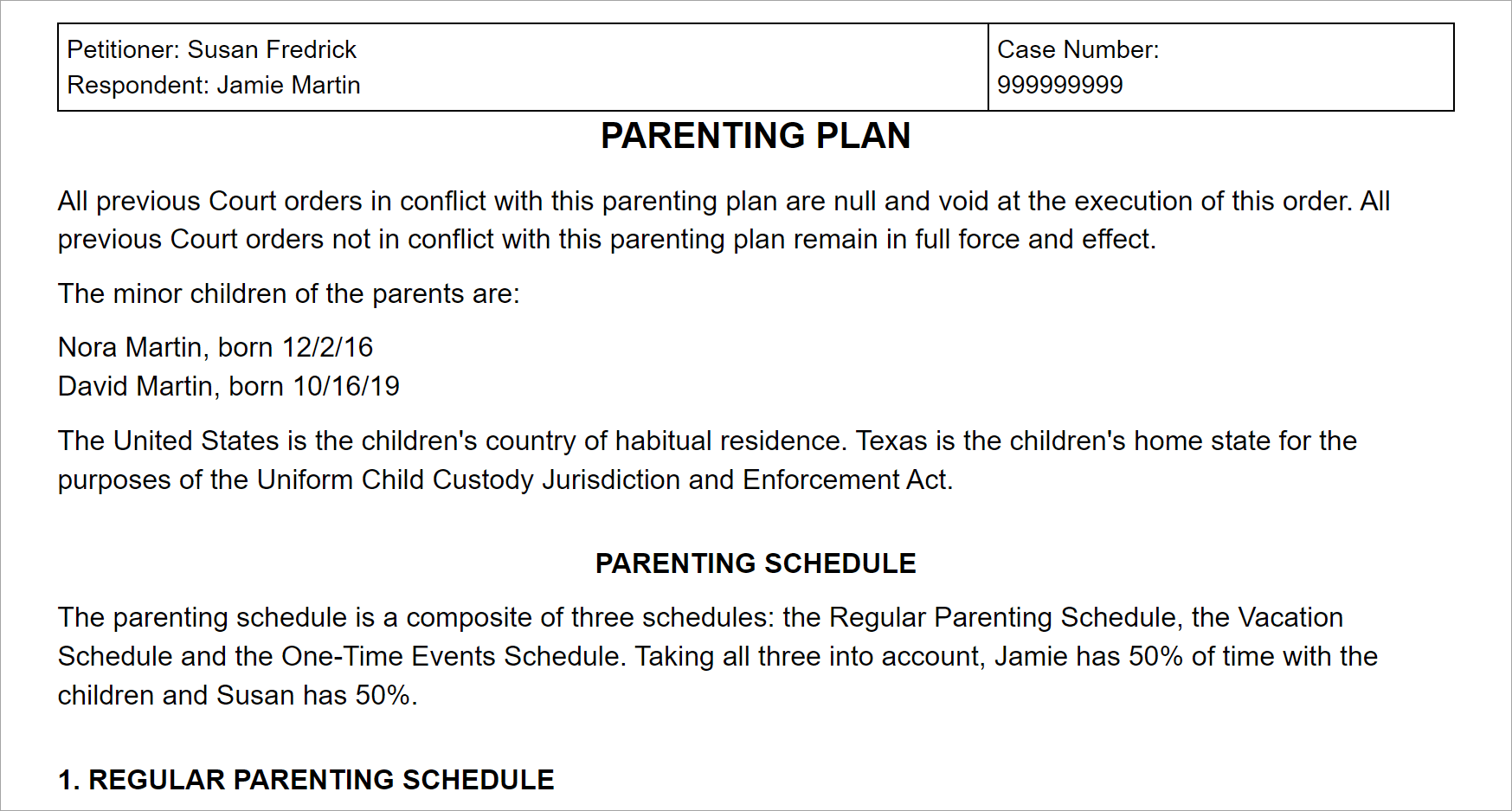
The combination of a visual and written schedule means your family will have no problem knowing who has the child when. Take advantage of Custody X Change to make your schedule as clear and thorough as can be.