
South Carolina Child Custody and Visitation Schedules
In a divorce or child custody case, in addition to deciding legal and physical custody, the judge typically orders a parenting schedule. Less commonly, they just decide which parent will have the majority of time with the child, leaving the visitation schedule open-ended.
The schedule that will work best for you, your co-parent and your child depends on how far apart you and your co-parent live, your work schedules and other facts relevant to your child's well-being. The judge needs information from you on all of this to issue a court order.
A great way to communicate with the other parent and the judge is with a visual calendar. Describe your proposed schedule in words too. Put it in the parenting plan that you and your co-parent draft separately or together. If the judge approves your proposed schedule, it will become part of your court order.

Visualize your schedule. Get a written parenting plan. Calculate your parenting time.
How you get a custody and visitation schedule
Opening a divorce or custody case leads to an order for physical custody of your child. Early in your South Carolina court process, if you and your co-parent haven't reached agreement, the judge will likely give you a temporary schedule to follow during the case. At your final hearing, you'll receive your final schedule.
Most court orders allow both parents to see their child, even if one parent receives sole physical custody. If both parents want a lot of involvement in the child's life, the judge could order sole custody to one parent and give liberal visitation (more time than standard) to the noncustodial parent, or the judge could instead award joint physical custody.
To discuss how you can begin to take a more active role in your child's life, you and your co-parent may seek mediation through a Department of Social Services pilot program called Visitation Involvement Parenting. This program, available in some South Carolina counties, helps parents to agree on a plan. If appropriate, a judge may structure increasing visits through a step-up parenting plan.
Agree on as much as you can. If you agree on everything, the judge is likely to approve your joint proposal and make it a court order. If you can't agree on some things despite your best efforts, you'll go to trial, where the judge will decide for you.
How to choose the right schedule for your family
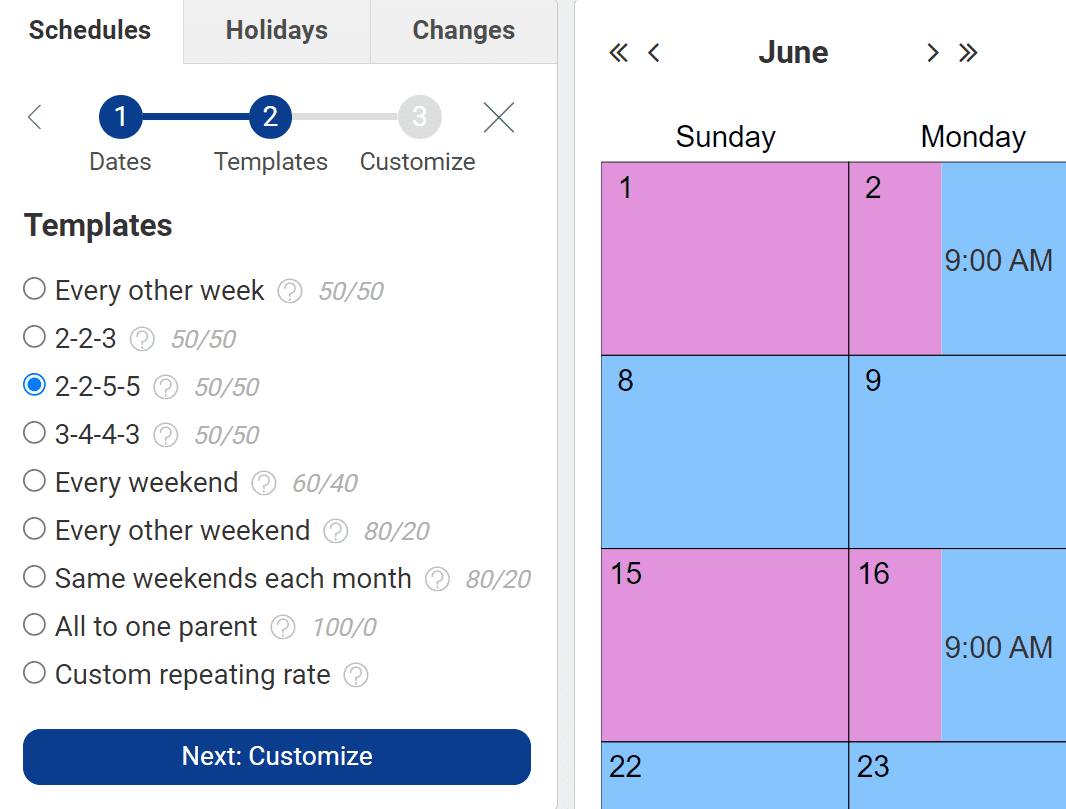
You can quickly visualize and compare schedules with a Custody X Change calendar. Choose from templates for common schedules, or build a schedule from scratch.
Among the factors to consider as you evaluate schedules are your child's:
- School and activity schedules
- Relationships with friends and other people
- Ability to adapt to change
- Preferences
- Age
As your child gets older, they may be comfortable spending more time away from a parent. Consider specifying dates when your parenting schedule will automatically change or when you and your co-parent will discuss making a change.
While you may prefer not to have a set schedule, most parents end up with one. Knowing how many nights your child spends with each parent per year helps determine child support.
Standard schedule: Every weekend or every other weekend
In sole custody situations, parents often receive what many South Carolina courts call a standard visitation schedule (though your local court may tend to order something different). You may hear it called basic visitation or regularly scheduled visitation.
It's based on an every-weekend or every-other-weekend schedule. The judge may say that a weekend is strictly Friday through Sunday (with exchanges generally at 6 p.m.), or they may extend the weekend from Thursday night to Monday morning.
It's common for the parent who has less parenting time to get several weeks with the child during summer break.
Usually, parents split holidays evenly. If this doesn't work for you, raise your specific need with the judge.
Every-weekend schedules give about a 70/30 time split.

An every-other-weekend schedule often includes a midweek visit for a few hours. If the weekend parent gets some extra time in summer, it could work out to an 80/20 time split.
Equal time schedules
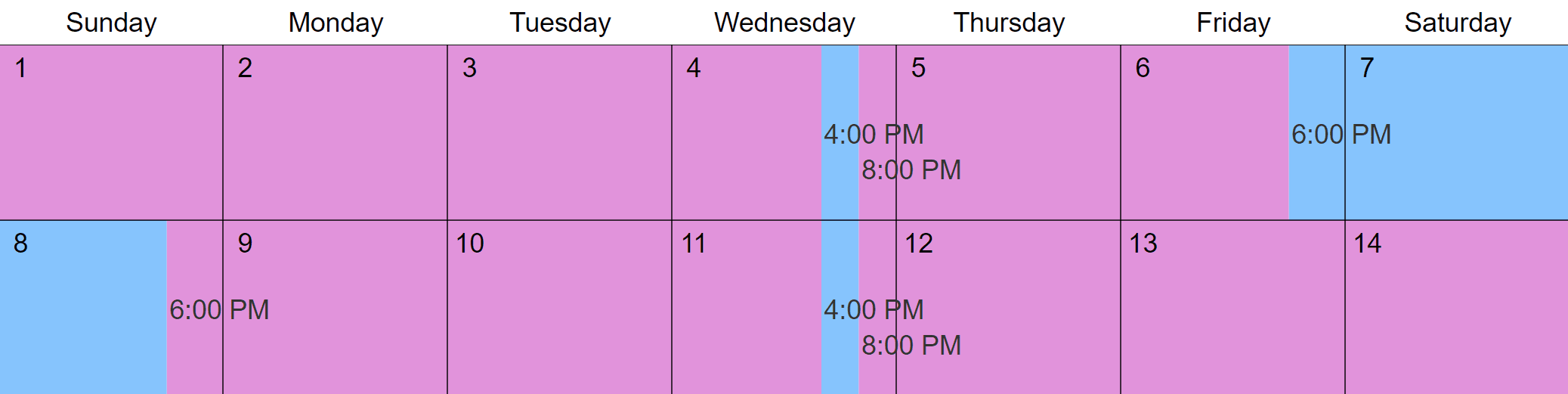
The following schedules are all 50/50 time splits (equal time).
The 2-2-3 schedule involves frequent exchanges (appropriate for small children).
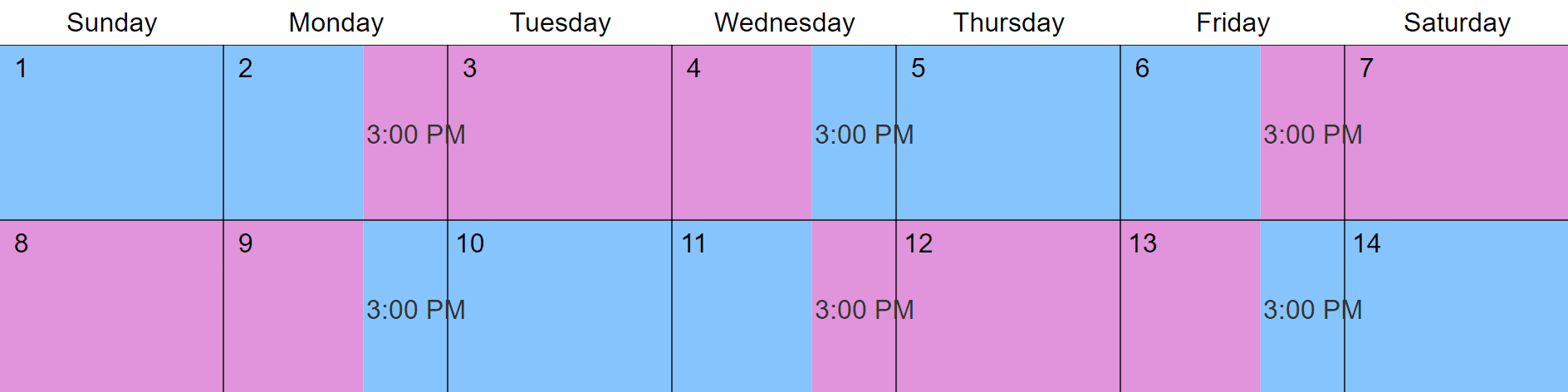
So does the 3-4-4-3 schedule.

In the 2-2-5-5 schedule, the child has two days with one parent, two days with the other, then five days with one, five days with the other.
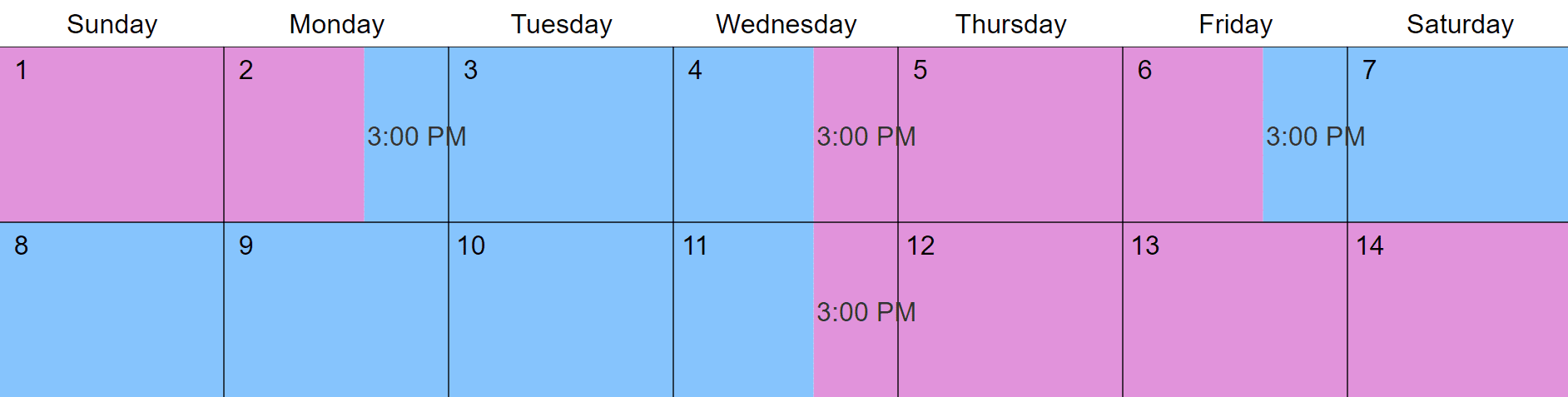
An older child may spend one week with one parent, then the next week with the other. The exchange often happens at the end of the school week. This is called alternating weeks.
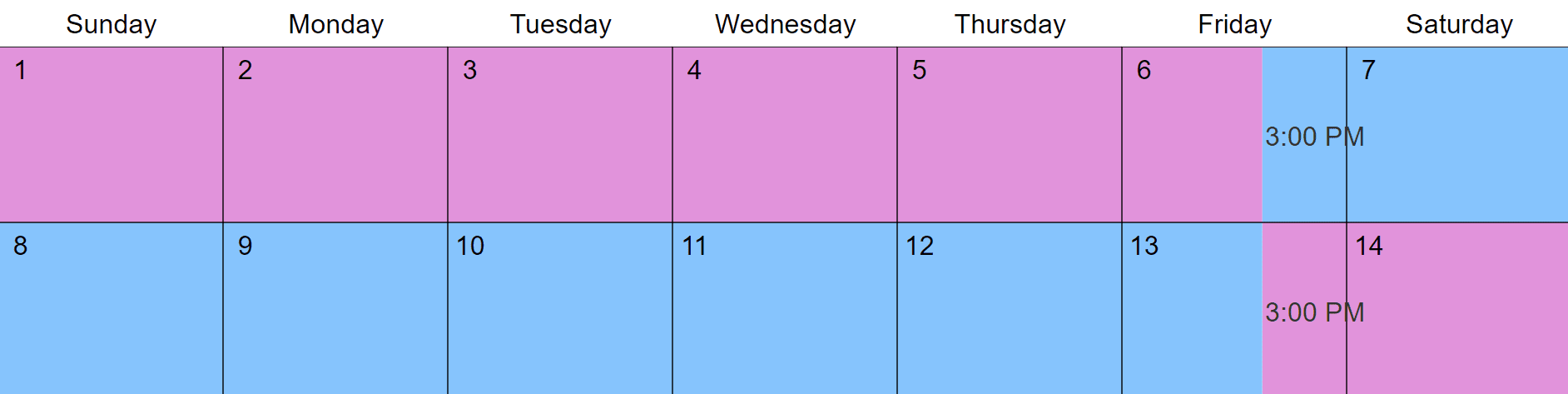
When one parent sees the child infrequently
When the visiting parent is given less time than usual, it's called limited visitation (e.g., no overnights). This might be a 90/10 time split or, as shown below, a 95/5 split.

Some parents receive an order that limits them to supervised visitation. This order is usually only temporary and relates to a safety issue. Parents can propose who will supervise the visits and when, and the judge may appoint that person or someone else.
Suspended means that the judge orders that one parent can't have visitation at all. This is rare.
Anticipating disagreements
Try to anticipate situations that might be important to your child or might cause conflict with your co-parent.
For disagreements you can predict: Say what should happen if, for example, your child wants to go a monthlong sleepaway camp. How will you communicate with your co-parent about this? How will you adjust your parenting time to be fair to both of you?
For disagreements you can't predict: Say what should happen when you and your co-parent have any scheduling disagreement. Can you agree on a fair way to break a tie for disagreements in general? Will you let a third person help you decide?
Include these important strategies in your parenting plan.
If the schedule isn't working out
Once you have an order, you can ask the court for changes, but you'll have to prove that your circumstances have significantly changed.
Parents are allowed to agree to minor changes to the schedule, e.g. swapping a weekend or moving a weekly exchange by 30 minutes.
If the other parent isn't complying with the court order, document what's happening. Custody X Change lets you track the actual time you spend with your child and journal about incidents.
In mediation, you may be able to negotiate or reach a better understanding with the other parent. You may also consult a lawyer about whether to file for contempt in family court. Don't withhold child support — that's not a valid or legal way to negotiate or pressure the other parent.
The easiest way to make a schedule
If you're like most parents, creating a custody and visitation schedule will feel daunting. How do you make something that meets legal requirements and doesn't leave any loose ends?
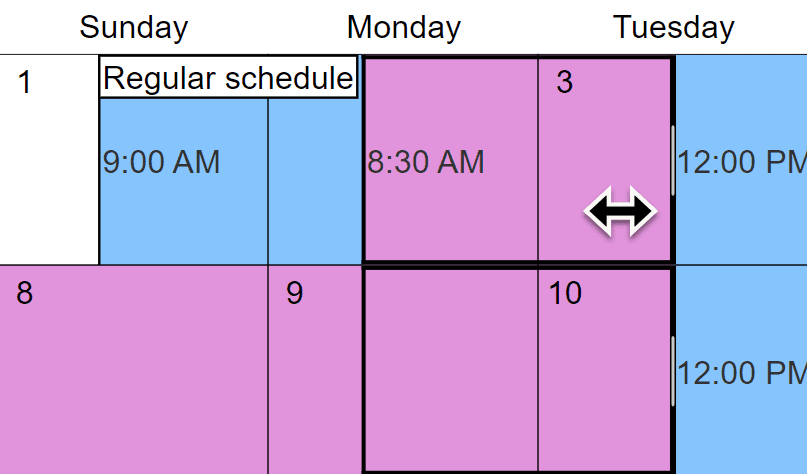
The Custody X Change app makes it easy. First, click and drag in your color-coded calendar.
Then watch a full description appear in your parenting plan.
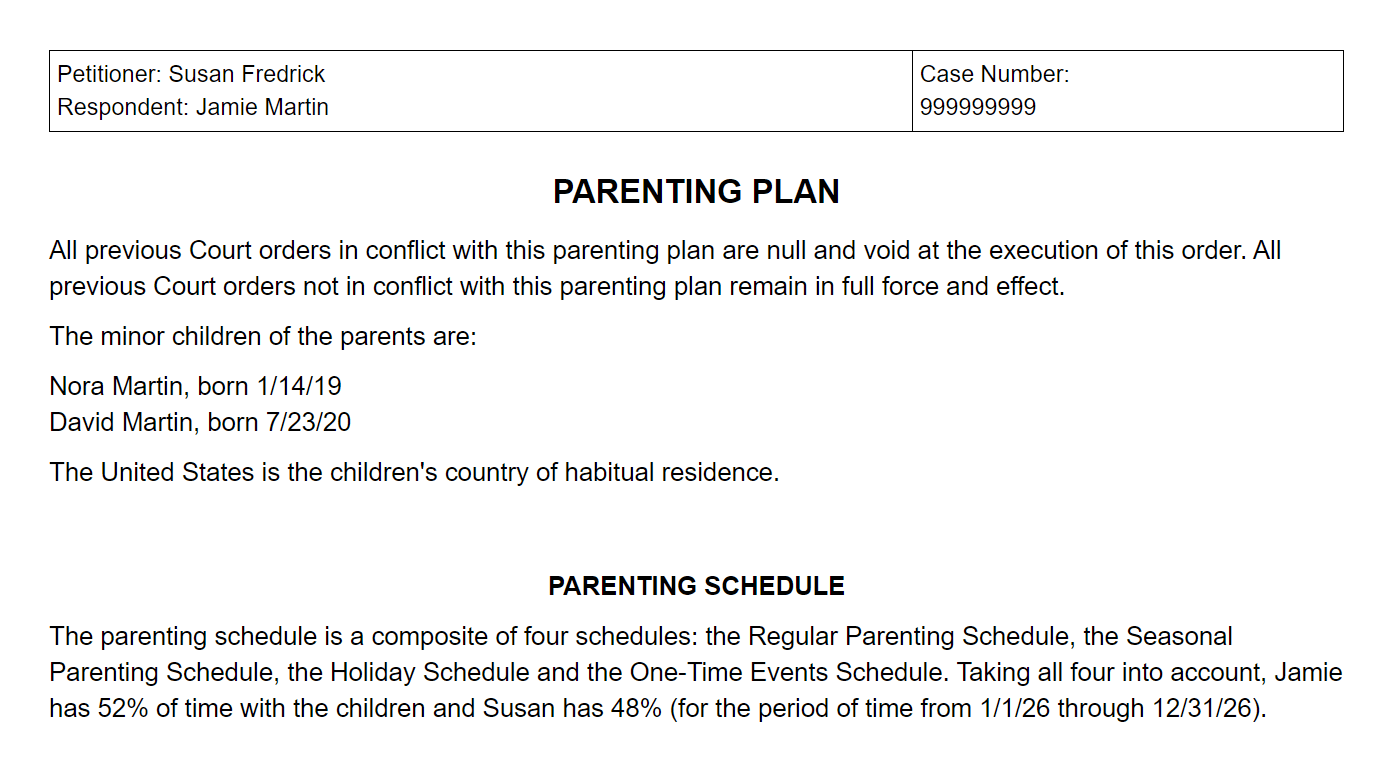
The combination of a visual and written schedule means your family will have no problem knowing who has the child when. Take advantage of Custody X Change to make your schedule as clear and thorough as can be.
Visualize your schedule. Get a written parenting plan. Calculate your parenting time.