
Ohio Parenting Plans and Custody Agreements
Ohio custody cases require a parenting plan (sometimes called a custody agreement in other states) that outlines how parents will share the rights and responsibilities of raising their children.
You and the other parent can draft a plan together. You can also create a plan on your own to negotiate with the other parent or present your requests to the court. Many aspects of making a parenting plan are the same regardless of your state. Below are guidelines specific to Ohio.
Trying to settle
Parents know what's best for their child. It's better for you to explain how you intend to parent than to wait for the court to tell you how you must parent.
If you settle, the judicial official turns your parenting plan into a court order, as long as it ensures the health, safety and welfare of your child.
If the case goes to trial, the judicial officer develops a parenting plan and issues it as part of your final order.
Templates
Many Ohio courts prefer shared parenting — in which parents have joint legal and residential custody — unless it would not benefit the children. You can use Ohio's shared parenting plan template. If shared parenting won't work for you, you can use Ohio's regular parenting plan template.

You're also free to use your own template (or a combination of templates) to customize or supplement your parenting plan. Many parents use the Custody X Change parenting plan template which lets you choose from over 140 provisions popular with parents.
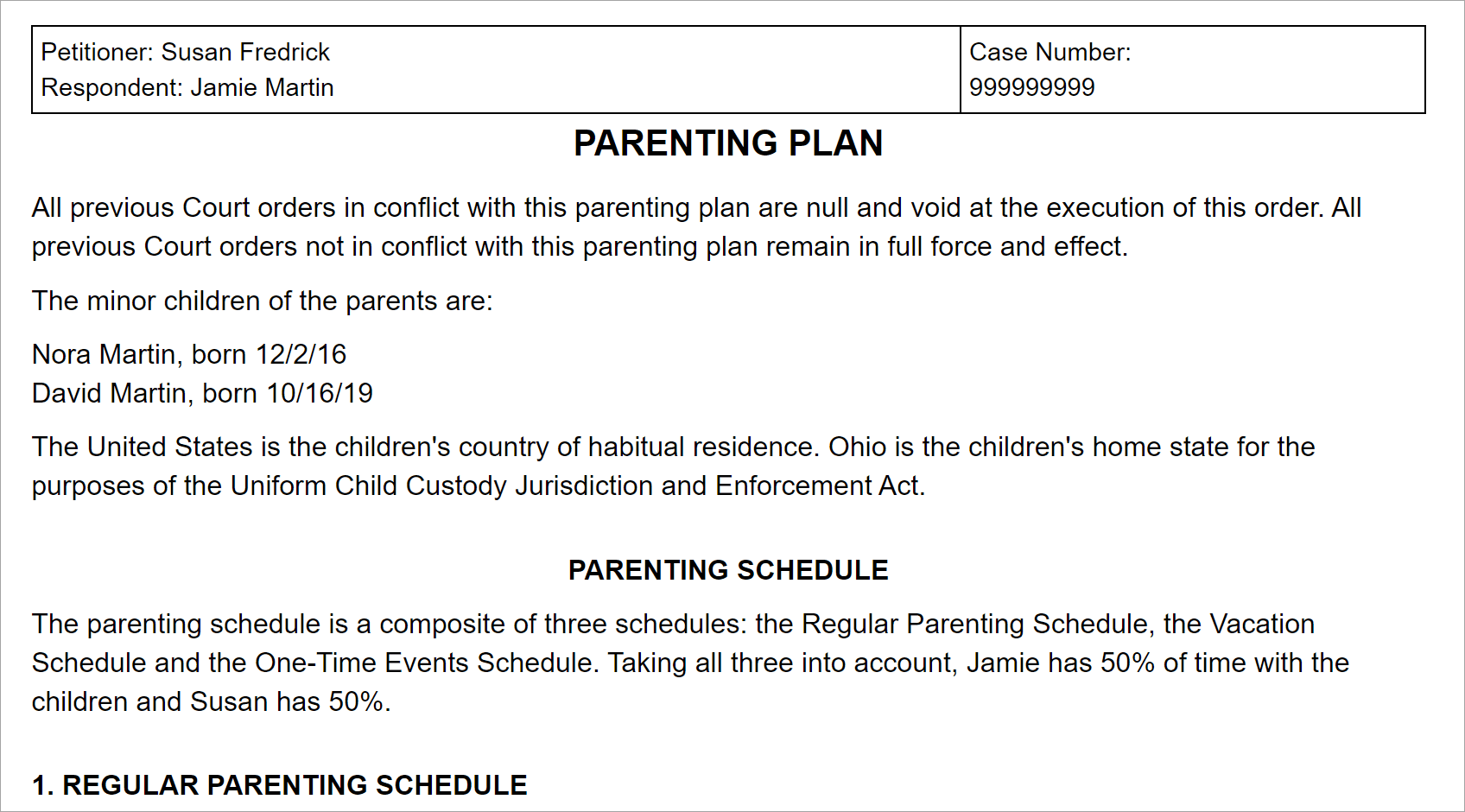 Try this with Custody X Change.
Information required in your plan
Your parenting plan must address three topics: residential custody, legal custody and child support.
Residential custody
Residential custody determines where the children live.
Specify whether one parent will have sole residential custody or the two parents will share joint residential custody. If you use joint custody, designate a residential parent for school enrollment purposes, meaning the children will enroll in the school district where that parent resides.
Include a written parenting time schedule to show when each parent will care for the children. Each child can have a different schedule, depending on their age and other factors.
In addition, you can include a visual parenting calendar to help explain the schedule.
Legal custody
Legal custody is the authority to make decisions for and about your children.
Your plan must state whether one parent will have sole legal custody or the two parents will share joint legal custody.
For joint custody, specify how parents will divide or collaborate on major decisions for the children. Some options:
- Require parents to agree on some or all major decisions.
- Allow parents to make decisions independently.
- Give one parent purview over certain decisions.
- Designate a third-party, such as a parenting coordinator, to resolve disagreements.
Child support
Plans must include a child support worksheet for sole/shared custody (or in rare cases, a child support worksheet for split custody) and a Health Insurance Affidavit, which helps determine who will pay for the children's health insurance.
If parents settle, they can agree on a child support amount and include it in their plan for court approval.
Additional information to include
You aren't required to have additional information in your plan, but courts encourage parents to include as much detail as possible.
To avoid later stress and confusion, try to think of all potential disagreements ahead of time, then stipulate in your plan exactly how they'll be handled.
Below are key parenting plan provisions Ohio lawyers and mediators advise clients to include.
Resolving disagreements
You can require a visit to a mediator or parenting coordinator to help you reach an agreement on certain decisions. And you can name someone, like the parenting coordinator or a mutual friend, to be the "tie-breaker" when you're at a standstill.
Expenses
In Ohio, many parents with similar incomes split large expenses evenly: medical bills, school tuition, etc. Each parent covers smaller costs when the children are in their care, and child support payments serve to even out these expenses. Specify in your plan whether you'll use this setup or a different one.
Claiming dependents
Designate who may claim the children as dependents on taxes. If you contribute equally to your children's needs, you can alternate who claims the children each year.
Relocation
Include a clause that mandates you and the other parent live within a certain area, such as a school district or county. You can also specify a time frame in which parents must notify one another of a move.
Exchanges
It's a good idea to specify that the receiving parent will be responsible for picking up the kids. The parent who's already with the children can often be distracted or want more time, so custody exchanges are more likely to happen punctually when the receiving parent does the transporting. (This does not apply to parenting plans in which parents meet at neutral locations or have monitored exchanges.)
Schedule specifics
Include definitions to support your parenting time schedule. Does the weekend begin at 3 p.m. on Friday? What length of time constitutes a dinner visit? Also, make sure your plan lays out ways to deal with unexpected scheduling changes. For example, what happens if a parent is suddenly unable to pick up the children?
Periodic schedule review
Your children's activities will change as they get older. Consider a provision that allows adjustments to the parenting time schedule every few years without going to court.
Response time
Plans should always state how long a parent must wait after contacting the other before they can act alone. For example: If two parents agreed to make decisions about extracurricular activities together, but one hasn't replied to an email about a new karate class, how long before the other parent can sign the kids up on their own?
Sharing information
Specify how you'll share important information with one another, such as:
- Your children's grades, test scores and other educational records
- Medical records
- Emergency contacts
- Travel itineraries when taking the children on vacation (flights, hotel, etc.)
Parent–child communication
Decide when and how to communicate with the children when they're with the other parent. What time is too late to call on a school night? Should you provide updates throughout the day? Is video calling okay?
New partners
Specify how you'll introduce new partners to your children. Should the other parent meet your partner before the children? How soon after relationships begin should you introduce your partner to the children? Are you comfortable with the kids addressing the partner as "mom" or "dad"?
Mutual respect
The amount of respect parents give one another impacts their children. Include a provision requiring respectful communication to hold both parents to a standard that fosters healthy family relationships.
Special circumstances
Your parenting plan should be unique to your family and reflect any special circumstances. Consider including specialized provisions in your plan, such as:
- Provisions for parents who live far apart
- Provisions for parents who live in different states
- Provisions when one parent's time with the children must be supervised
Making sure you don't overlook anything
While the state's parenting plan templates cover a lot of important information, they don't know your family's circumstances. To ensure your children's needs are fully addressed, make sure to add custom provisions or build your own plan.
Custody X Change enables you to do both. In the app, you can choose from over 140 provisions (as well as enter your own) to create a document that can attach to an Ohio template or stand alone.
In the end, you'll be glad you made a thorough plan that will work for you and your children for years to come.
More guidance
For more guidance as you create your parenting plan, see these resources:
- Age guidelines for parenting plans and schedules
- Temporary parenting plans and schedules
- Modifying your parenting plan and schedule