
NC Consent Orders, Parenting & Custody Agreements
North Carolina uses three types of parenting plans: consent orders, parenting agreements and child custody agreements. These plans define each parent's role in a child's custody. When writing a plan, you can use any format — including the Custody X Change template — as long as it meets the requirements for your situation (details below). If you hire a lawyer, mediator or other legal professional, they will help you create your plan.
If parents agree on custody, they use a plan to document their agreement. If they don't agree, they go to trial, where each parent can suggest a plan to the judge. Then the judge issues a permanent custody order.
Types of plans
North Carolina's three types of parenting plans contain much of the same information, though each is used differently.
Consent orders
Consent orders are the most common type of plan.
Parents submit a proposed consent order to the court when they settle a case without using a mediator, and it becomes a court order once signed by a judge. Parents can also submit proposed consent orders individually when they can't agree.
If you have an attorney, they will help you draft the document. If you don't, you can write your own consent order, but you should have an attorney review it.
A consent order may include information on child support payments.
Parenting agreements
Parenting agreements detail the terms of custody when parents settle through private or court-mandated mediation. They become court orders once a judge signs.
The mediator will draft the agreement. You, the other parent and your lawyers (if applicable) should review it before the mediator submits it to the court.
Parenting agreements cannot cover child support. You must apply for child support separately with North Carolina Child Support Services.
Child custody agreements
Custody agreements are contracts between parents that aren't filed with the court.
Attorneys warn that they can be difficult to modify or enforce, since they aren't court orders. Be sure to include information about how a court should handle breaches of the contract, in case you ever need to sue the other parent. Some parents eventually turn their agreement into a consent order to have it on file with the court.
Attorneys can draft an agreement, or parents can do it on their own. Either way, you must have it notarized.
Custody agreements are often part of separation agreements (contracts for separating or divorcing parents). If you and the other parent aren't married, you only need the custody agreement.
Unlike parenting agreements, custody agreements can address child support.
Required information
Your plan must list the children involved and their primary addresses. It must also list the parents, along with their home and work contact information. Both parents must sign.
In addition, all plans must detail:
- Whether parents will share joint legal custody or one will have sole legal custody
- For joint legal custody, who will make decisions about education, medical issues, extracurricular activities and religious participation
- Whether parents will share joint physical custody or one will have sole physical custody
- What visitation schedule parents will use
Additional information to consider
Courts encourage parents to include as much further detail as possible. To avoid later stress and confusion, try to think of all potential disagreements ahead of time, then stipulate in your plan exactly how they'll be handled.
Below are some common provisions to consider. You'll find over 140 like these in the Custody X Change app.
Transportation and exchange
Plans should include provisions about how and where exchanges will take place. Should they happen in a neutral location? At what time? Who will transport the child?
Relocation
Include a clause that mandates how you and the other parent will notify one another of a move. How much notice must you provide? How far can you move without the other parent's consent?
Response time
State how long one parent must wait after contacting the other before he or she can act alone. For example: If two parents agreed to make decisions about extracurricular activities together, but one hasn't replied to an email about a new karate class, how long before the other parent can sign the kids up alone?
Age considerations
Plans should anticipate future needs. For example, if you currently use an infant time-sharing schedule, how will your schedule change when the child is a toddler? How about when they start elementary school?
Parent–child communication
Decide when and how to communicate with the children while they're with the other parent. What time is too late to call on a school night? Is video calling allowed?
Factors the court will consider
The judge will turn your draft consent order or parenting agreement into a court order if it ensures the health, safety, and welfare of your child. He or she will look at the following to decide if your plan is in the child's best interest:
- Your child's age
- Your child's health
- Your child's relationship with each parent
- Your child's preference (if he or she is mature enough)
- Your child's ties to school, home and community
- Each parent's ability to care for the child
- Any evidence or history of drug or alcohol abuse by a parent
- Any history of abuse committed by a parent against the other parent or a past partner
- Any history of a parent abusing a child
More guidance
For more guidance as you create your parenting plan, see these resources:
The easiest way to make a parenting plan
When you're writing a parenting plan, it's critical you use airtight language that leaves no room for interpretation. You must also be careful not to omit any information required by the court. If you hire a lawyer or mediator, they'll write up the plan and ensure it meets the court's requirements.
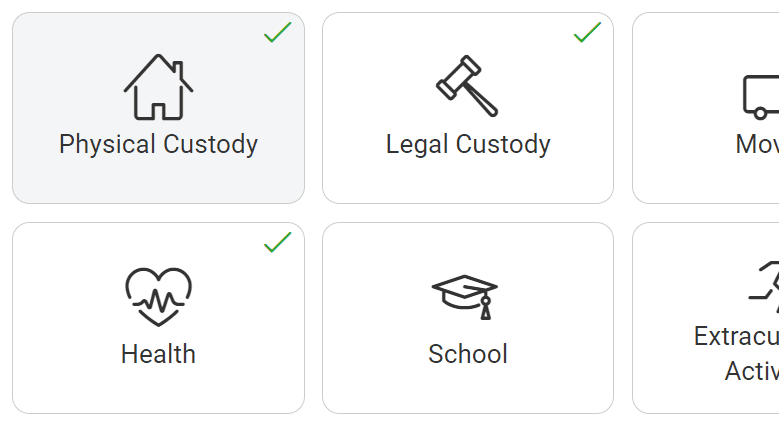
If you write your own plan, use technology to take guesswork out of the equation. The parenting plan template in the Custody X Change online app walks you through each step, whether you need a consent order, parenting agreement or child custody agreement.
 Try this with Custody X Change.
The result is a professional document that demonstrates your competence as a parent from the first glance.
The easiest and most reliable way to make a parenting plan is with Custody X Change.