
Manitoba Parenting Time Schedules
Your parenting time schedule details when your child will be in the care of either parent. You'll include a schedule in your proposed or agreed-upon parenting plan. When a judge decides or approves your plan and schedule at the end of the court process, both become part of a parenting order. Some parents choose to leave parenting time flexible (called reasonable parenting time), but a schedule is recommended to avoid disagreements and returns to court.
A lawyer, parenting coach or mediator can help parents come up with an arrangement outside of court if they cannot agree on one themselves.
Types of parenting time arrangements
There are three parenting time arrangements. The terminology used depends on whether you are divorcing or were in a common-law relationship, meaning you lived with the other parent for at least three years but never married.
- Shared parenting time (divorce) / Shared care and control (common-law): Each parent has the child in their care for at least 40% of the year.
- Majority parenting time (divorce) / Primary care and control (common-law): One parent has the child in their care for more than 60% of the year.
- Split parenting time (divorce) / Split care and control (common-law): Each parent has at least one of the children in their care for more than 60% of the year.
Supervised visits and supervised exchanges can be necessary. You'll find a supervision agency in Winnipeg and in Brandon.
In extremely rare circumstances, a parent won't have any parenting time if they are a threat to the child's well-being.
Shared parenting time schedules
There is a move toward awarding shared parenting in most cases — although it is not the default. Common shared schedules in Manitoba include the following.
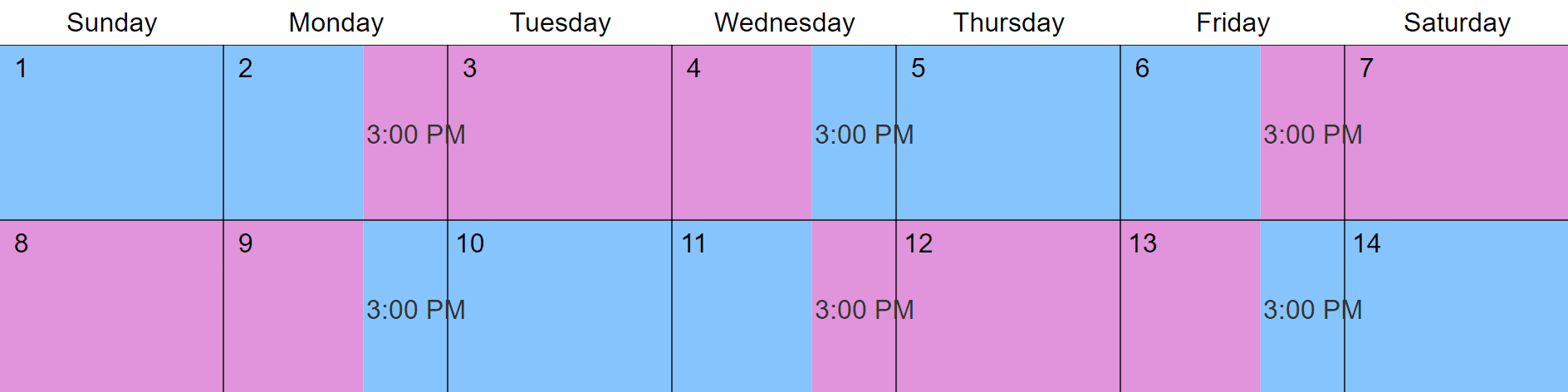
2-2-3 schedule (50/50 schedule)
The 2-2-3 schedule has the child stay with one parent for two days, then switch to the other parent's home for two days before returning to the first parent's home for three days.
Each week the start parent switches so that they end up with equal time over two weeks.
 Try this with Custody X Change.
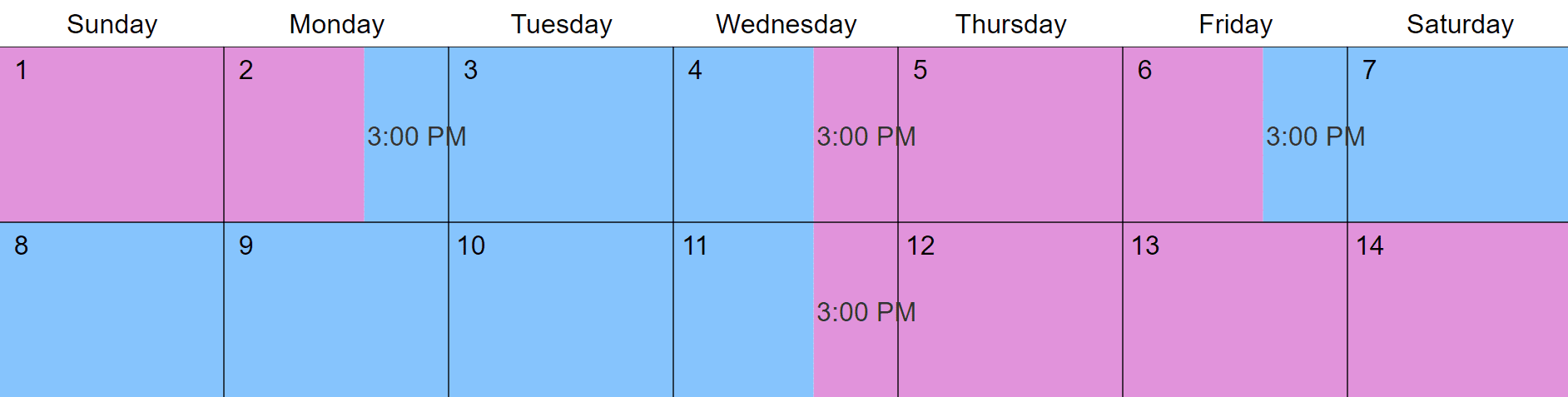
2-2-5-5 (50/50 schedule)
With the 2-2-5-5 schedule, the child lives with one parent for two days, switches to the other parent's household for two days, then completes the cycle by spending five days with each parent.
Every extended weekend schedule (60/40 schedule)
With the every extended weekend schedule, one parent has the child Monday through Friday while the other parent has them Friday through Monday.

Majority parenting time schedules
Majority parenting time is less common than shared parenting time. The following schedules are common when one parent has the majority of the time.
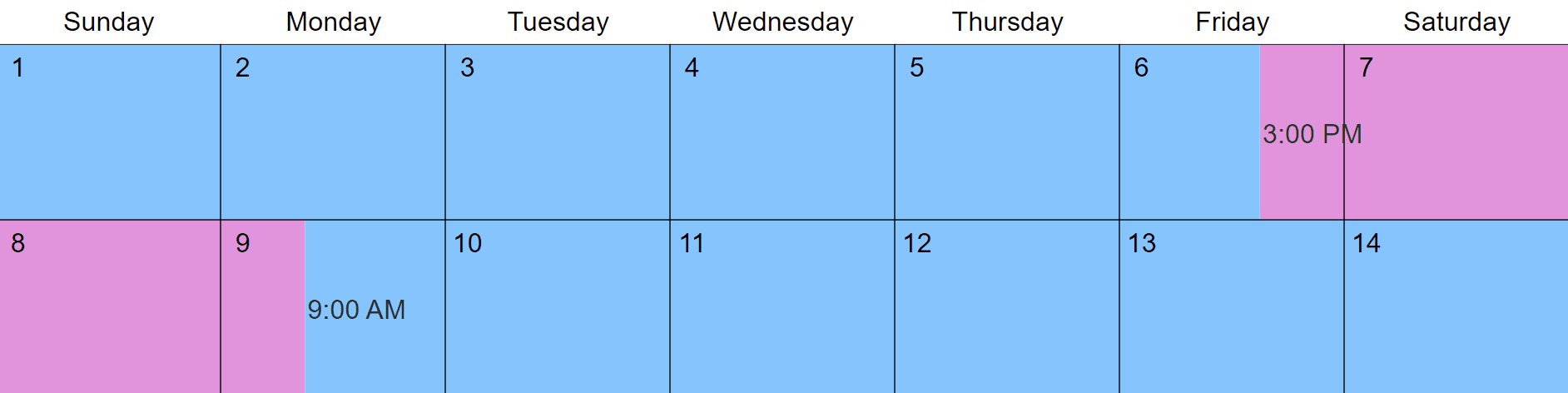
Alternating weekends (80/20 schedule)
With the alternating weekends schedule, the child lives with one parent on weekdays and transitions to the other parent's home every other weekend.
Every weekend schedule (70/30 schedule)
The every weekend schedule has your child live with one parent every weekend and the other parent throughout the weekdays.

5-2 schedule (70/30 schedule)
The 5-2 schedule has the child live with one parent for five days of the week and the other parent for two days. These days don't have to be consecutive.

Holidays and vacation schedules
Holidays and vacations provide valuable quality time for parents to spend with their children. Include this time in your schedule so both parents get a fair share of time.
Often in Manitoba, one parent celebrates a holiday a day early or late. For example, one parent might celebrate Thanksgiving on Sunday instead of Monday. Who has to celebrate on the off day can alternate every year.
Another way to split holidays is to split the day in half. For example, parents might exchange the child at 4 p.m. so they can each celebrate with the child for part of the day.
Vacations are also typically split evenly. If one parent lives far away, you might give them all of the school holiday time.
The easiest way to make a schedule
If you're like most parents, creating a parenting time schedule will feel daunting. How do you address holidays, school breaks and birthdays while ensuring the schedule will work in the years to come?
The Custody X Change app makes it easy. First, click and drag in your colour-coded calendar.
Try this with Custody X Change.
Then watch as your choices automatically apply to future years and a full description appears in your Custody X Change parenting plan.
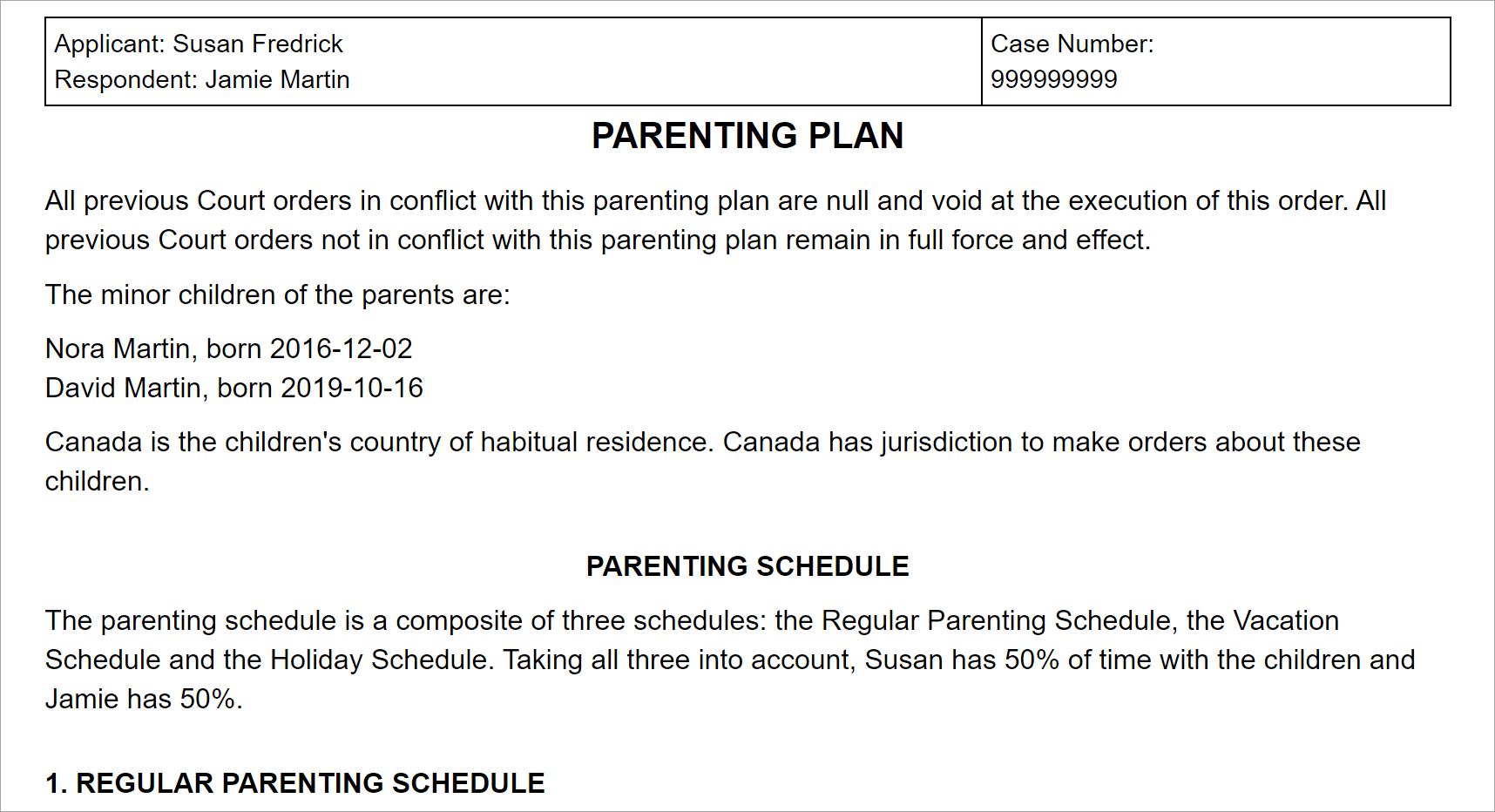
The combination of a visual and written schedule means your family will have no problem knowing who has the child when. Take advantage of Custody X Change to make your schedule as clear and thorough as can be.