
Indiana Parenting Plan & Custody Agreement Guidelines
A parenting plan details exactly how parents share rights and responsibilities for raising their child. It explains the parenting time schedule and the legal custody arrangement, including co-parenting rules.
When parents reach a settlement, they can choose to include the state's guideline rules or other rules they agree on in their plan. This may mean customizing or adding to the guideline rules. But when they can't agree, a judge decides the parenting plan in a final custody hearing. The plan generally includes Indiana's guideline parenting rules verbatim, though each parent can propose alternatives to the judge.
Negotiating a plan with the other parent
Before you resort to having a judge decide the details of your parenting plan, you should try to reach consensus with the other parent. You can have a mediator or attorney guide negotiations and write up the resulting plan (either before or after you open a court case.)
Bring multiple plans to negotiations to help you reach a compromise.
Try this with Custody X Change.
Using Indiana's guidelines
The Indiana Parenting Time Guidelines detail basic co-parenting rules, including rules for parenting time.
If you agree with the other parent to follow the guidelines as they are, you don't need to make a parenting plan. You can simply check the appropriate box on your court paperwork.
However, this option typically only works well when the noncustodial parent has minimal parenting time and legal custody responsibilities. Experts strongly recommend customizing the guideline rules and adding provisions specific to your family's situation.
Customizing the guideline rules
Consider these adjustments to make the guideline rules more specific and effective. While you can adapt wording, be sure to maintain the basic principle of the guideline so your settlement is approved by the court.
Communication
The guidelines include general rules for communication between parents and with the child.
Prevent confusion by creating provisions for parent-to-parent communication that lay out the exact methods allowed. Consider also including rules for response times.
To help you communicate civilly, plans can require parents to communicate using a parent messaging tool like the one from Custody X Change, which monitors for aggressive language and keeps an accurate record of your conversations.
You can also set parameters for how parents can communicate with the child during the other's time. For example, you might establish certain times for calls.
Implementing and changing parenting time
To ensure smooth exchanges, the guidelines include basic rules for transportation, punctuality, etc. They also broadly cover changes to parenting time.
Make life easier with custom provisions for exchanges and scheduling, including detailed rules about who can transport the child, where exchanges take place and what happens when a parent is late. Specify requirements for makeup parenting time and notifying the other parent of scheduling changes.
As dictated by the guidelines, when child care is needed, parents must give each other the chance to watch the child. Make this more specific by adding time requirements. (e.g., "When either parent requires child care for two hours or more, they must give the other parent first opportunity to care for the child.")
Exchange of information
The state's guidelines discuss how to share the child's information, including school and health records. Customize these rules to better meet your family's needs. For example, you might want to state that parents must use the child's legal name on everything — no nicknames or new last names.
Resolution of problems
The guidelines require that parents make a meaningful attempt to resolve co-parenting disputes before taking court action to enforce or modify the parenting plan. Additionally, if a parent does file in court for modifications, the guidelines require that parents attempt mediation.
Create more structure for settling disagreements with provisions for dispute resolution. Consider appointing a mutual friend or religious adviser to informally mediate disputes, or require that you try private mediation before returning to court.
Relocation
When either parent wants to move (even within the same city), Indiana law requires them to give the other parent and the court 90 days written notice (by registered mail). Within 20 days, the other parent must file a response with the court. If parents can't agree, the judge decides whether to approve or deny relocation.
Make relocation clearer by including specific moving requirements. Clarify how parents will handle moves within the same town, to somewhere else in Indiana and out of state. For example, you might require that parents get together to negotiate an out-of-state custody schedule if a parent wants to leave Indiana.
Adding parenting provisions
In addition to the guideline provisions above, consider the provisions below to ensure that your parenting plan meets all of your needs.
Decision-making and child-rearing
If you have joint legal custody, you should add specific provisions about how you'll make shared decisions about your child's education and extracurricular activities, medical care and more.
Consider additional parenting guidelines to establish requirements for discipline, religious participation, etc. You may want to include stipulations for children's social media usage, sleepovers, driving, employment and more. Many parents also include rules for how their new romantic partners will be introduced to and spend time with the children.
Some parents opt to divide types of decisions rather than making all decisions together. For example, one parent might make education decisions, while the other makes health decisions.
Age-based rules and changes
Include age-based provisions specific to your child's current needs.
Prepare for their development and future needs with age-based changes. Parenting stipulations for an infant often change when the child becomes a toddler, and children in elementary school require different rules than teenagers. Specify these changes and when they'll go into effect.
Safety
If your child's safety is a concern, create restrictions on parents' substance use, who can be around the children, physical discipline, firearms in the home and more. These provisions are often included when the court orders supervised visitation.
Child care
If your child goes to day care or regularly spends time with a third-party caregiver, you can specify who provides the care. (Child care expenses are included in your child support order.)
Expenses
Your child support order accounts for education, medical/dental insurance and child care expenses.
Usually, parents with similar incomes split additional large expenses. Then, each parent covers smaller, daily costs when caring for the child, and child support payments even out discrepancies. In your plan, specify whether you'll use this common arrangement or another.
Travel
Set how much notice parents must give each other before taking the child on vacation, who holds onto the child's passport, and other travel rules. If your child will travel alone to see the other parent, set parameters for this as well.
Parallel parenting plans
In cases with extremely high levels of conflict, the judge may order a parallel parenting plan, in which parents have minimal or even no contact with each other.
These plans typically give sole legal custody to one parent so parents don't have to make decisions together. Parents' communication is limited and always in writing (except in emergencies). The court may also require parents to use a messaging tool that keeps an accurate record of conversations and flags hostile language.
To further prevent parents from interacting, these plans also limit the number of parenting time exchanges and may require supervised exchanges. They also include court orders for counseling and, possibly, parent education classes or parenting coordination.
Parallel parenting plans are reviewed in a hearing every 180 days so the judge can decide if the plan should continue as is, be modified to address issues, or be replaced with a standard parenting plan.
The easiest way to make a parenting plan
When you create a parenting plan, it's critical you address all of your children's needs and use airtight language that leaves no room for interpretation.
If you're writing your own plan, use technology to take the guesswork out of the equation. The Custody X Change app will walk you through each step of creating a comprehensive parenting plan.
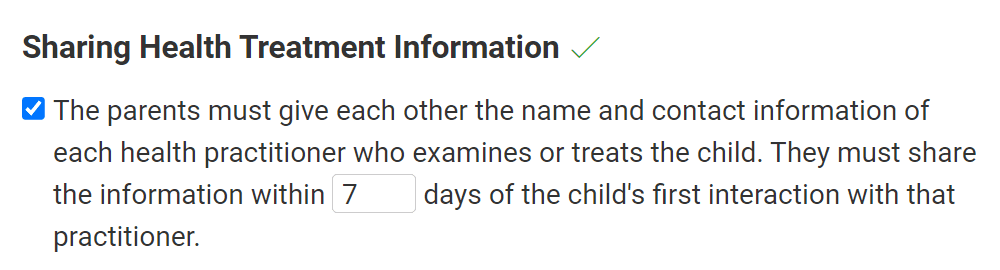
Choose from over 140 common provisions in more than 25 categories. Just select the items you want to include in your plan and fill in the blanks. You can also create custom provisions to meet your family's unique needs.
 Try this with Custody X Change.
The result will be a professional document that demonstrates your competence as a parent from the first glance.
The easiest and most reliable way to make a parenting plan is with Custody X Change.