
Florida Parenting Plan Guidelines
All parenting responsibility cases in Florida require a parenting plan. Your plan outlines how you and your co-parent will share the rights and responsibilities of raising your child, and it includes a time-sharing schedule.
Who writes the parenting plan
Parents who are settling submit a plan together. (This is sometimes called a custody agreement in other states.) The judge usually approves the plan as is, but they can make changes for the best interests of the child.
In a trial, each parent submits a proposed plan. The judge reviews the proposals and creates a final plan based on the evidence presented.
You can use any template or format — including the Custody X Change parenting plan template or a template from the Florida courts — as long as it meets the requirements for your situation (details below). If you use a lawyer, mediator, or other professional, they will help you create your plan.
General plan requirements
Courts won't accept a vague or incomplete parenting plan, so make sure yours is detailed and includes all required information. The more you explain how your family's needs and potential disagreements will be handled, the more effective your plan will be.
All plans must lay out:
- How parental rights, responsibilities and child care tasks will be shared
- How decisions about education, medical and dental care, extracurricular activities, religious participation, travel and discipline will be shared
- How expenses related to education, medical and dental care, and child care will be divided (This is separate from the child support arrangement.)
- How time-sharing will be divided, including time-sharing schedules
- How transportation and child exchanges will work
- How parents will communicate with each other
- How children will communicate with the parent they're away from
- How changes to the plan and schedules will be handled
- How conflicts related to the parenting plan and parenting time will be resolved
In addition, plans should anticipate future needs. For example, if you currently use an infant time-sharing schedule, explain how parenting time will change when the child is a toddler, when they start preschool/kindergarten and when they start elementary school.
You should also outline how you will make decisions for any other issues important to you and your children: special health needs, social media usage, etc.
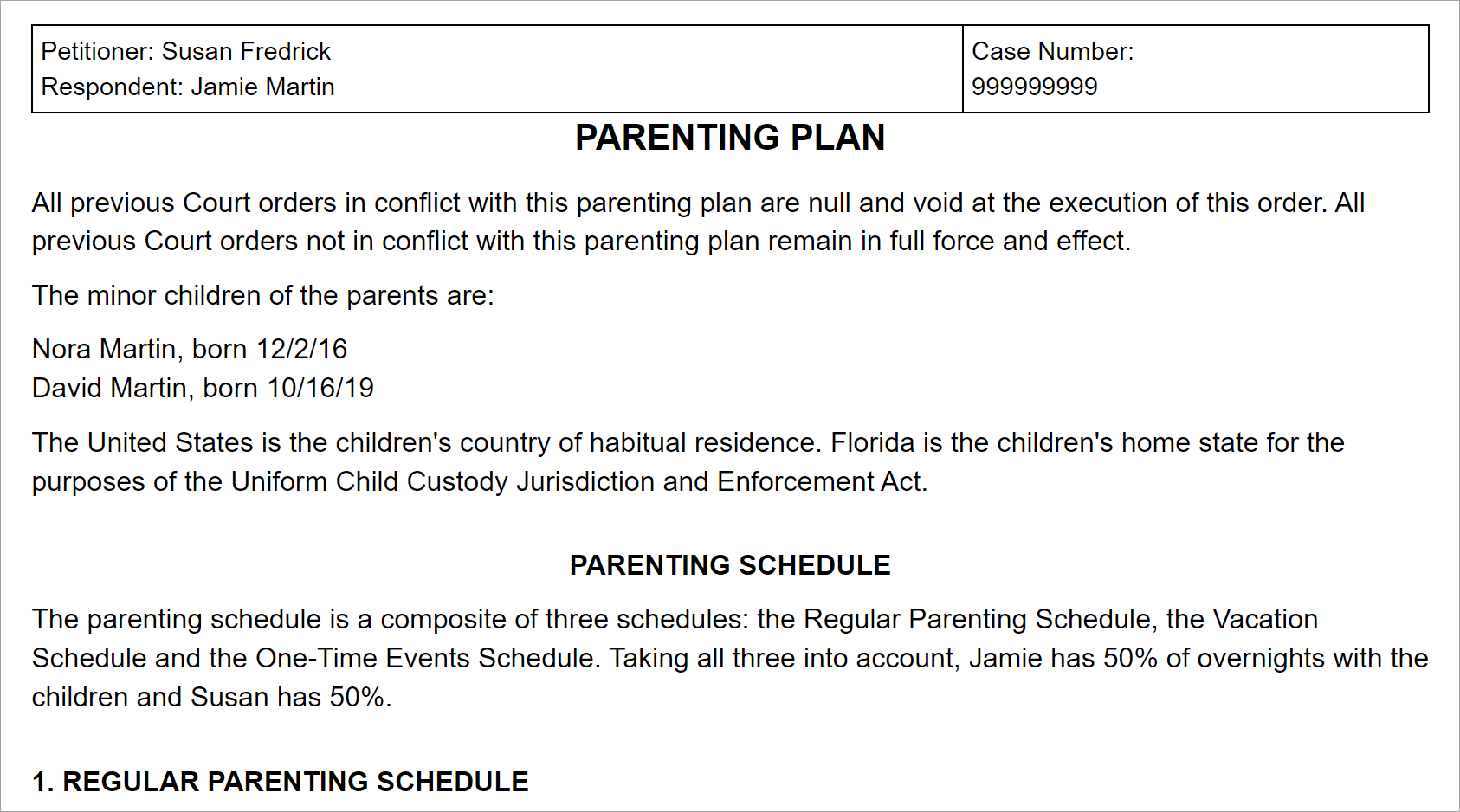 Try this with Custody X Change.
Types of plans
Florida uses four types of parenting plans. Each requires slightly different information, in addition to the requirements listed above.
Choose the plan that best fits your situation. You can use any template or format, as long as the required information is included.
The basic plan
Create a basic plan if you and the other parent:
- Agree on most aspects of parenting
- Communicate reasonably well
- Do not have a history of domestic violence, child abuse or substance abuse
- Are not planning to live more than 50 miles from each other
The basic plan doesn't require any information beyond what's mandatory for all Florida parenting plans (explained above).
The long-distance plan
Create a long-distance plan if you and the other parent:
- Agree on most aspects of parenting
- Communicate reasonably well
- Do not have a history of domestic violence, child abuse or substance abuse
- Are planning to live more than 50 miles from each other
The long-distance plan, sometimes called the relocation plan, requires additional details about children's travel between homes and their communication with the parent they're apart from.
The highly structured plan
Create a highly structured plan if you and the other parent:
- Struggle to agree on many aspects of parenting
- Need help communicating with each other civilly
- Do not have a history of domestic abuse, child abuse or substance abuse
This plan is for high-conflict cases with frequent disagreement. It's typically developed with mediators or lawyers.
It sets out strict rules for decision-making and time-sharing to prevent further conflict. It may include defaults for when parents can't come to an agreement, as well as statements of parenting principles and children's rights. Frequently, highly structured plans mandate parenting coordination.
A highly structured plan can be combined with a long-distance plan if parents live more than 50 miles apart.
The safety-focused plan
Create a safety-focused plan if one parent puts the children at risk due to issues like:
- Domestic violence
- Child abuse
- Substance abuse
- Criminal activity
This plan prioritizes children's physical safety while maintaining the parent–child relationship.
In the safety-focused plan, the parent who poses a risk receives supervised parenting time or parenting time that has other restrictions on it (e.g., parenting time in public places only). If supervision is required, the plan must explain who will supervise and where.
In extreme circumstances, the court may deny a parent time-sharing entirely because it's in the children's best interests. This would be indicated in the safety-focused plan.
A family safety plan is also required, which may include restrictions on firearms, physical discipline, parents' substance use and who can have contact with the children.
If parents live more than 50 miles from each other, a safety-focused plan can be combined with a long-distance plan. It can also merge with a highly structured plan if necessary.
Modifying your parenting plan
Florida courts only modify an approved parenting plan if at least one of the following is true:
- The children's safety is at risk.
- The children would benefit significantly.
- A parent has become unable to fulfill their obligations.
- The family meets requirements for modification laid out in the plan itself.
When a parent asks the court to modify an order, both parties present their arguments to a judge. They follow a legal process similar to that of getting the original orders.
However, many changes parents agree on can be made outside of court. This is why plans should explain what will happen when parents don't see eye to eye on a potential change. They might use lawyers, a parenting coordinator or a mediator to reach agreement.
Always document changes carefully. Some county courts require parents to submit signed statements verifying that they agree to a change agreed upon outside of court.
The easiest way to make a parenting plan
When you're writing a parenting plan, it's critical you use airtight language that leaves no room for interpretation. You must also be careful not to omit any information required by the court.
If you hire a lawyer or mediator, they'll write up the plan and ensure it meets the court's requirements.
If you write your own plan, use technology to take guesswork out of the equation. The parenting plan template in the Custody X Change online app walks you through each step.
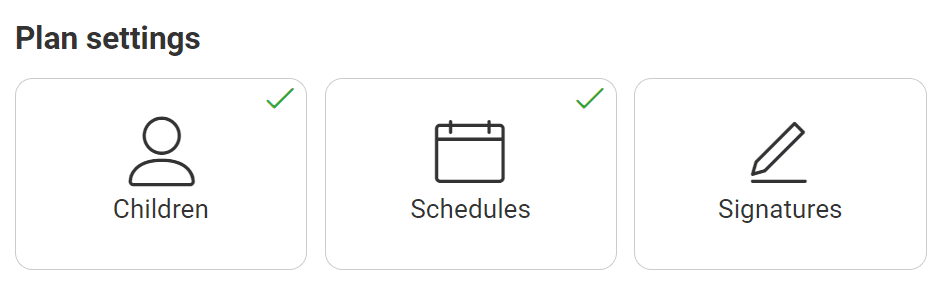
The result is a professional document that demonstrates your competence as a parent from the first glance.
The easiest and most reliable way to make a parenting plan is with Custody X Change.