
California Custody and Visitation Schedule Guidelines
These guidelines will help you make your custody and visitation schedule, which explains how your family plans to divide parenting time. A schedule is one part of your California parenting plan.
You will need to submit a schedule and parenting plan to the court if you settle your case. You can also present a suggested schedule and plan during trial or in negotiation settings like mediation and collaborative law conferences.
Before you put together a schedule, consider your child's unique needs and remember that it will affect your child support payment. Contact your local court to learn if your county or courthouse has any specific rules, regulations or forms.
Choosing a type of physical custody
Physical custody refers to how parents share time with their child. Before you make a detailed schedule, decide if joint physical custody or sole physical custody would be best for your child, and include this required element in your parenting plan.
In joint physical custody, your child spends significant time with both parents. In sole physical custody, your child lives primarily with one parent and (usually) has visits with the other.
If you and the other parent agree on the type of physical custody you want, the court will approve it unless there are concerns about the child's well-being. If you do not agree, the court will decide for you.
If you want sole physical custody and the other parent does not concur, you must show the court how it would be in your child's best interest.
Showing the details of your physical custody arrangement
You will explain the details of your physical custody arrangement through a custody and visitation schedule. The schedule should specify:
- If/how parents will split time with the child on weekdays
- If/how parents will split time with the child on weekends
- If/how parents will split time with the child during school breaks
- If/how parents will split time with the child on holidays and special occasions
- If/when each parent can take the child on vacation
Your schedule must have a written version. You have the option to add a visual custody calendar for easier comprehension.
Common schedules for joint physical custody
You can create a schedule from scratch or look at popular parenting schedules for ideas.
California prefers to give children significant time with both parents whenever it's in their best interest. Below are examples of schedules you could use to give equal time to two parents.
The alternating weeks schedule has your child spend seven days with one parent, then seven days with the other.
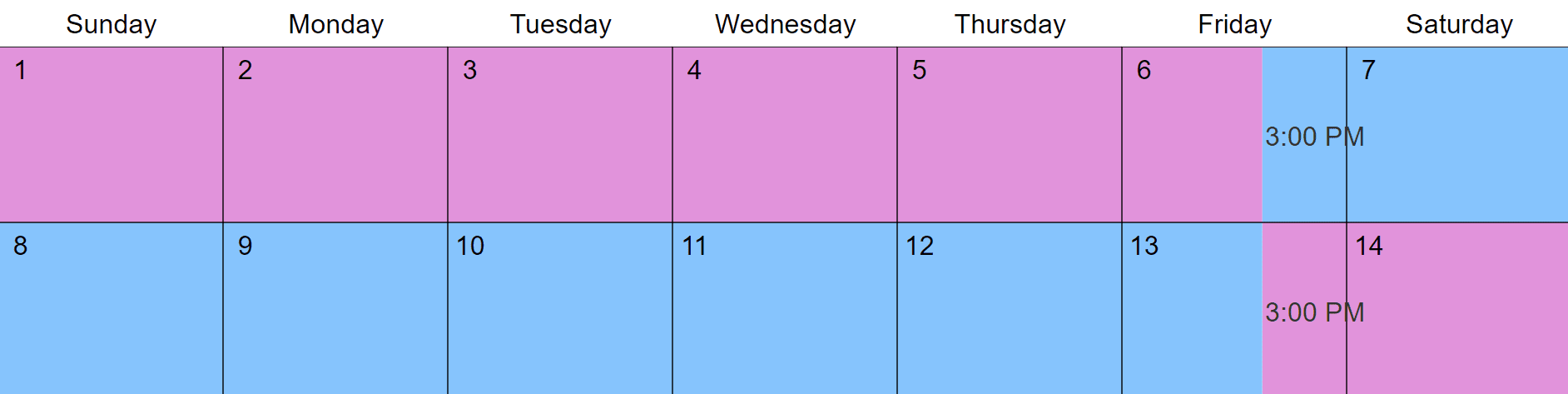
You can customize this to fit your situation with Custody X Change.
The 3-4-4-3 schedule has your child spend three days with one parent, then four days with the other parent. The next week, the child spends four days with the first parent, then three days with the other.
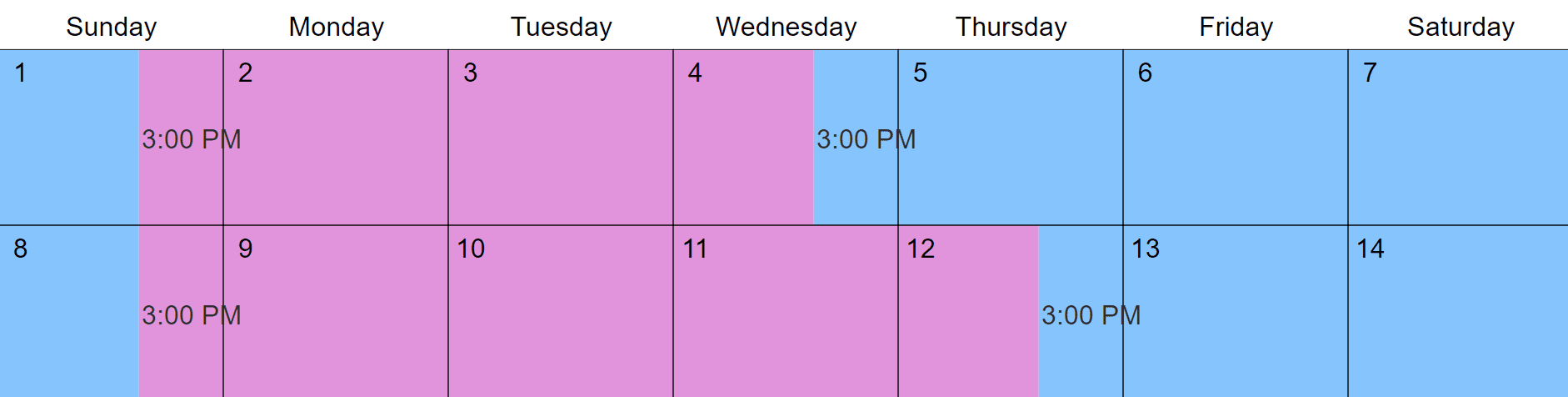
You can customize this to fit your situation with Custody X Change.
Other custody and visitation arrangements
If necessary, you can have supervised visitation, where your child visits the noncustodial parent only when supervised by another adult.
You can also ask the court for no visitation if it's better for the child not to be around one parent.
If you want to share parenting time without a detailed schedule, you can include general information about joint or sole physical custody in your plan and say that parents agree to reasonable visitation.
A reasonable visitation arrangement doesn't have scheduled dates or times. Instead, parents plan visits as they go.
Reasonable visitation can work if parents get along and communicate well. But if there's frequent conflict, a schedule works better.
The court can grant visitation to stepparents, grandparents, foster parents and any other person that has played a significant role in the child's life, as long as the court finds it in the best interest of the child.
Visitation awarded to a nonparent shouldn't interfere with a parent's visitation time. Keep this in mind when making your visitation schedule, if applicable.
Age-based considerations
Custody and visitation schedules are often distinct for children of different ages — sometimes even within one family. In addition, schedules often need to change as a child grows.
Infants and toddlers need frequent, consistent contact with caretakers to develop secure relationships and limit anxiety. Older children are able to handle longer periods away from each parent but need their extracurricular activities and social lives accounted for.
The easiest way to make a schedule
If you're like most parents, creating a custody and visitation schedule will feel daunting. How do you make something that meets legal requirements and doesn't leave any loose ends?
The Custody X Change app makes it easy. Either customize a schedule template, or click and drag in your custody calendar to make a schedule from scratch.
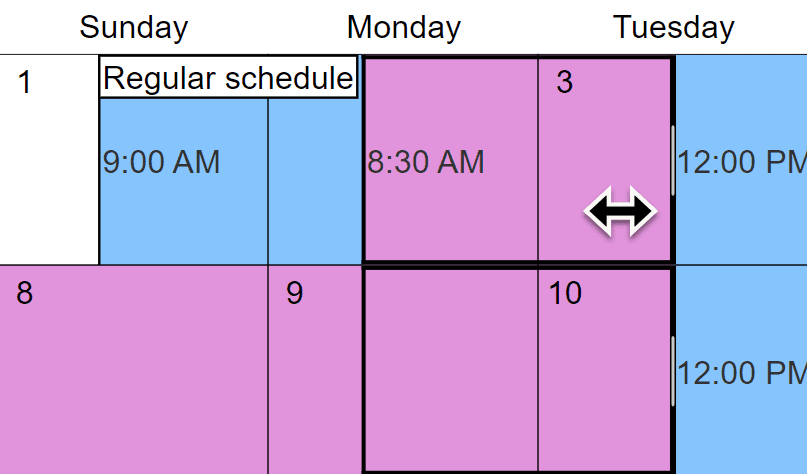
You can customize this to fit your situation with Custody X Change.
Then watch a full description appear in your parenting plan. The app will even walk you through how to address holidays and vacations.
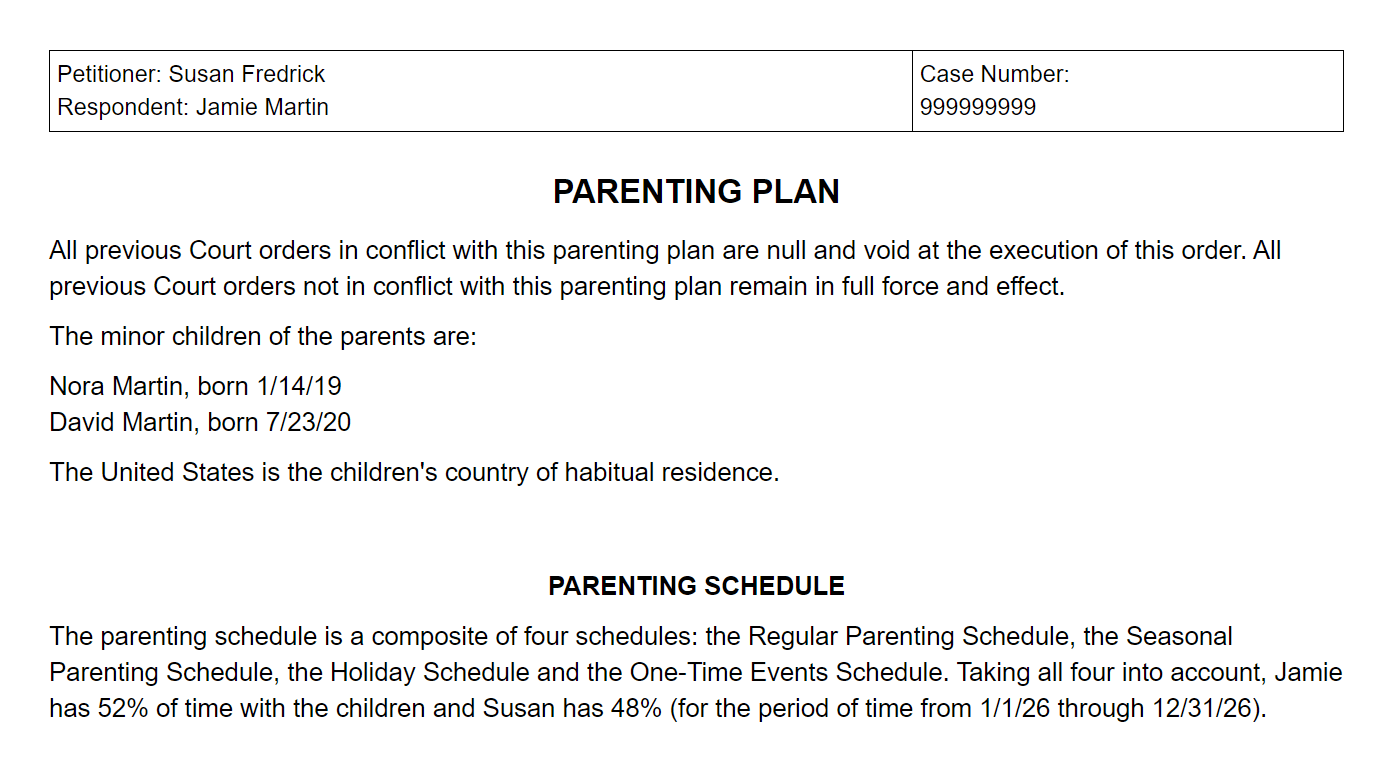
You can customize this to fit your situation with Custody X Change.
The written description is what the court will enforce if your schedule becomes a court order. Take advantage of Custody X Change to make it as clear and thorough as can be.