
Alabama Parenting Agreements (Parenting Plans)
A parenting agreement (often called a parenting plan) describes how you'll care for your child after a divorce, breakup or legal separation.
If you and the other parent will both be involved in the child's life, the Alabama judge who hears your case will want you to present a parenting agreement. You can do this with the other parent to settle your custody or divorce case, and the judge will likely approve it. But if you can't agree, write a thoughtful proposal on your own, and submit it before trial as an exhibit. Doing so not only helps you make your argument, it gives the judge essential information as they decide your case.
Choosing a template
You can hire a mediator or a lawyer to help you draft a parenting agreement. They'll have their own templates.
You can also use an app like Custody X Change. The Custody X Change parenting plan template walks you through more than 140 common provisions and helps you create a custody schedule for your family.
Your local courthouse may have a standard order available, which shows what your judge tends to order and the format they tend to use. Use this as a guide if you write your agreement without professional help, but don't be afraid to stray from what's standard to meet your family's needs.
Including a schedule
Alabama courts prefer that fit parents have frequent contact with their child, but there's no assumption of joint physical custody or equal parenting time.
Whether you propose joint or sole physical custody, make it clear what parenting time schedule you want. Address holiday and vacation schedules in addition to regular parenting time.
You can get ideas from anywhere. The Alabama Law Institute's handbook has hundreds of pages of schedule variations. Custody X Change schedule templates help you customize popular schedules in a few clicks.
 Try this with Custody X Change.
Typical provisions
A complete proposal must state the basics of how you'll care for your child: legal and physical custody, child support and anything else essential to your child's wellbeing.
The more detail you can provide about how you'll parent, the more likely you are to persuade the judge. You can even ask your judge what they hope to see in your agreement.
Try this with Custody X Change.
Sharing contact information
Generally, co-parents need to keep each other updated about their addresses and phone numbers, and they both should serve as emergency contacts for their child. Write down this expectation.

Making decisions together
If you're asking for joint legal custody but you anticipate disagreements with the other parent, you can specify who has the final say for certain decisions. You can propose your own decision-making categories. The usual ones include:
- Education
- Religion
- Civics
- Culture
- Athletics (and other activities)
- Health care (including dental)
Communicating
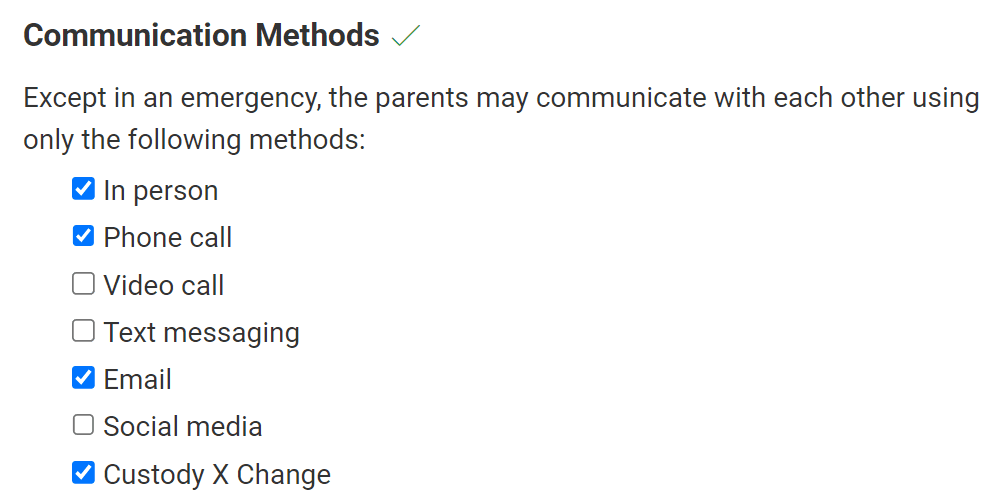
Say also how you agree to communicate with the other parent — for example, by text message and email. Then consider how you'll communicate with your child when it's not your parenting time. Specify whether this communication can only happen within certain hours.
Exchanging the child
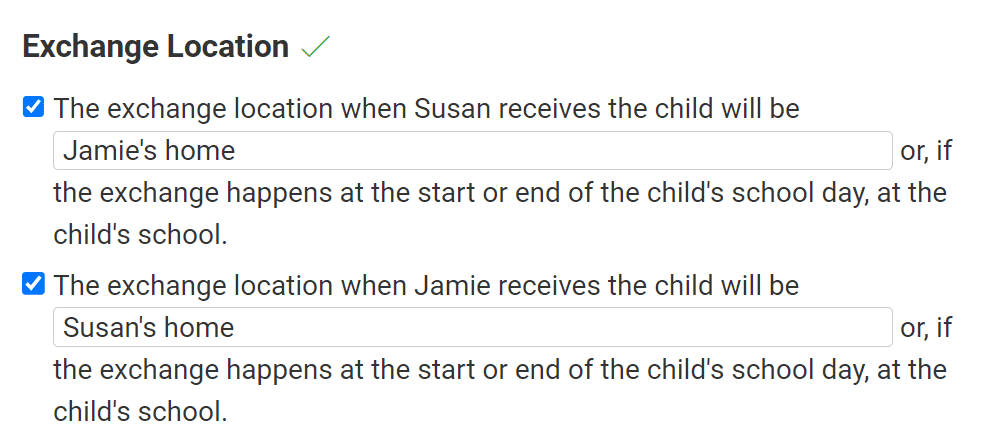
Plan your exchanges. When the other parent's time is beginning, will they arrive at your home to pick up the child? Will you bring the child to the other parent's home? Will you meet somewhere else, like school? How long will you wait for each other if someone is running late?
Making changes to the schedule
Everyone has to reschedule now and then, so set expectations for courtesy. How much advance notice will you expect the other parent to give you? If one parent gives too little advance notice or is a no-show, do they also forfeit the right to ask for makeup parenting time?
Other provisions to consider
Some parents agree with each other to include morality clauses. For example, they may agree that, until they remarry, their romantic partners won't spend the night while the child is in their home. Judges can't order such clauses against parents' wishes unless the purpose is to prevent child endangerment.
Child support ends when the child turns 19, and a judge can't force parents to pay for their child's college. However, some parents reach an agreement about how they will (or won't) cover college costs, and the court may help enforce it later. If you say how you'll pay for college, specify if there will be a dollar limit or an age cutoff.
If you're divorcing, you're probably writing a broader marital settlement agreement that covers topics like property division. Your parenting agreement is one part of that larger agreement.
Your parenting agreement should cover any topics important to raising your unique child. The focus should always be on your child's best interests.
Planning for tomorrow and the years to come
Your co-parenting situation might be in flux. And every child's needs change as they grow. A thorough parenting plan meets your immediate needs while anticipating the far-off future.
You can ask for a court order that is only temporary — taking effect just during the months you're waiting for a hearing or final trial, for example. If this is what you want, clearly identify your parenting proposal as temporary, and follow the court procedure for requesting a temporary order.
In a proposal for a permanent order, include details to show how you and the other parent will meet your child's needs in the years to come. For instance, you could choose a new schedule to follow once your child starts high school.
You can also ask the court to change your parenting agreement after it's been ordered, but try to plan ahead so you don't have to do this often.
The easiest way to make a parenting agreement
When you're writing a parenting agreement, it's critical you use airtight language that leaves no room for interpretation. You must also be careful not to omit any information required by the court.
If you hire a lawyer, they'll write up the plan and ensure it meets the judge's expectations.
If you write your own plan, use technology to take guesswork out of the equation. The parenting plan template in the Custody X Change online app walks you through each step.
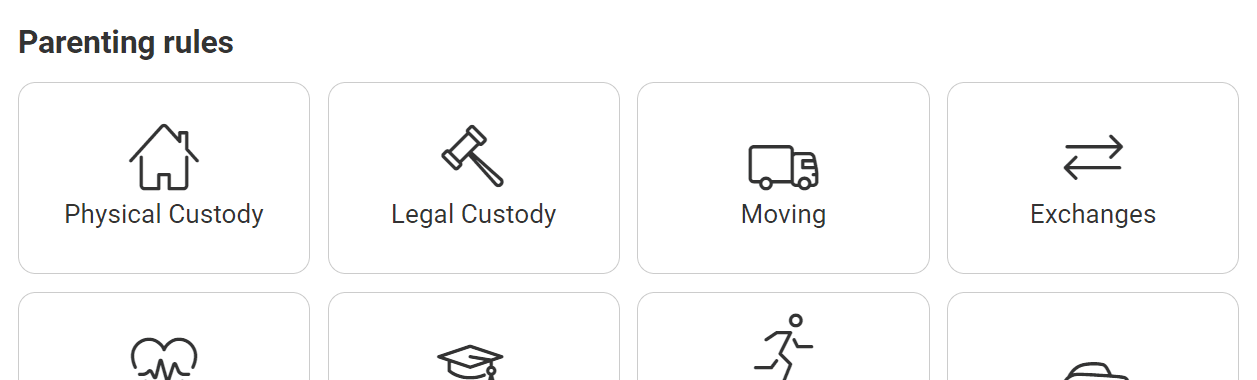
The result is a professional document that demonstrates your competence as a parent from the first glance.
The easiest and most reliable way to make a parenting agreement is with Custody X Change.