
Washington Residential Schedule Guidelines
Residential schedules explain where a child lives and how much time they spend with each parent. A schedule is one part of your parenting plan.
You will need to submit a schedule to the court if you settle your case. You can also present a suggested schedule at trial or in negotiation settings like mediation and collaborative law sessions.
Before you put together a schedule, consider your child's unique needs and contact your superior court to find out if it has any unique rules or forms.
Visualize your schedule. Get a written parenting plan. Calculate your parenting time.
Choosing a type of schedule
Begin by deciding if a joint residential schedule or sole residential schedule would be best for your child.
With a joint residential schedule, your child lives with both parents. With a sole residential schedule, your child lives primarily with one parent and usually has visits with the other.
No matter the schedule, the parent with the majority of their child's time is the primary residential parent. The other is the nonprimary residential parent. (Keep in mind that the nonprimary parent pays child support.)
The court will approve whatever type of residential schedule you and the other parent agree on, unless it has concerns about the child's well-being.
If you can't agree, the court will decide for you after a trial. Expect a joint residential schedule, as this is the default, as long as it's in the child's best interest. If you want a sole schedule and the other parent disagrees, you must prove it would benefit your child.
Common schedules
Parents can adjust common residential schedules to fit their needs or create a schedule from scratch. Here are some examples for you to consider.
2-2-5-5: Your child spends two days with one parent, two days with the other parent, then five days with the first parent and the next five with the second parent. The schedule then repeats. This is a 50/50 schedule, meaning each parent has the child 50 percent of the time.
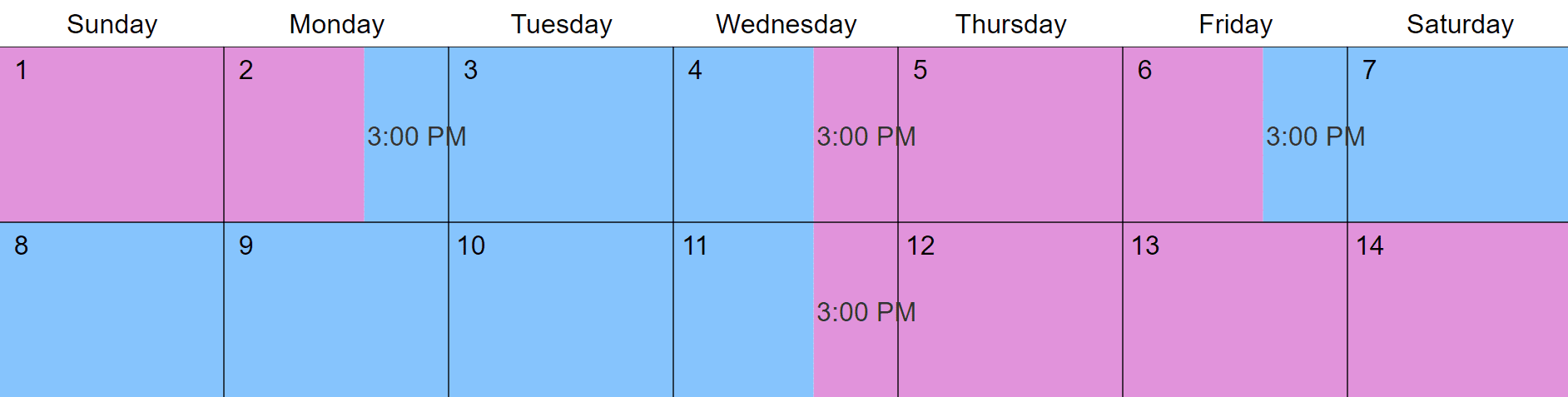
Every weekend: Your child spends weekdays with one parent and weekends with the other. This is a 70/30 schedule.

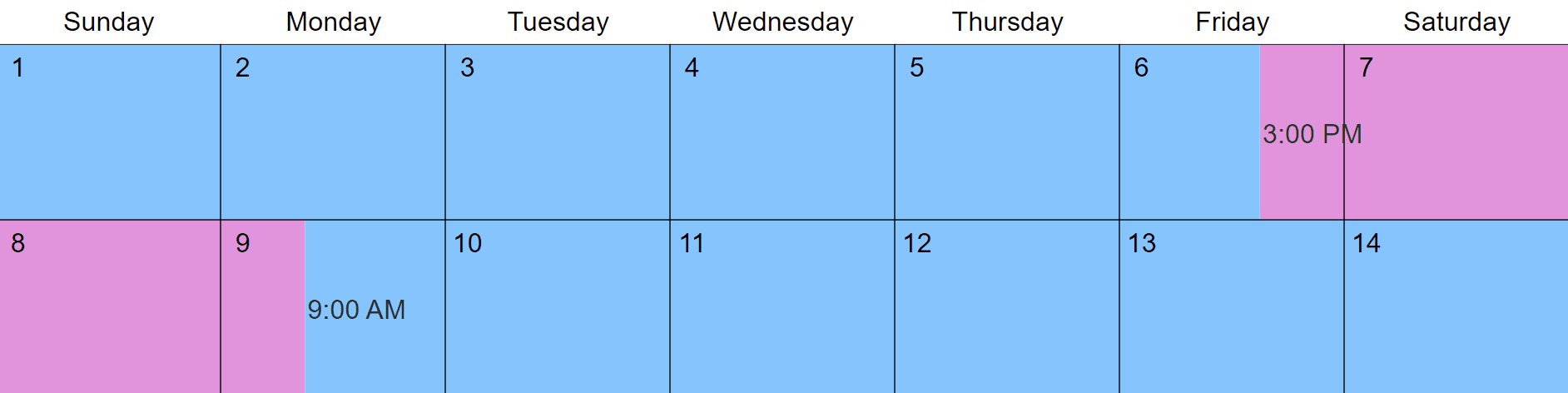
Alternating weekends: Your child lives with one parent and spends every other weekend with the other parent. This is an 80/20 schedule.
Showing the details of your schedule
Your schedule must have a written version. You have the option to add a visual custody calendar for easier comprehension. Both should specify:
- If/how parents will split time with the child on weekdays
- If/how parents will split time with the child on weekends
- If/how parents will split time with the child during school breaks
- If/how parents will split time with the child on holidays and special occasions
- If/when each parent can take the child on vacation
There are many ways to arrange custody for a holiday. You might give each parent half the day, alternate who has custody, or let one parent have custody every year (common for Mother's Day and Father's Day).
Specify that the holiday schedule overrides the regular residential schedule. And, if you make a different schedule for summer break or other school breaks, state what will happen when holidays conflict with it.
Parents should also consider how vacation time will work. How long can a trip last? Can it overlap with the other parent's scheduled time? Can the child miss school? How soon does the other parent need to be notified? Address these issues in your parenting plan.
A couple more tips for writing your schedule:
- Allow flexibility in unexpected situations.
- Use specific language that applies to any year.
"The child shall visit Dad on Mondays and Wednesdays from 3 p.m. to 6 p.m. Pacific time, unless circumstances necessitate otherwise."
"For three-day weekends not already detailed, the child will spend the additional day off with the parent who has the attached weekend."
Other schedule arrangements
Supervised visitation is often necessary when a child would be at risk if left alone with a parent. Some counties in Washington have supervised visitation centers — neutral sites where a parent's interactions with their child are monitored by professionals.
Courts may require supervised visitation, reduce a parent's time with their child or even eliminate visits altogether when the parent has a history of abuse or addiction.
The easiest way to make a schedule
If you're like most parents, creating a residential schedule will feel daunting. How do you write something that meets legal requirements and doesn't leave any loose ends?
The Custody X Change app makes it easy. Either customize a schedule template, or click and drag in your custody calendar to make a schedule from scratch.
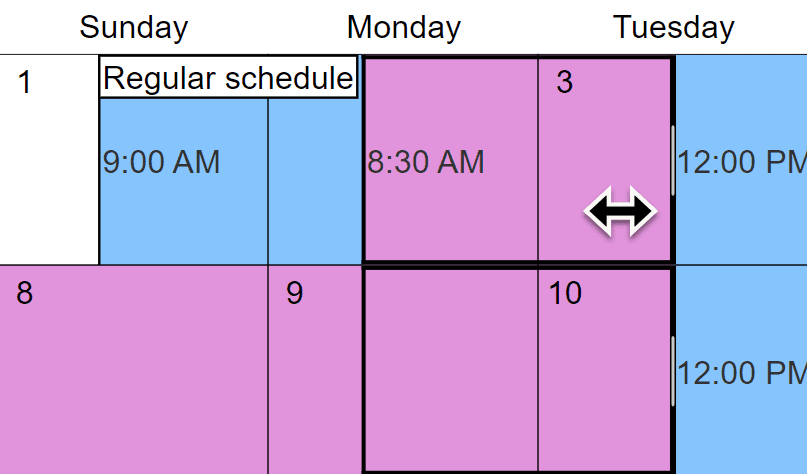

The combination of a visual and written schedule means your family will have no problem knowing who has the child when. Take advantage of Custody X Change to make your schedule as clear and thorough as can be.
Visualize your schedule. Get a written parenting plan. Calculate your parenting time.