
Virginia Parenting Time Schedule Guidelines (Visitation)
Your physical custody arrangement determines whom your children live and spend time with. The details are explained in a parenting time schedule (also called a visitation schedule).
If your divorce case requires a separation period, you can also write a schedule into your separation agreement.
Parents can agree on a schedule in a settlement, often with the help of lawyers or a mediator. When parents can't agree, each proposes a schedule in trial, and a judge decides after assessing the children's best interests.
Visualize your schedule. Get a written parenting plan. Calculate your parenting time.
You should choose a schedule tailored to your children's needs and your family's situation. A flexible arrangement is possible if your court thinks it's a good fit, but most cases end up with a specific schedule for parents to follow.
In addition to when they'll exchange the children, parents need rules for how they'll exchange the children: what happens if a parent is late, what the kids must bring between homes, etc. You can include these provisions alongside your schedule or in your parenting plan.
Liberal and reasonable (flexible) parenting time
Occasionally, in settlements with joint physical custody, the courts allow liberal and reasonable parenting time. In this flexible arrangement, parents agree to an approximate division of time (e.g., 50/50 or 70/30) and work together to create a schedule as they go.
This option is only recommended when parents agree easily and communicate effectively. It often works best for parents with older teenagers.
Courts typically can't enforce liberal and reasonable time. If a parent feels they're not seeing the children enough, they have to negotiate with the other parent or return to court to get modified orders with a specific schedule.
Specific schedules (recommended)
The vast majority of cases result in a specific parenting time schedule. Specific schedules are generally preferred because they:
- Ensure children have adequate time with each parent
- Create structure and stability
- Include plans for school breaks, holidays and special occasions
- Can be enforced by the court
Judges must issue a specific schedule for contested cases, and some judges won't approve a settlement that lacks one.
A schedule is always detailed in writing. Adding a visual parenting calendar is strongly recommended and may be required by your court or judge. In both versions, clearly note start and end times (e.g., 4 p.m. Friday to 8 a.m. Monday for extended weekend visits).
Long-distance schedules
If parents live far apart, they might use a long-distance schedule, in which exchanges are less frequent than usual.
Alongside their schedule or in their parenting plan, they should include travel provisions. The provisions might cover whether the children can travel alone, how to share travel expenses, etc.
Popular schedules for specific parenting time
You have countless options for parenting time schedules. You can choose a common schedule and adapt it to your family's needs, or you can invent your own.
Equal parenting time schedules
Whenever reasonable, courts prefer schedules that give parents equal time.
In the alternating every 2 days schedule, children live with each parent for two days at a time. This arrangement is common for parents who live close to each other or have young children.
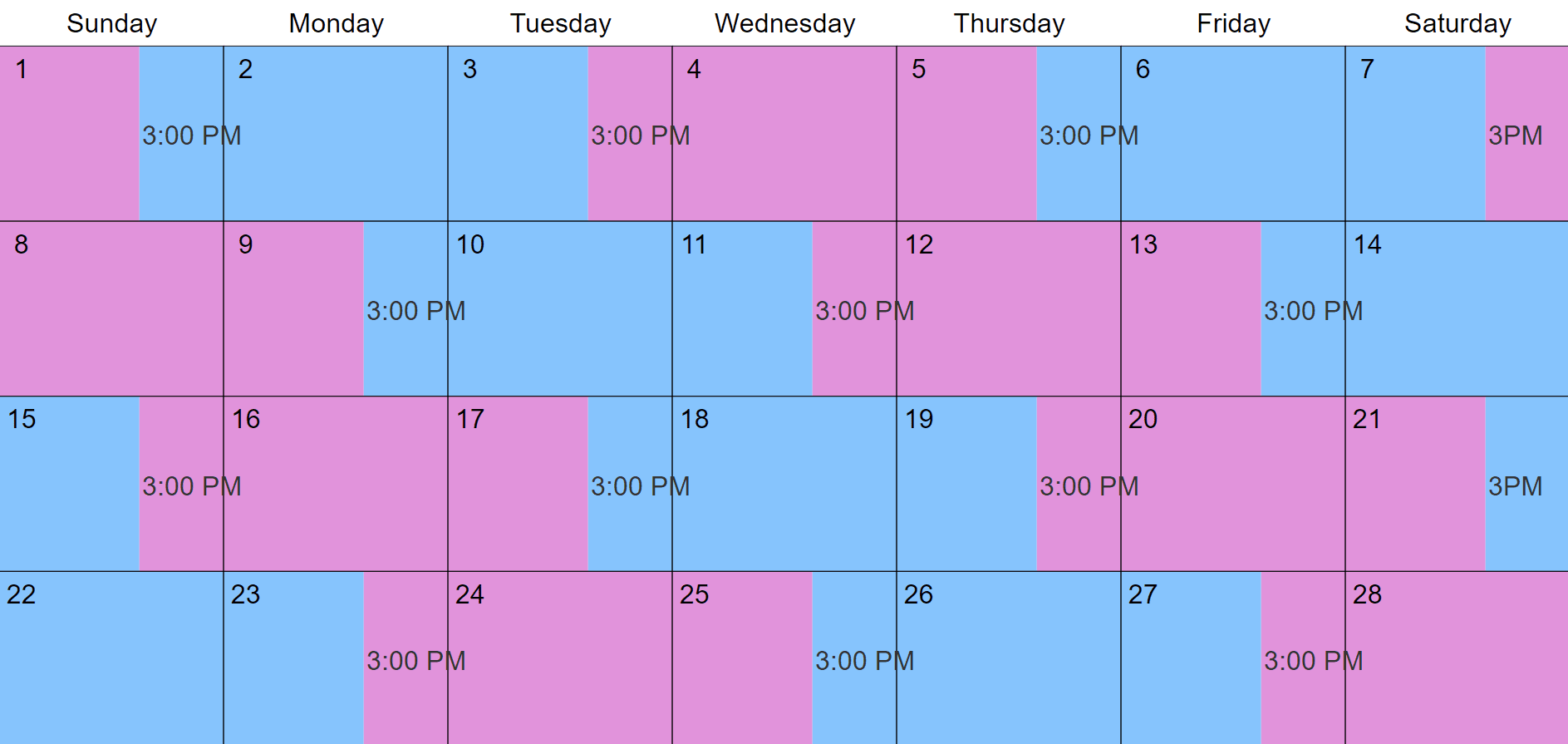
In the 3-4-4-3 schedule, children spend three days with one parent and then four days with the other. Then, it switches so children spend four days with the first parent and three days with the other.
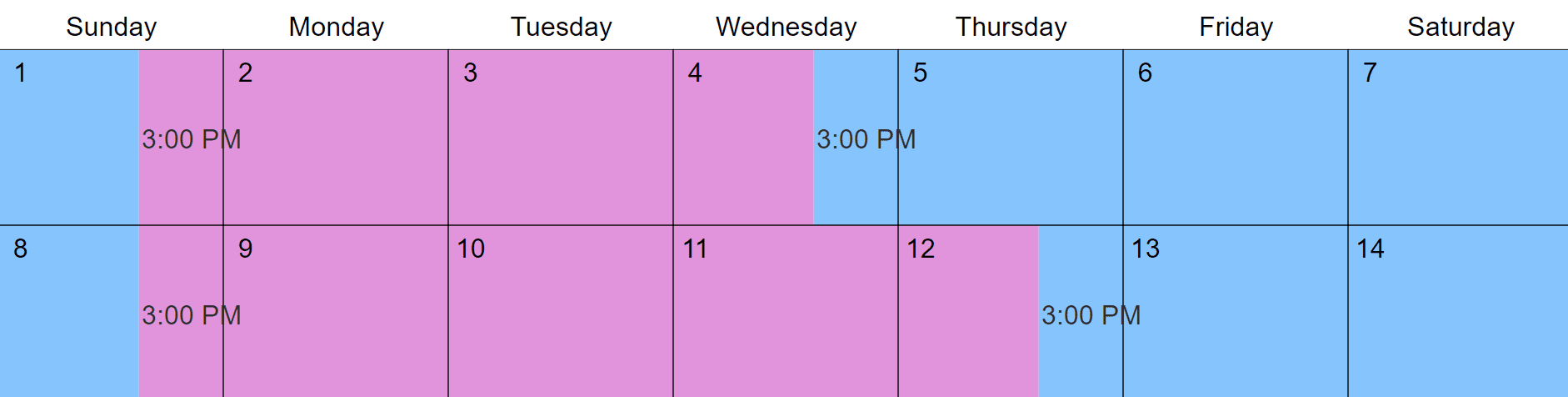
Parents who want fewer exchanges often use the alternating weeks schedule, in which children spend seven days with one parent, then seven days with the other.
Other schedules
When children live mostly with one parent, that parent is considered custodial, and the other is called noncustodial. These terms typically refer to the physical arrangement only — the parents often still share joint legal custody.
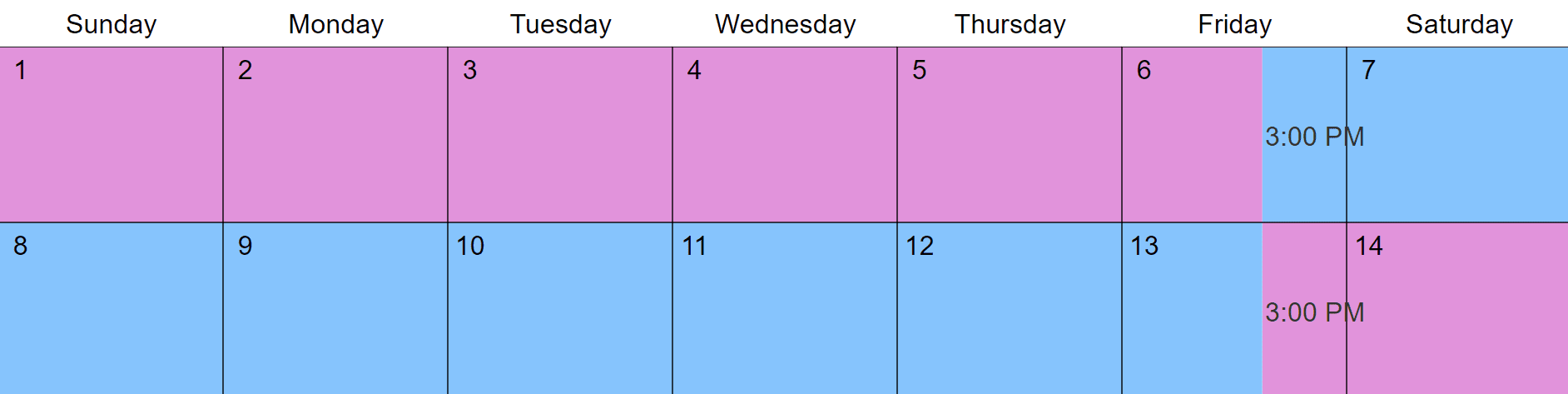
A common arrangement is the every extended weekend schedule. Children live with the custodial parent during the week and spend Friday afternoon to Monday morning with the noncustodial parent.

The 4-3 schedule has children live with the custodial parent for four days, then with the other for three days.

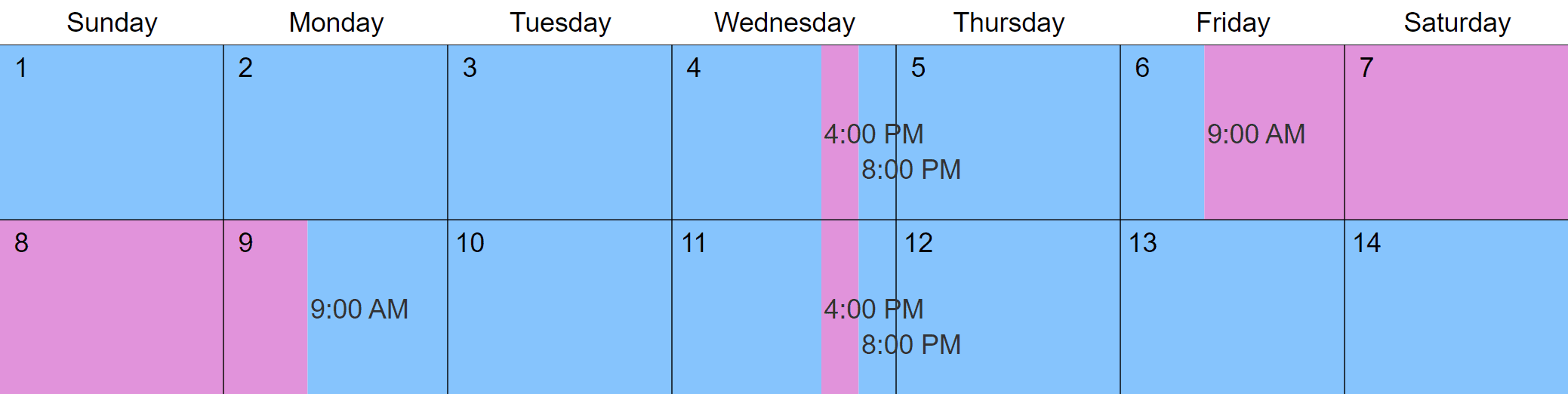
Another common arrangement in Virginia has the children with the noncustodial parent every other weekend and one weekday evening per week. This is a variation of an alternating weekends schedule.
Supervised visitation and exchanges
The court can order supervised visitation or exchanges if they need to protect children or parents.
When being alone with a parent would put the children's safety or emotional well-being at risk, they order supervised visitation. This is common when a parent has spent little time with the children or has a history of crime, family abuse, neglect or substance abuse.
When parents have a violent or particularly combative relationship, they order supervised exchanges, in which a third party helps transfer the children so parents have minimal or no interaction.
How Virginia counts parenting time for child support
When both parents have at least 90 days a year with the children, parenting time becomes a factor in their child support calculation.
Virginia has a unique way of counting days. Overnight visits under 24 hours count as half a day, 24-hour visits count as a day, and other visits don't count at all.
You can count parenting time manually, or you can use the Custody X Change app. To use the app, first adjust its automatic calculation to meet Virginia's definition of a day. Here's how:
- In your account settings, make sure your calculations are set to "hours" and "year."
- If you haven't yet, enter your custody schedules into a calendar.
- Duplicate the calendar so you can make changes for the calculation without affecting the original.
- In the new calendar, remove any non-overnight visits belonging to the parent with less custody time. You can do this by dragging a visit's start time to its end time.
- Next, adjust that parent's overnight visits that are less than 24 hours long to make them 12 hours long.
- Then, shorten their remaining visits to the nearest multiple of 12 hours. (e.g., Drag a 47-hour visit to make it a 36-hour visit.)
- Lastly, find the parent's annual time percentage at the top of the screen. Multiply it (as a decimal) by 365 to see how many days they have with the children a year, according to how most Virginia judges count. (e.g., 40 percent equals 146 days.)
A traditional calculation of parenting time in days or hours can also be useful. It can help convince a judge to deviate from the suggested child support payment.
The easiest way to make a schedule
If you're like most parents, creating a parenting time schedule will feel daunting. How do you write something that meets legal requirements and doesn't leave any loose ends?
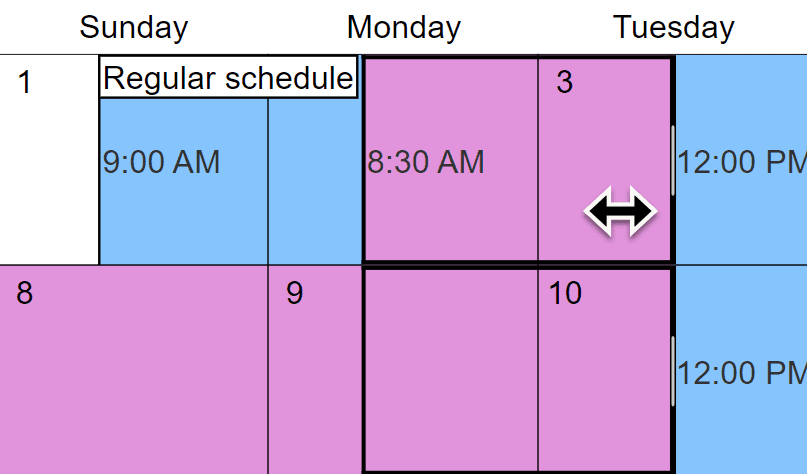
Custody X Change makes it easy. Either customize a schedule template, or click and drag in your custody calendar to make a schedule from scratch.
Then watch a full description appear in your parenting plan.
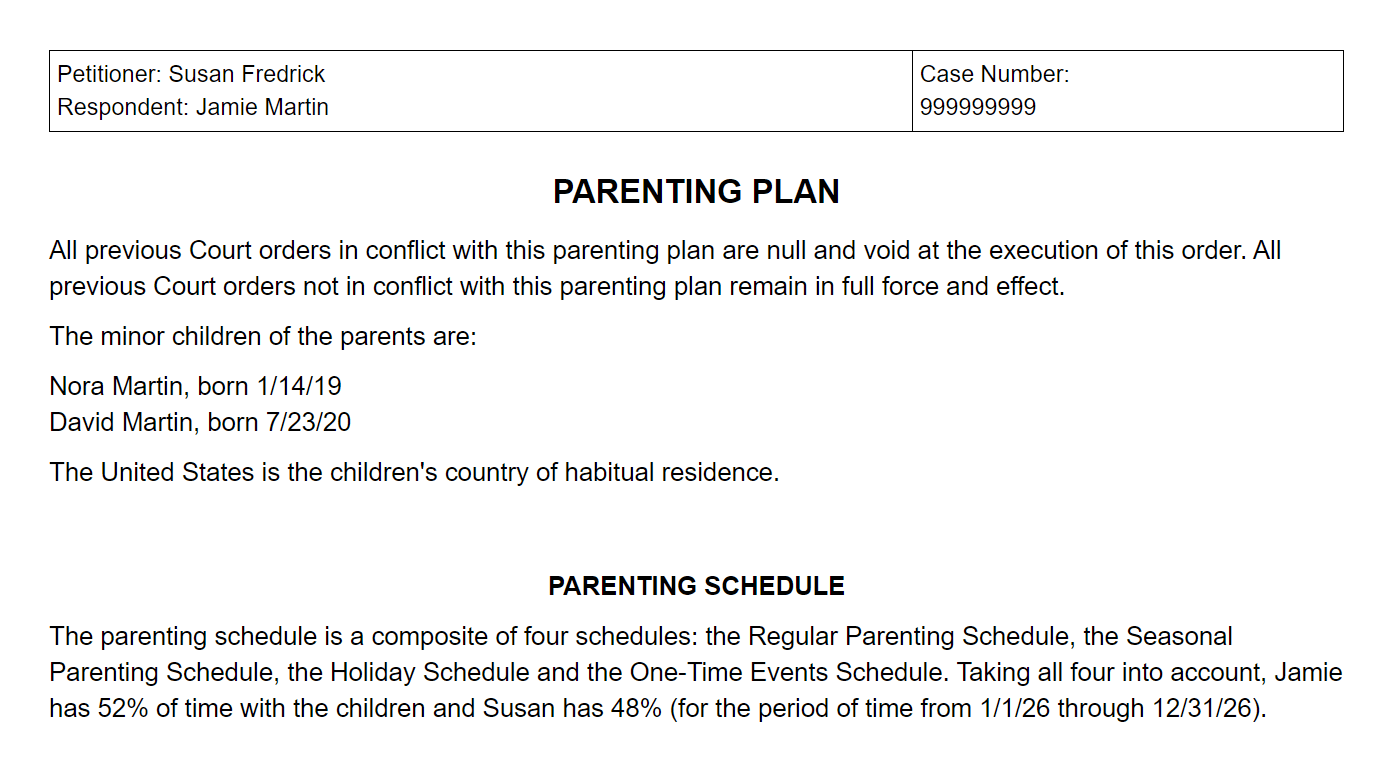
The combination of a visual and written schedule means your family will have no problem knowing who has the children when. Take advantage of Custody X Change to make your schedule as clear and thorough as can be.
Visualize your schedule. Get a written parenting plan. Calculate your parenting time.