
Texas Parenting Plan and Agreement Guidelines
Parenting plans (called custody agreements in some other states) address how issues involving children — like conservatorship, possession and child support — will be handled following a family law case.
They become legally enforceable when a judge includes them in a court order.
Often, courts require each parent to propose a plan. Even if it's not required, you can still choose to do so.
You will also need a plan if you settle your case, and you can bring one to mediation or other negotiations to propose to the other parent.
Visualize your schedule. Get a written parenting plan. Calculate your parenting time.
If parents submit an agreed-upon plan to the court, a judge will make it a court order, unless it would be harmful to the child. The court may look more scrupulously at agreements reached without involvement from neutral professionals (such as mediators, arbitrators or collaborative law teams.)
Your attorney will help you draft a plan, or you can use Custody X Change to make a plan on your own.
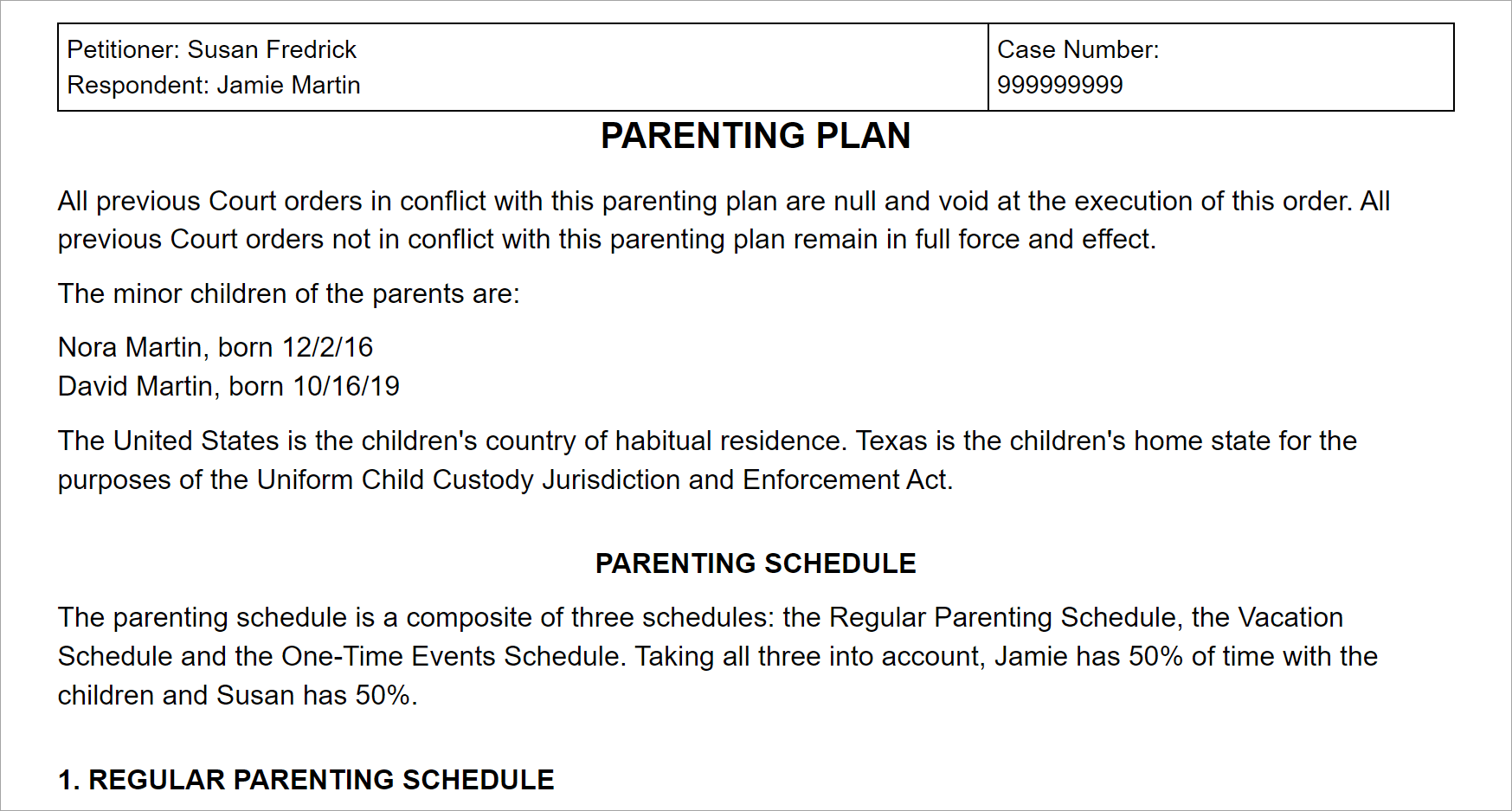
Information required in a Texas parenting plan
Your parenting plan should have the names of all children in the case near the top of the document.
It should include anything you requested in your initial filing and must also specify:
- If each parent will be a managing conservator or a possessory conservator (At least one must be a managing conservator.)
- How parents will share or divide decision-making rights and responsibilities
- How parents will share or divide rights and responsibilities regarding the physical care, support and education of the child
- Which parent has the right to choose the child's main residence (i.e., which will be the custodial conservator) and whether or not the residence must be within a certain area (If parents share this right, designate an area within which both will live.)
- A possession and access schedule explaining when the child will be with each parent
- If either parent will pay child support and how much
- How the parents will pay the child's medical and dental costs
- Provisions to minimize disruptions to the child's education, routine and friendships
Standard provisions in a parenting plan
The Texas standard possession order (SPO) includes the following provisions. (The standard possession order is what a judge orders as default, unless circumstances warrant or parents agree otherwise.) You can choose whether to include any of these provisions in the plan you create.
- A conservator must notify the other when unable to take possession of the child as planned.
- Each conservator may designate a competent adult to pick up and return the child on their behalf.
- Each conservator must return the child with the personal items the child arrived with.
- If a conservator's time with a child ends when school begins, they must immediately notify the school and the other conservator if the child will miss school.
- When the noncustodial conservator begins time with the child, they will pick up the child from school or from the custodial conservator's home.
The SPO also includes one of the following:
- When the custodial conservator's possession time begins, they will pick up the child from school or from the noncustodial conservator's home.
- When the custodial conservator's possession time begins, the noncustodial conservator will drop the child off at school or the custodial conservator's home. If the custodial conservator moves to a new county, they will instead pick the child up from school or from the noncustodial conservator's home.
Note: The standard possession order uses different terminology than above; it uses managing conservator instead of custodial conservator and possessory conservator in place of noncustodial conservator. Although the SPO terms can be confusing, some judges want you to use them if you write your own possession order.
Additional provisions to consider
You may also want to include some of these common parenting plan provisions. Use as much detail as possible to avoid conflict or confusion.
- In the future, parents will use an alternative dispute resolution method before taking a disagreement over the child to court, except in an emergency.
- Neither parent can take the child out of state without written approval from the other parent.
- Neither parent can apply for or renew a passport on behalf of the child without written approval from the other parent.
- If the child is hospitalized or admitted to surgery during a parent's possession time, that parent will inform the other within X hours of the hospitalization or admission. (Choose a number of hours.)
- Each parent must promptly inform the other if they get married.
Include any other provisions important to your family, and try to anticipate any conflicts that could arise. Use Custody X Change to choose from more than 140 popular provisions you can customize.
Factors the court considers when deciding on a plan
To determine whether a parenting plan is best for a child, the court will consider many factors, some of which are listed below. Take them into account when making your plan.
- The preferences of both parents
- The preferences of the child, if over 12 years old
- Which parent has served as the child's primary caregiver
- The relationships between the child and each parent
- The physical, mental and emotional health of the child
- If the child has any special needs, and how well each parent can meet those needs
- Each parent's capacity to handle parental responsibilities
- Each parent's capacity to raise the child in a safe, stable, loving environment
- Each parent's capacity to provide the child with clothing, food, shelter, etc.
- How the child is doing in their home, school and community
- If the child has any siblings or close relationships with other family members
- Other people living in the child's home
- If either parent has committed domestic violence, physical or sexual abuse, neglect, substance abuse or another act that could endanger the child
The easiest way to make a parenting plan
When you're writing a parenting plan, it's critical you use airtight language that leaves no room for interpretation. You must also be careful not to omit any information required by the court.
If you hire a lawyer or mediator, they'll write up the plan and ensure it meets the court's requirements.
If you write your own plan, use technology to take guesswork out of the equation. The parenting plan template in the Custody X Change online app walks you through each step.
The result is a professional document that demonstrates your competence as a parent from the first glance. This document can be edited in the app or in Microsoft Word, in case your court has unique requirements.
The easiest and most reliable way to make a parenting plan is with Custody X Change.
Visualize your schedule. Get a written parenting plan. Calculate your parenting time.