
Successful Shared Custody Schedules for Toddlers
Shared custody will place your toddler with each parent for close to equal time. Here's all you need to know about creating a shared custody schedule for a toddler and how to carry out the arrangement successfully.
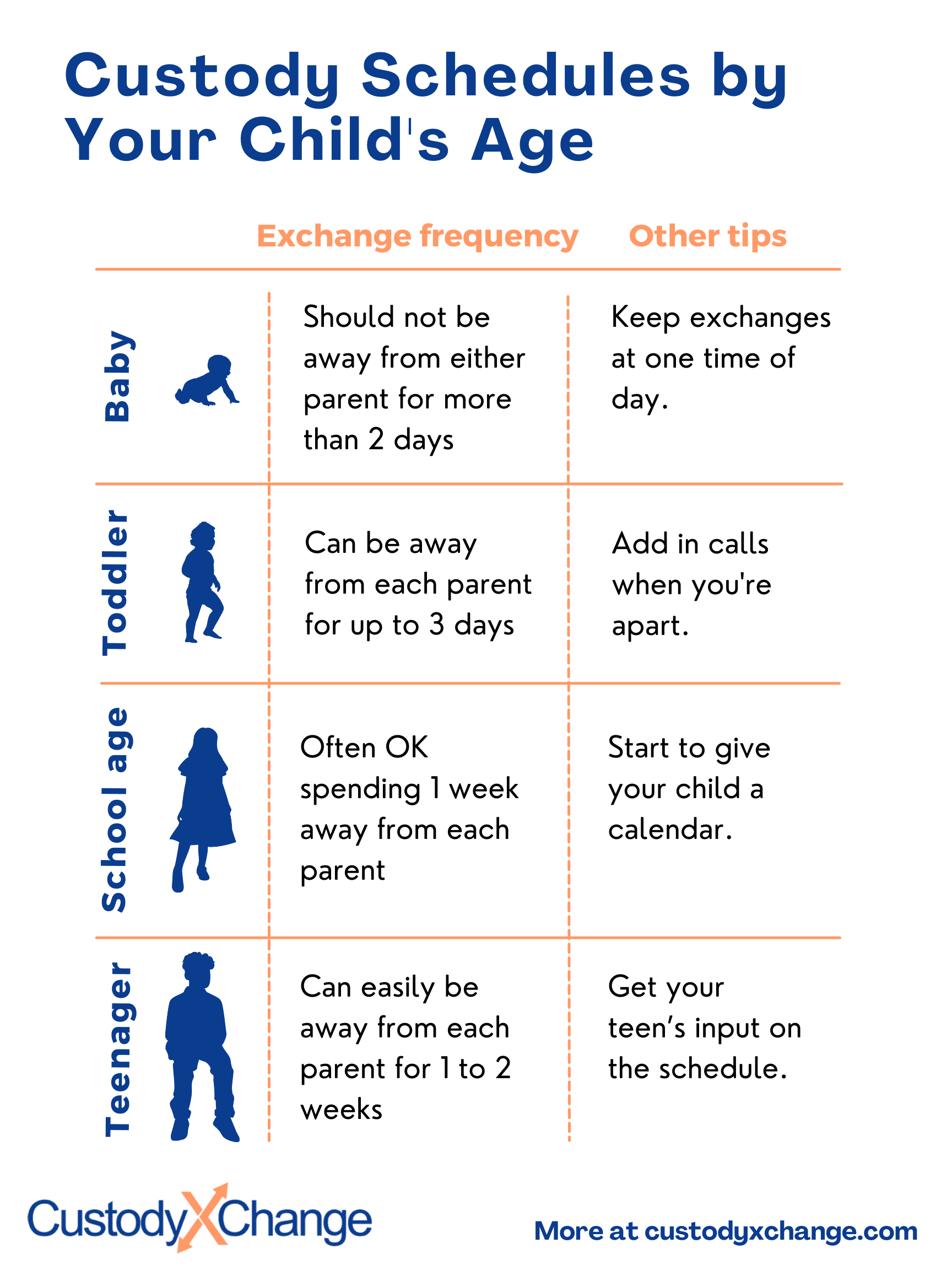
How do I make a shared custody schedule for my toddler?
If you don't want to pay the high cost of a lawyer, and want to easily make your own schedule, you can use the Custody X Change software. You can create your own custody and visitation schedule on your own or with the other parent. Or, you can work with a lawyer or legal professional and have them create it.
What is a shared custody schedule for toddlers?
Shared custody schedules describe in detail where your child will live during the week. While most shared custody situations designate one parent's home as the toddler's primary residence, the child lives with the other parent for part of the week. The time spent at each location is made as equal as possible while promoting the child's best interests.
It may seem simple to create a custody schedule by dividing up days on the calendar. However, that will not meet your toddler's needs for proper growth and development. A successful shared custody schedule for toddlers fits what the child needs, not what you and the other parent desire.
Custody X Change software makes creating a shared custody schedule easier for children of all ages. You can make a visual calendar with clearly marked times that your toddler spends with each parent.
What makes a successful shared custody schedule for toddlers?
A successful shared custody schedule for toddlers allows both parents to create homes where their child feels comfortable, and facilitates smooth transitions between them. The best thing for your toddler is for both parents to have the chance to become competent and comfortable in all aspects of your child's daily routine.
You can tell that your shared custody schedule is successful by the following:
- The schedule is predictable and clear.
- Exchanges are smooth and swift.
- You've included what your toddler needs for proper development.
- Both of you participate in key moments in your toddler's life.
- Your toddler shows little signs of stress or anxiety.
- You and the other parent notice fewer miscommunications about visitation.
- Big changes are introduced slowly and gradually.
Above all, keep your toddler's schedule predictable and consistent. At this age, children respond well to multiple caretakers as long as their cues and needs are being met, combined with regular waking, eating and sleeping schedules. When you create a shared custody schedule that reflects all this, you have the best chance for success.
How should a shared custody schedule address toddler development?
In order for your toddler to form important relationships with both parents and reach physical and emotional developmental milestones, consider what your toddler needs as you structure your shared custody schedule.
Frequent contact. Children between 1 and 3 years old do not have a grown-up's concept of time. Absence from one parent may seem like forever, even if it is only for a few days. Frequent contact with both parents helps you and your toddler maintain positive relationships.
Minimal transitions. Toddlers normally resist transitions, whether it's time to nap or clean up toys. Transition between homes can be hard on toddlers, so structure the schedule to have as few as possible. Keep exchanges as smooth and stress-free as you can.
Self-comforting rituals. Young children have the ability to comfort themselves with objects, such as a special blanket or toy. Display a picture of the absent parent at each home, and designate a special item that travels with the toddler. In your shared custody schedule, build in a special time to call the absent parent, such as right after dinner, to maintain contact.
Constant reassurance. Toddlers are growing more independent but still need the reassurance that their parents are there to support them. Losing a caregiver and losing their familiar things are among the biggest fears toddlers face when going through a divorce. Create a custody schedule that reassures the child that their fears will not be realized.
In addition to helping you create a custody schedule, Custody X Change software lets you write out parenting plans from templates suited to all ages. Combine the parenting plan and the custody schedule to detail everything you and the other parent need to do to raise a happy, well-adjusted toddler.
What specifics should go in my toddler's shared custody schedule?
Your shared custody schedule for toddlers should include as many specifics as possible, including what time visitations begin and end as well as cover special events like birthdays.
Many parents find it convenient to use a color coded calendar that clearly designates where the child is for every hour in the day. Custody X Change software lets you create a clear, visual calendar that you can print out or upload to your mobile devices.
Your shared custody schedule should address issues such as:
- What time exchanges occur and where
- When any third party time occurs, such as day care or time with a relative
- What days parents are responsible for drop-off and pick-up from day care
- Which parent is responsible for childcare when the toddler is sick
- What time each holiday period begins and ends
- When vacation time with each parent begins and ends
- How the child's birthday will be shared
Always remember that your toddler is a unique individual that develops at his or her own speed. Because parental separation and divorce can create stress in your toddler's life, certain parts of your shared custody schedule may cause your child to temporarily regress. Make adjustments to your shared custody schedule to help your toddler cope with the changes.
What should I avoid in a shared custody schedule for toddlers?
Avoid including anything in your shared custody schedule that takes the toddler away from his or her existing routine too much. While you and the other parent may want to spend as much time with your toddler as possible. what is fair to the parents is not always best for the child.
Here are 4 things to keep in mind as you create a shared custody schedule for your toddler:
- Avoid constant transitions. Don't create a schedule that requires the toddler to make multiple transitions per day. Try to blend exchanges with other activities, such as the other parent picking the child up from day care and taking him or her home for a few hours.
- Avoid multiple new locations. Toddlers like familiar places, so parents should create a schedule that doesn't thrust the child into new settings. For example, don't use two day cares or don't force the toddler to suddenly stay overnight at one parent's brand new apartment.
- Avoid excessive overnights. While toddlers may tolerate an occasional overnight with the secondary caregiver, they should not be away from the primary caregiver for more than a night or two. More than two nights away may be too mentally stressful.
- Avoid overwhelming changes. Introduce big changes to the shared custody schedule slowly and gradually. If you and the other parent want to lengthen visits, for example, increase the duration slowly over a few weeks rather than all at once.
When should I revise a shared custody schedule for my toddler?
You and the other parent can revise your shared custody schedule for several reasons--when something is not working, when major changes are on the horizon and as your toddler gets older.
Toddlers change and grow at a rapid rate, and what may be appropriate for a younger child might no longer apply to a growing toddler. As your toddler reaches developmental milestones, you and the other parent can implement making small, gradual adjustments to the shared custody schedule.
When you adjust the shared custody schedule to accommodate your toddler's milestones, keep in mind your toddler continues to require guidance and support even as they take steps toward more independence.
You and the other parent can agree to re-examine the custody schedule at set times, such as every 6 months. If you or the other parent are making a big change, such as a move or remarrying, that's an appropriate time to revise the schedule as well.
Custody X Change features calendars that can be easily revised to accommodate any changes you and the other parent decide to make.
The easiest way to make a shared custody schedule for toddlers
Creating a schedule on your own can feel overwhelming. You have to be sure to use airtight legal language and can't omit any required information.
The Custody X Change app takes the guesswork out of the equation by helping you build a schedule piece by piece.
Try this with Custody X Change.
As a result, you get a written schedule and a visual calendar. They meet your family's needs, as well as the court's standards.
For quick, reliable and affordable help making a custody schedule, turn to Custody X Change.