
Pennsylvania Parenting Plans and Custody Agreements
Parenting plans (also called custody agreements) outline how parents will cooperate in raising their children.
Parents who reach a settlement submit a parenting plan together. With the judge's approval, it becomes a final order.
If parents can't agree, each may submit a proposed parenting plan. In some places, the court requires this. The judge considers each proposal when making a decision following trial. (Proposals are usually due five days before the pre-trial conference.)
General guidelines for parenting plans apply regardless of your state. The following are guidelines specific to Pennsylvania.
Visualize your schedule. Get a written parenting plan. Calculate your parenting time.
Parenting plan templates
You may draft a plan with or without a legal professional. Either way, use a template to ensure you cover all the bases.
Parents who agree on custody terms can use any format, such as the Custody X Change parenting plan template.
Parents who disagree with each other must follow Pennsylvania's parenting plan format.
Regardless of the format you use, you can add personalized provisions to your plan using the Custody X Change app.
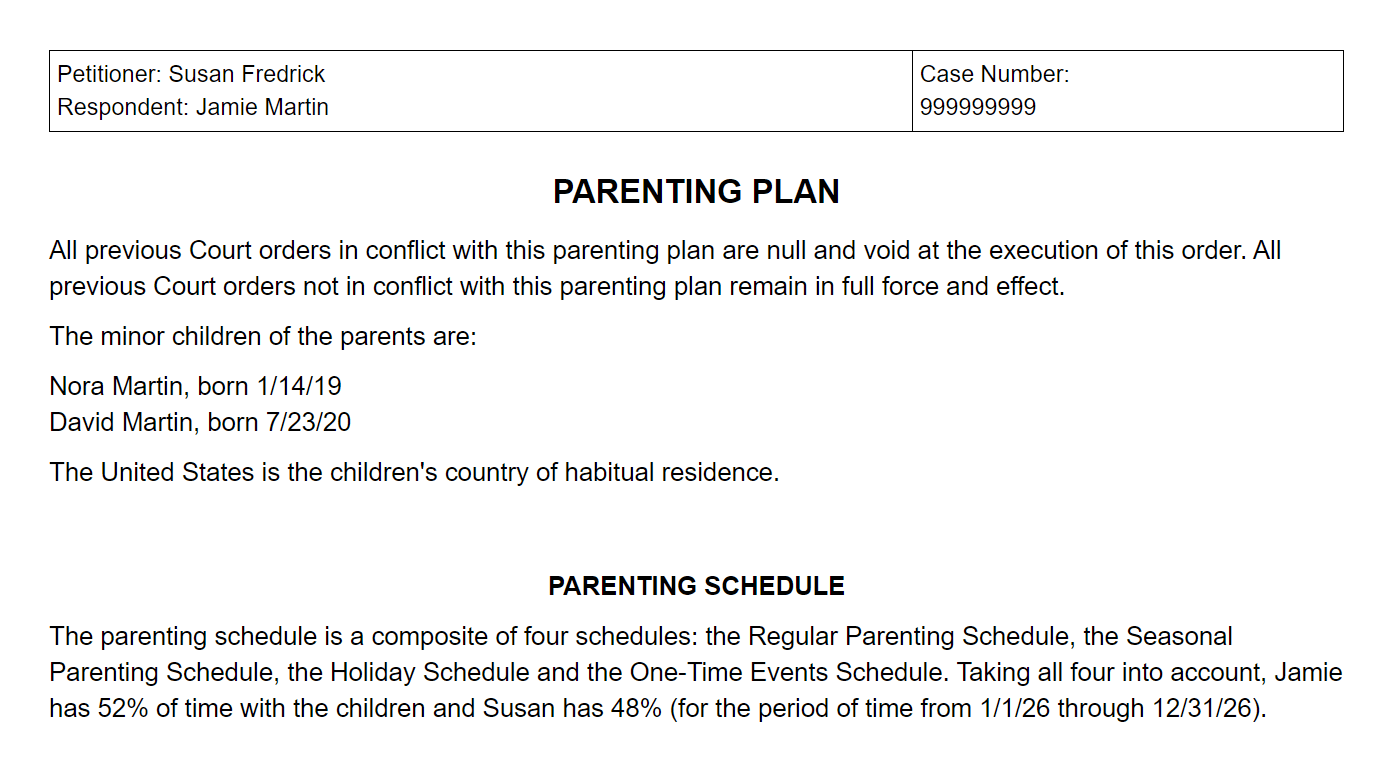
Information required in your plan
Your parenting plan must address any matter important to the best interests of your child, including their:
- Education
- Religious involvement (if any)
- Health care
- Non-parent supervision
- Transportation
In addition, the plan must state which alternative dispute resolution method you'll use to resolve disagreements with the other parent. It must also address physical and legal custody.
Physical custody
Physical custody determines where your child lives and who takes care of them.
Your plan must specify a type of physical custody and lay out a written custody schedule. You can also add a visual calendar to illustrate your arrangement. Each child may have a different schedule depending on their age and needs.
Your options include:- Shared physical custody: Parents split custodial time nearly equally. (Judges prefer this, as long as it's in the child's best interests.)
- Primary/partial physical custody: The parent with primary physical custody has at least 60 percent of parenting time. The other parent gets the remaining time (i.e., partial physical custody). The partial custody time may be supervised if the child shouldn't be alone with that parent.
- Sole physical custody: One parent has all the custody time, and the other parent doesn't see the child. Judges only award this in rare circumstances, like when a parent is incarcerated or has abused the child or other parent.
Legal custody
Legal custody is the right to make decisions for your child.
In your plan, state whether parents will share joint legal custody (the court's preference, when appropriate) or one parent will have sole legal custody.
If you choose joint legal custody, you may:
- Require parents to agree on some or all major decisions
- Allow parents to make some or all major decisions independently
- Give one parent purview over certain decisions
- Name a third party to make decisions when parents reach a standstill
Suggested information to include
To avoid later stress and confusion, try to think of all potential parenting disagreements ahead of time, then stipulate in your plan exactly how you'll handle them.
Pennsylvania lawyers recommend you include the following provisions in your plan.
Expenses
Describe how parents will split expenses not covered by child support (e.g., school trips) or by health insurance (e.g., co-pays).
Communication with the child
State when and how a parent can communicate with the child during the other parent's custody time. Should the child have a cell phone on them? When is too late to call on a school night? Is video calling okay?
Communication with the other parent
Parents should keep an open line of communication in case of emergency. Say when and how (e.g., text, call) they may contact one another.
Appropriate discussions
Parents should protect their child from details of legal proceedings and parental disagreements. Stipulate that parents will not argue or discuss disputed issues in front of the child.
Right of first refusal
What happens when one parent needs someone to look after the child on short notice? Stipulate whether they must ask the other parent to watch the child first.
Third-party caregivers
Explain who besides parents can look after the child, possibly listing options in order of priority. For example, should parents contact relatives before a hired babysitter?
Exchanges
Specify that the receiving parent will pick up the kids. The parent who already has the children may be distracted or want more time, so exchanges are more likely to happen punctually when the receiving parent does the transporting. (This may not apply to families who require supervised custody or exchanges.)
Travel restrictions
Detail any limitations on travel with the child, and how far in advance parents must notify each other of a trip. May they take the child outside of the state? Outside of the country?
Making sure you don't overlook anything
While county parenting plan templates cover a lot of important information, they don't know your family's circumstances. To ensure your child's needs are fully addressed, make sure to add custom provisions or build your own plan.
Custody X Change enables you to do both. In the app, you can choose from over 140 provisions (as well as enter your own) to create a document that can attach to your county's template or stand alone.
In the end, you'll be glad you made a thorough plan that will work for you and your child for years to come.
More guidance
For more guidance as you create your parenting plan, see these resources:
- Age guidelines for parenting plans and schedules
- Temporary parenting plans and schedules
- Modifying your parenting plan and schedule
Visualize your schedule. Get a written parenting plan. Calculate your parenting time.