
Ohio Parenting Time Schedule Guidelines
These guidelines will help you make your parenting time schedule (sometimes called a visitation schedule in other states). A schedule is one part of your Ohio parenting plan.
Courts are highly unlikely to approve a plan that doesn't lay out a specific schedule. You must include a written version in your parenting plan. Adding a visual custody calendar for easier comprehension is optional.
Before you map out a schedule, consider your children's unique needs. Contact your county court to find out if it has any specific rules, regulations or forms.
Visualize your schedule. Get a written parenting plan. Calculate your parenting time.
Choosing a type of residential custody
Residential custody refers to whom the children live with. Begin by deciding if joint residential custody or sole residential custody would be best for your children, and include this required element in your parenting plan.
In joint residential custody, your children spend roughly equal time with each parent. In sole residential custody, your children live primarily with one parent and — in almost all cases — have visits with the other.
The court will approve whichever type of residential custody you and the other parent agree on, unless it has concerns about the children's well-being.
If you cannot agree, the court will decide for you. In this case, expect joint custody. If you want sole residential custody and the other parent disagrees, you must show the court how it would benefit your children.
Showing the details of your residential custody arrangement
A parenting time schedule explains the details of your arrangement. The schedule should specify:
- If/how parents will split time with the child on weekdays
- If/how parents will split time with the child on weekends
- If/how parents will split time with the child during school breaks
- If/how parents will split time with the child on holidays and special occasions
- If/when each parent can take the child on vacation
Be sure to specify which items take precedence. For example, holidays should supersede the regular schedule. This means that if Memorial Day is your holiday with the kids, you'll get that day with them even if they usually spend Mondays with the other parent.
Common parenting time schedules
Whether you're settling a case or just suggesting a schedule, you have many options; you can create your schedule from scratch, look at popular parenting schedules for ideas, or see what your county recommends.
County-recommended schedules
Each Ohio county sets one or more standard parenting time schedules. Judicial officers often award these schedules, though they have flexibility. Parents who settle can choose whether to draw on a standard schedule.
You can find standard schedules through county court websites. Below are the schedules for Ohio's largest counties:
- Franklin County standard parenting time schedule
- Cuyahoga County standard parenting time schedule
- Hamilton County standard parenting time schedule
- Summit County standard parenting time schedule
- Montgomery County standard parenting time schedule
Joint custody schedules
Remember that Ohio encourages joint residential custody, as long as it benefits the children involved. Below are examples of joint custody schedules.
The alternating weeks schedule has your child spend seven days with one parent, then seven days with the other.
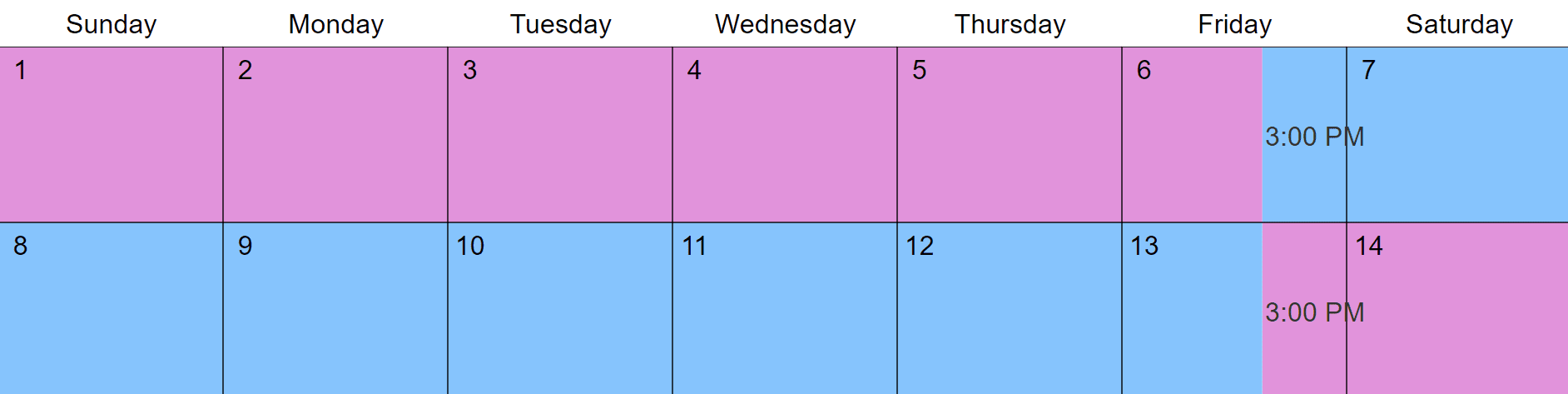
The 4-3 schedule has your children spend four days with one parent and three days with the other parent.

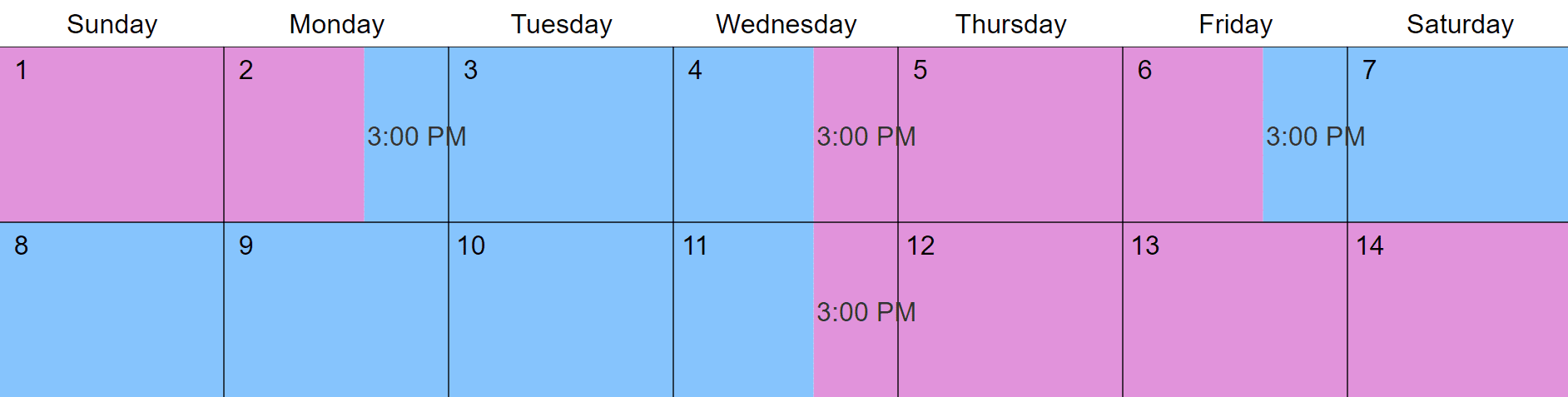
The 2-2-5-5 schedule has your child spend two days with one parent and two days with the other, then five days with the first parent and five days with the other parent.
Sole custody schedules
Despite the state's preference for joint custody, courts do award sole custody when it's best for the children, or when parents agree on it.
If one parent has sole residential custody, the nonresidential parent commonly has the children every other weekend and once during the week for an overnight visit. Children also spend half a day on holidays and half of school breaks with the nonresidential parent.
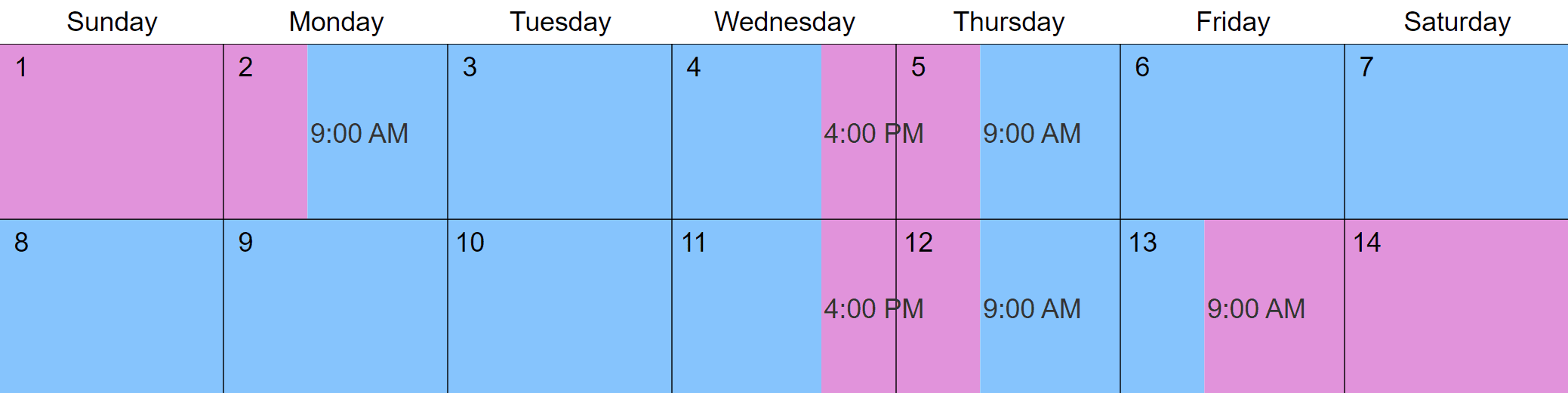
Another possibility is for the children to visit the nonresidential parent every third weekend.

Or you can choose from other schedules with an 80/20 parenting time split.
Other parenting time arrangements
If necessary, the court will order supervised parenting time, in which your children visit the nonresidential parent only when supervised by an approved adult. You can also ask the court to deny the other parent any time, if it's better for the children not to be around them at all.
The court can grant visitation with grandparents, step-parents, foster parents and any other person that has played a significant role in the children's life, as long as it's in the best interest of the children. Visitation for nonparents cannot interfere with a parent's scheduled time.
Age-based considerations
Families might have different schedules for each of their children, thanks to age-based custody schedules.
Babies need frequent contact with caretakers to develop relationships. Teenagers need their extracurricular activities and social lives accounted for. And children in between go through various stages of visitation needs.
In addition, families often need to modify schedules as their children grow. You can write these schedule changes into your parenting plan ahead of time and set a date for them to take effect.
Helping children adjust to a schedule
When implementing a parenting time schedule, help your children adjust by:
- Keeping your schedule consistent and predictable
- Making exchanges conflict-free
- Maintaining similar routines for mealtime, bedtime and other tasks in both homes
- Allowing kids to bring their favorite toy, blanket or other item on visits
- Being consistent with discipline (e.g., continuing a punishment given in the other home)
If the children have not had much contact with a parent, that parent's time should increase slowly, possibly starting out as supervised parenting time. Children shouldn't feel forced to go somewhere unfamiliar.
The easiest way to make a schedule
If you're like most parents, creating a parenting time schedule will feel daunting. How do you write something that meets legal requirements and doesn't leave any loose ends?
The Custody X Change app makes it easy. Either customize a schedule template, or click and drag in your custody calendar to make a schedule from scratch.
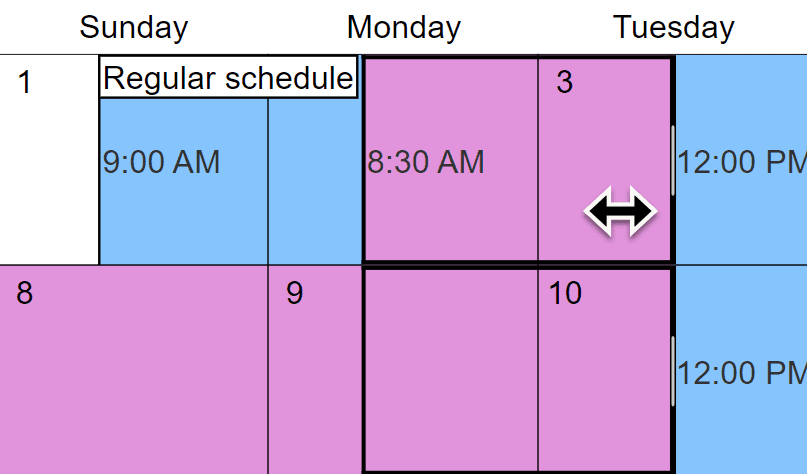
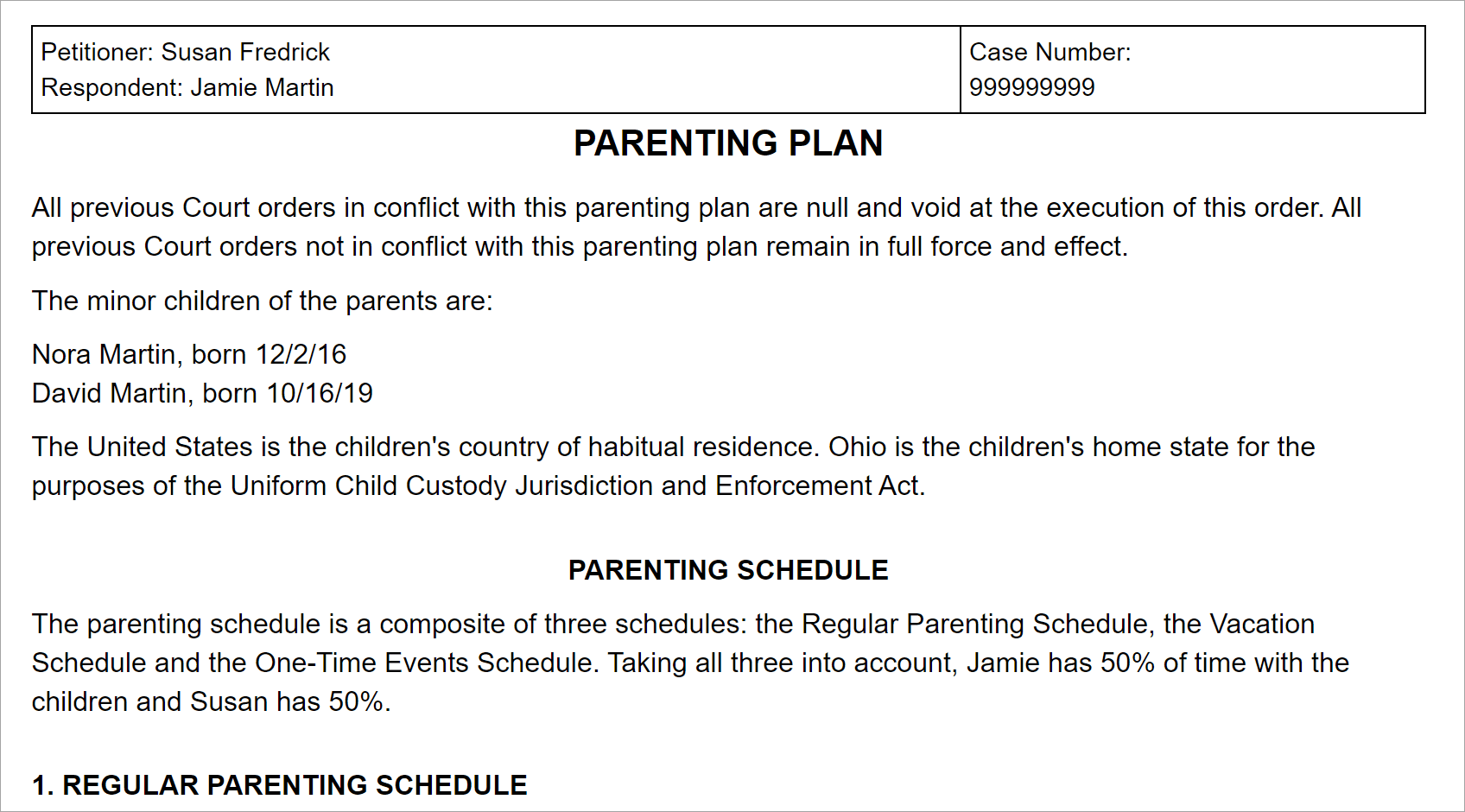
The combination of a visual and written schedule means your family will have no problem knowing who has the children when. Take advantage of Custody X Change to make your schedule as clear and thorough as can be.
Visualize your schedule. Get a written parenting plan. Calculate your parenting time.