
13 Factors to Consider When Creating a Schedule
Thinking about the following factors as you create your custody schedule will help you make a schedule that fulfills your child's physical, emotional and social needs.
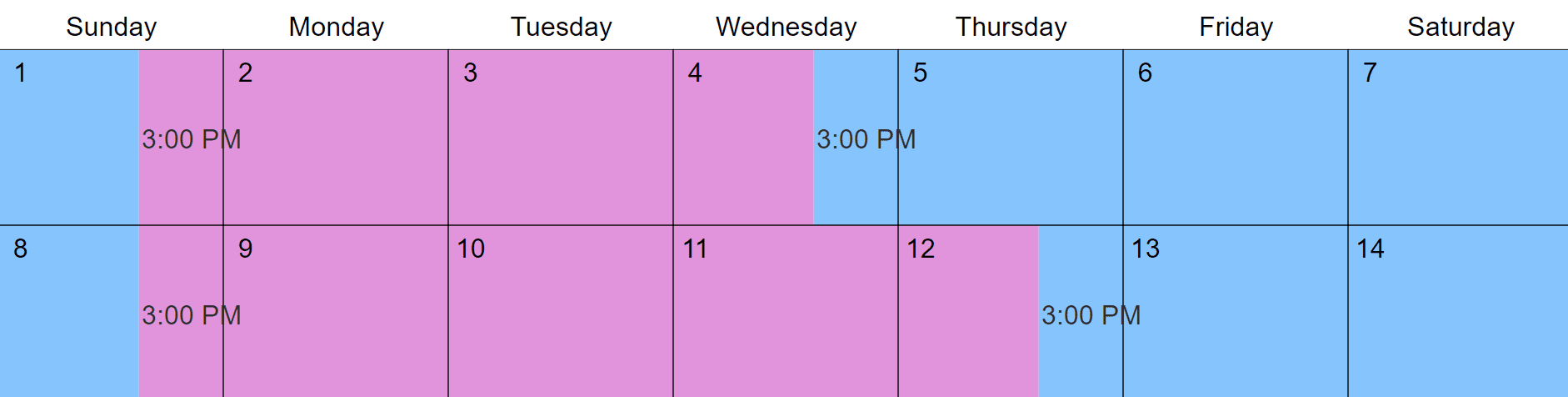 Try this with Custody X Change.
Your child's age and temperament
Choose age-appropriate custody schedules. Babies and toddlers need to see each parent frequently, while teenagers need schedules that fit with their social lives and activities.
Different temperaments do well with different schedules. If your child is easy going, you have many options for a schedule. If your child struggles with exchanges or needs extra consistency, choose a schedule accordingly.
You may need to modify your schedule as your child grows older and matures.
Your child's special needs
The parenting time in your schedule should be arranged so that your child can receive care for medical, developmental, educational, emotional or social needs, such as autism.
Your child's ability to adapt to change
Your child may struggle to adjust to the change in the family situation and/or have a hard time switching between parent's homes. Keep this in mind.
You may want a schedule that has fewer exchanges and longer time with each parent, or you may want a schedule that gives frequent contact with both parents so your child feels secure.
Your child's daily schedule
Plan your exchanges when they work for your family. For example, if your child is in school, you could exchange at the end of the school day. Or, if your child is in daycare, picking the child up from daycare could be the exchange.
Avoid exchanges that will interrupt the child's schedule or routine. For example, if your child gets started slowly in the morning, set exchanges for the afternoon or evening. If your child goes to bed early, schedule the exchange with enough time to get ready for bed.
Your child's school and community environment
Your schedule should allow your child to keep track of and complete homework assignments and school projects. This may impact midweek visits and exchanges.
Whenever possible, both parents should have the opportunity to be involved with the child's education.
If your child has extra activities, like sports practices or music lessons, parenting time should be arranged so your child can still participate.
Your child's sibling or other family relationships
Parents typically have the same custody schedule for all of their children, but you can have a split custody arrangement, in which parents have custody of different children.
Your schedule should allow your child to have time with siblings and other family members. Both parents should encourage the child to have good relationships with family.
If you have multiple children, you may want to consider scheduling some time for each parent to have alone time with each child.
The travel time for exchanges
The distance between the parents' homes impacts what schedules are practical. Parents who live close by each other have many options for a schedule. Parents who have long distance schedules are more limited and will need to be open to finding parenting arrangements that work.
The distance from each parent to the child's school, the child's daycare, or other places where the child spends time also impact what schedule is practical.
Each parent's schedule and lifestyle
You will have to plan parenting time around each parent's work schedule and other obligations.
If one parent travels frequently for work, you'll probably need to be more flexible with parenting time.
Each parent's capability to meet your child's needs
For a child to stay with a parent, that parent must have a stable home environment. Otherwise, the parents can consider having visits at the child's home or in a different place.
The amount of care that each parent provided the child before the separation influences the parenting time. If both parents have been very involved, the child should continue to spend significant time with both parents.
If a parent has not been very involved in taking care of the child before the separation but wants to be more involved, you can create a step-up parenting plan. You'll start with a custody schedule that gives short, frequent visits to the parent. As the parent becomes more confident and comfortable with the child, you can increase the duration and number of visits.
The parents' plan to share responsibilities
Parents who want to equally share responsibilities often have a joint custody schedule. When one parent has the main responsibility for the child the parents have a sole custody schedule.
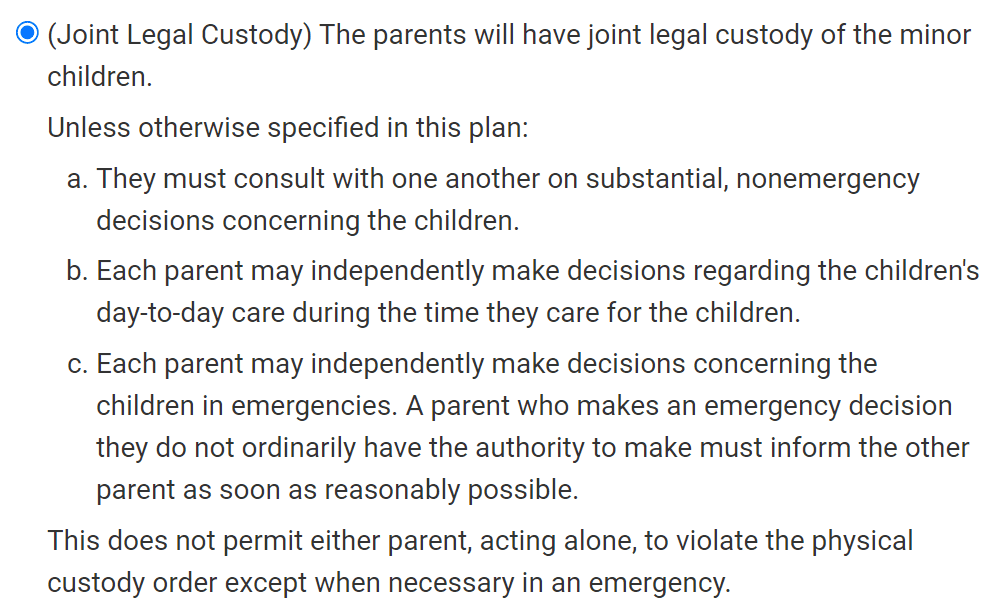
Your plan to share responsibilities will impact how you and the other parent split time and make decisions for the child.
The relationship between you and the other parent
Some schedules require a lot of communication and coordination between the parents. If parents get along reasonably well and can talk to each other without fighting they can consider these schedules.
Parents in high conflict situations will need to make a schedule that is very consistent and that requires less communication to work it out. You will also want to schedule exchanges so there is limited interaction.
Parents should not expose their children to fighting and conflict during exchanges or at other times. You may want to include schedule provisions about this in your parenting plan. Whenever possible, both parents should agree to the schedule so there is less conflict and fighting about it.
Your child's preferences
Depending on your child's age and maturity, you can talk to your child about your child's preferences for the parenting time schedule. You can take your child's preferences into consideration, but you and the other parent should decide on the final schedule.
Teenagers typically want more of a say in the schedule and as they get older they may want to work out the parenting time by talking directly to each parent.
Any danger or history of abuse
Your child must be protected from danger. Any history of physical, emotional, or sexual abuse from either parent must significantly alter the custody schedule. You may need to have supervised visitation and use the court to protect to your child.
A parent who has a problem with substance abuse or has been involved with illegal activities may also need supervised visitation or court intervention.
Next step: Get help with schedules
Once you've considered these factors, it's time to create a schedule — or a few, so you can present the other parent with options.
Making a schedule on your own can feel overwhelming. You have to be sure to use airtight legal language and can't omit any required information.
The Custody X Change app takes the guesswork out of the equation by helping you build a schedule piece by piece.
Try this with Custody X Change.
As a result, you get written and visual versions that meet your family's needs, as well as the court's standards.
For quick, reliable and affordable help making a custody schedule, turn to Custody X Change.