
Archive

Archive for the ‘Joint custody’ Category

Custody and Visitation Schedules for a Joint Custody Agreement

May 24th, 2010 No comments

Have you decided to try a joint custody agreement for your custody situation? You are not alone. Many divorced and separated parents try to put their children first be adopting a joint agreement to raise the children. This is often the right solution to some difficult questions.

Basically, a joint custody agreement means that the mother and father will share the responsibilities of raising the children. This means that they both participate in making the decisions for the children, and they both spend time with them. Because the custody and visitation schedule is such an important part of the agreement, parents who want a joint agreement need to make a schedule that goes along with this.

A joint custody schedule doesn’t mean that each parent gets exactly half of the time with the children. Instead, it means that the mother and father both have significant time with the child so that both parents can develop a strong relationship with the child. A schedule should be made that gives both the mother and father ample time to be with the child.

One of the biggest factors that affects visitation schedules for joint custody is the child’s school schedule. Children who are not yet in school are more flexible and visitation is usually set up around the parents’ schedules. Once children attend school, though, the school day becomes a priority.

Because of this, it may not be possible for each parent to have the child for half of the week. Instead, parents should realistically look at the options and plan visits the work for the child. As with any schedule, it is vital that the joint custody and visitation schedule be made with the child’s best interest in mind.

Parents who make a schedule where the mother and father are both involved will be more likely to be satisfied with the schedule. This means that there will not be a court battle, or an endless saga of trying to get things changed. Instead, the parents can focus on parenting the child.

Example joint custody schedules include: alternating weeks, alternating days or every two days, the child living with one parent but having significant visitation with the other parent throughout the week, alternating custody every two weeks, setting up one schedule during the school year and an alternate schedule during the summer break to even out the time, etc.

Using Family Law Software to Set up Joint Custody Agreements

September 4th, 2009 No comments

In a joint custody agreement, the parents have about equal time with the children. There are a myriad of ways to set up a joint custody schedule. You can set up an Ackerman plan, a 2/2/5/5 schedule, a 3/3/4/4 schedule, switch custody every other week or every two weeks, etc. One way to make setting up this schedule easier is to use family law software.

There are a few different types of family law software that have been developed. For setting up a custody agreement, parents can get custody family law software. The software make is easier to create joint custody schedules in a few ways.

1. It makes it easy to experiment with ideas. In order to make the best joint schedule for the parents and the children, the parents will need to play around with some different options. Custody software makes it very easy to do this. Custody X Change lets you make as many plans as you want. You can experiment with different repeating cycles and visitation until you find one that works for you.

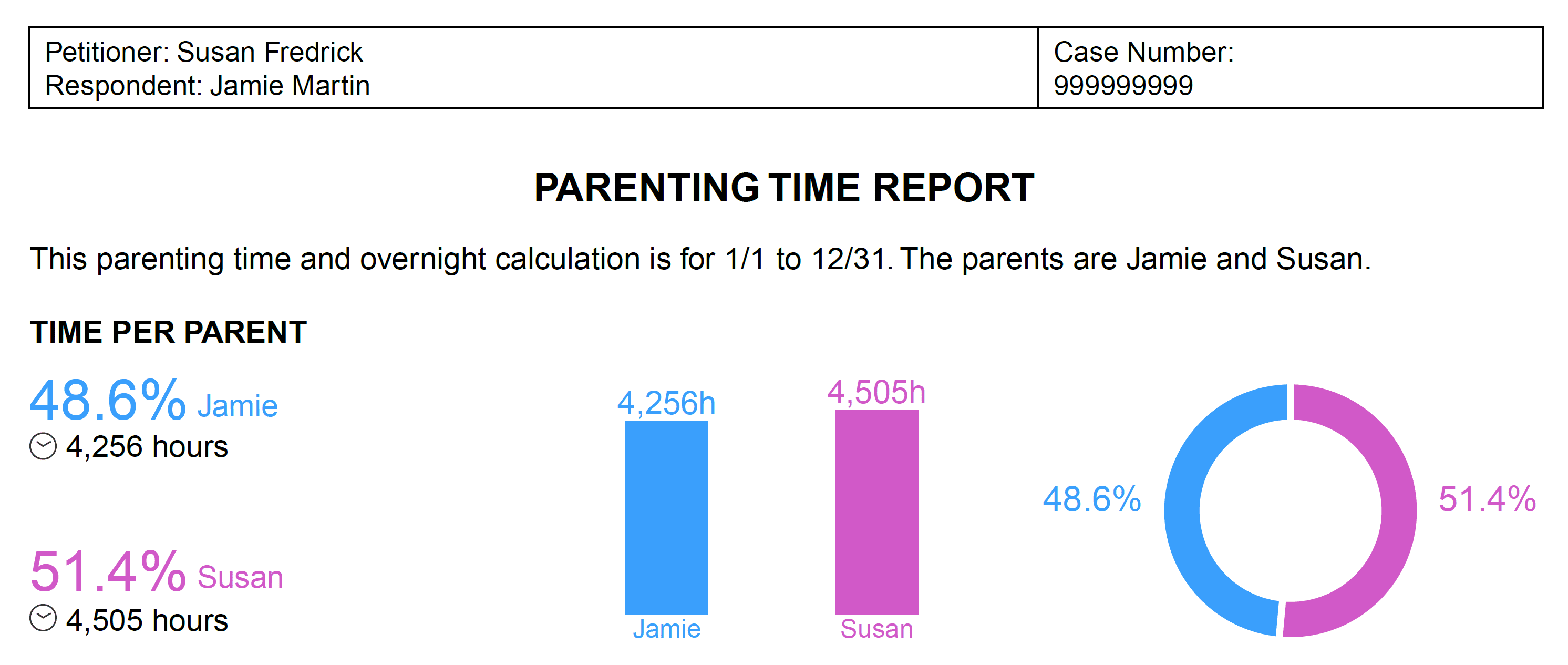
2. The software can give you an accurate time-share percentage for each parent. While you create a calendar in Custody X Change it constantly gives you the time-share percentage that each parent has with the children. This is especially helpful in joint custody arrangements because the parents can know for sure they aree sharing time equally.

3. You can easily make changes. Usually the parents who have joint custody schedules are a little more flexible with time because they are trying to work together. If the parents need to make a change in the schedule, having it on the computer makes it easy. You don’t need to remake your entire schedule or count all of the days. You simply open the calendar, click a few times, and everything is updated.

Co-Parenting With Toddlers and Young Children

August 18th, 2009 1 comment

Copy of BeeSlide

We’re continuing the posts about setting up joint custody arrangements for different ages of children. Today we’ll look at suggestions for setting up a co-parenting schedule for toddlers and young children.

Toddlers (18-36 months)

During the time as a toddler, a child has many developments socially, emotionally, and mentally. A toddler starts to recognize the world around them and forms multiple attachments to caregivers. At this age, a toddler may not handle separation very well. This can become evident during exchanges between parents. The child may cry and throw tantrums when it is time to go with the other parent–it is normal and doesn’t mean the parent is doing anything wrong. To help with this, it is important that parents support the visits. It may be easier if the parent drives the toddler to the other house to drop them off.

Toddlers are sensitive to anger and tension. Parents should work at keeping these feelings from their toddler. A custody arrangement should be routine and stable for the child. There should be consistent and frequent visits with the other parent–a child this age shouldn’t go more than a few days without seeing the other parent. At this age, parents can start telephone calls. The child will also recognize pictures of the parents–so a picture of the other parent can be in the bedroom of the child.

Young Children (3-5 years)

These are the pre-school ages for children. Children during time grow and develop rapidly. It is important for parents to adjust their plans to accomodate the changes in their child. It is also important for the parents to communicate about what is going on with the child–for instance, if the child is taking shorter naps or stopping naps altogether.

A young children needs consistency and predictablity. They may have problems with transitions and exchanges, but they will probably adjust quickly once in the parent’s home. It is important that both parents have established themselves as caregivers, because that is who young children are attached to. Parents should also realize that children at this age often blame themselves for a divorce or other problems.

If one parent has been the primary caregiver, visits should be set up to give that parent the opportunity to care for the child. Short, frequent visits are best to start with, and they can get longer as the child gets used to the parent. Children at this age can handle longer time between visits and longer stays with each parent. Children at this age also need to play with other children this age, so parents should try to schedule times with other children to play.

For more information about setting up a co-parenting schedule for toddlers and young children, check out this brochure: http://www.mass.gov/courts/courtsandjudges/courts/probateandfamilycourt/afccsharedparenting.pdf

Joint Child Custody: Pros and Cons

August 5th, 2009 1 comment

Joint child custody occurs when parents share legal or physical custody of their child.  Parents can share joint physical custody (where the child lives with each parent for a specific time period), or joint legal custody (where the child lives with one parent, but both parents have equal legal rights and responsibilities to that child).  Deciding what type of custody would work best for you is a big part of your child custody case. You will need to come up with a schedule that works in the best interests of the child, and that is suitable to both parents as well. Here are a few of the real life pros and cons of joint custody.

Pros

  1. Joint custody allows you to work out a plan based around your child’s needs and best interests. Parents with joint physical often (but not always) live close to one another, so the child is less impacted by moving from home to home.
  2. Joint physical custody allows the child to spend time with each parent. It allows each parent to be involved in their child’s life.
  3. Joint custody allows the parents to share the day to day  responsibilities of raising their child, so the work and expenses are  divided (although not always equally)
  4. If the parents are able to cooperate and get along, joint custody arrangements can be easier for all involved parties.

Cons

  1. If the parents are unable to get along, the scheduling and planning of joint custody can be a nightmare, and parental fighting can have negative effects on your child.
  2. With joint physical custody, the child is moved from place to place more often, and usually maintains two homes. As a result, important school papers or sports gear can easily be left behind in the “wrong” home.
  3. It can become expensive to maintain two homes large enough to house multiple children.
  4. Arguments can arise over pickup and drop off schedules, over who is paying “more” of the child’s expenses, and which parent is getting the easier schedule.
  5. The child can be made to feel like a referee, or used to deliver messages between parents who are unwilling to work together.

Joint custody works best when parents are able to get along well enough to decide on a custody agreement, and are willing and able to stick to that agreement.

Examples of Joint Custody Schedules (2/2/5/5 and 3/3/4/4)

July 27th, 2009 No comments

Parents who want to make a joint custody arrangement work have to come up with a good schedule for their children. If you want the children to have equal time with both parents there are a number of options you can choose. The mother and father can alternate weeks of custody or they can alternate every two weeks. If that seems too long without seeing the child, you may want to look into a 2/2/5/5 or a 3/3/4/4 custody schedule.

A 2/2/5/5 arrangement means that the mother gets two days with the children, the father gets the next two days with the children, then the mother gets five days with the children, and the father gets the next five days with the children. (of course you can switch the order of the parents so the father starts–it should be the same in the end) This is a two week repeating cycle. An example of this schedule applied to a month looks like this:

2.5

You can see in the calendar that the parents get equal time with the kids and it is pretty regular so you can establish a nice routine. I put this schedule into Custody X Change in the repeating cycle tab and applied it (this isn’t one of the options to choose on the list, but it took me only a minute to put it in–you just have to click on the days and times you want). The exact time share that the mom has with this arrangement is 50.14% and the dad has 49.86%. Of course, no holidays or other events have been added which would make the time even more equal. It sure is nice to be able to see the exact percentage at the bottom of the screen though.

Another joint custody schedule sample that is similar to this is the 3/3/4/4 arrangement. In this calendar, the mother spends 3 days with the child (again, you can start with the father–it shouldn’t make any difference) and then the father spends 3 days with the child. Then the mother spends four days with the child and the father gets the next four days with the child. This is also a two week repeating cycle. When applied to the calendar it looks like this:

3.4

This is what it looks like when I put the repeating cycle into Custody X Change. This is also an arrangement that you have to custom–but it is really quick. After I applied the schedule, the time-share percentage with the mom is 50.05% and the time-share with the dad is 49.95%. That also doesn’t include holidays, vacation time, or special events.

It’s worthwhile for parents to investigate different options like these. These schedules may not be the first ones that you think of for a joint custody agreement, but they divide the time up equally and the schedule isn’t crazy. These are very easy to create in Custody X Change so you don’t have to go through a whole calendar counting days.

Parenting Plans for Joint Custody

July 20th, 2009 No comments

If you are in the process of figuring out a parenting plan for you, your former spouse and children then you may want to think about joint custody. Joint custody is a way for both parents to be involved in the children’s lives and to help raise them. Parents who opt for joint custody acknowledge and understand that children do best when both parents are involved in their lives and that both mother and father play an important role. When developing your parenting plan for this type of agreement you should consider and discuss

  • how you and the other parent will show consistency in regulating rules and behavior
  • the age and temperament of each child–how they will adjust to changes in the schedule, their routine, etc.
  • any special needs of the children
  • how each parent was involved before the separation and how to allow each parent to be involved now
  • the flexibility and availability of the parent’s schedules
  • how far apart the parents live from each other, the school, and daycare
  • how the parents will keep communication open and how they will cooperate

Thinking all of these issues through as you make your parenting plan will give you a good start on your custody agreement. It’s nice to start with a solid foundation because it means there won’t have to be drastic changes in the near future. It also puts you in a good place to make minor adjustments with less hassle.

Remember that Custody X Change lets you put in provisions with your parenting plan. There are many that you can choose from, but you can also add your own. So, as you and your former spouse talk about these issues, you can add them right into the agreement. Then you both have the peace of mind that what you talked about will be followed.